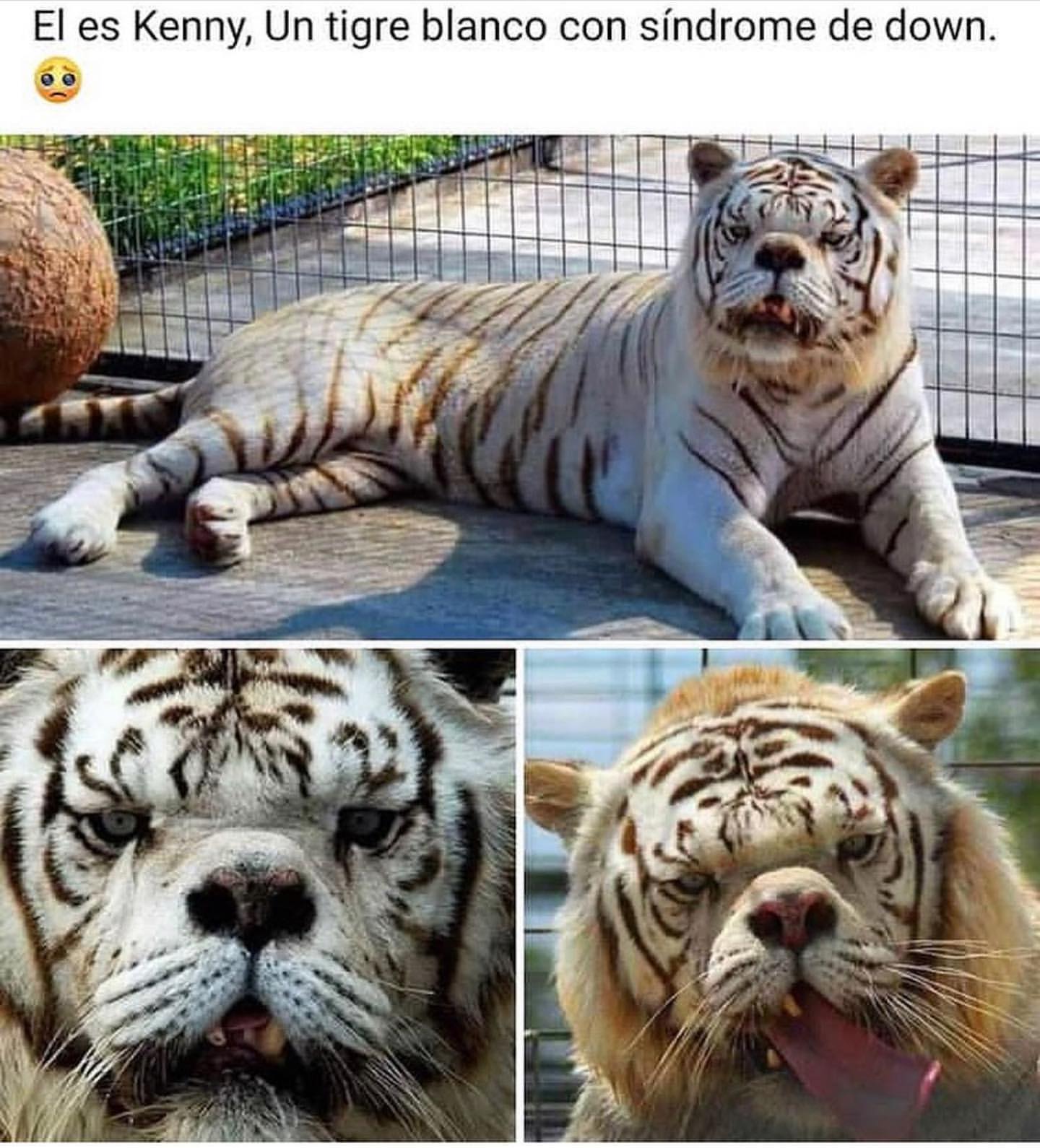
You’ve probably seen the photos. A white tiger with a flattened face, wide-set eyes, and a protruding jaw. The caption almost always claims it’s a tigre con sindrome de down. It’s one of those viral images that sticks in your brain because the animal looks so... human. It triggers an immediate sense of empathy. But honestly? The internet has been lying to you about this for years.
There is no such thing as a tiger with Down syndrome.
Biologically, it’s just not possible. Down syndrome is a specific genetic condition in humans caused by a third copy of chromosome 21. Humans have 23 pairs of chromosomes. Tigers? They only have 19 pairs. You can’t have a "human" chromosomal mutation in a species that doesn't even have the same map of DNA. When we see a tiger like Kenny—the most famous face associated with this myth—we are looking at something far more preventable and, frankly, much darker than a random genetic roll of the dice.
Why Kenny the Tiger became the face of a myth
Kenny was a white tiger who lived at the Turpentine Creek Wildlife Refuge in Arkansas until he passed away in 2008. He was rescued from a private breeder in Bentonville who had been trying to produce the "perfect" white tiger.
White tigers are not a separate species. They aren't Albinos, either. They are Bengal tigers with a double recessive gene that makes them white with black stripes. Because this gene is so rare, breeders often resort to intense inbreeding to make sure the "money-maker" white coat shows up in the cubs. We’re talking fathers mated with daughters, brothers with sisters.
Kenny was the result of this.
He didn't have Down syndrome; he had severe facial deformities caused by generations of inbreeding. His mother and father were siblings. Most of his siblings were stillborn or died shortly after birth. Kenny survived, but he was born with a deformed snout, dental issues, and neurological challenges. To the casual observer on Facebook or Reddit, he looked "different" in a way that resembled human Trisomy 21. So, the myth of the tigre con sindrome de down was born. It was an easy label for a complex problem.
The biological impossibility of feline Down syndrome
Let's get technical for a second, but I'll keep it simple.
Chromosomes are the instruction manuals for building a living thing. If you take a page from a manual for a car and try to stick it into a manual for a toaster, the toaster isn't going to work. Down syndrome is specifically the duplication of the 21st chromosome in humans. Since tigers only have 38 chromosomes total (19 pairs), their genetic "glitches" happen in entirely different places.
While animals can have chromosomal abnormalities, they rarely look like Down syndrome. In cats, there is a condition called Klinefelter syndrome, but that affects sex chromosomes. When a tiger has a facial deformity, 99% of the time, it’s the result of a "genetic bottleneck."
The dark business behind the white tiger
Why are people so obsessed with white tigers anyway?
Money.
A single white tiger cub can be worth $30,000 or more on the exotic pet market. Zoos and private exhibitors love them because they draw massive crowds. People want to see the "rare" white tiger, not realizing that these animals shouldn't really exist in the numbers we see today. In the wild, a white tiger is at a massive disadvantage. They can’t camouflage. They can’t hunt effectively. They basically disappeared from the wild in the mid-20th century.
Every white tiger you see in a cage today can be traced back to a single male tiger named Mohan, captured in India in 1951.
To keep the white line going, breeders have spent decades forcing close relatives to mate. This leads to "inbreeding depression." It’s not just facial deformities like Kenny’s. These tigers often suffer from:
- Cleft palates
- Immune deficiency
- Scoliosis (curvatures of the spine)
- Crossed eyes (strabismus)
- Kidney failure
When a cub is born looking like Kenny, breeders usually don't show them off. They are the "throwaways." Kenny was lucky because he ended up in a sanctuary where he was loved and cared for. Most "deformed" cubs are simply killed at birth because they aren't "marketable."
Misidentification in other species
It’s not just tigers. You might have seen "Otto the Kitten" or other animals labeled with Down syndrome.
In most of these cases, the animal actually has a condition called Panleukopenia (distemper) which they survived in the womb, or a different genetic mutation like Trisomy 22 (in chimpanzees, who have 24 pairs of chromosomes). Chimps are the only non-human animals that can have a condition truly analogous to Down syndrome because their genetic structure is so close to ours.
But a tiger? No.
Applying human medical terms to wild animals is a form of anthropomorphism. We do it because we want to relate to them. We see a face that looks "different" and our brain searches for a label we understand. But calling Kenny a tigre con sindrome de down actually does him a disservice. It masks the reality of animal cruelty and the unethical breeding practices that caused his suffering in the first place.
The role of social media in spreading the lie
The "Down Syndrome Tiger" narrative is perfect clickbait. It's heartwarming, it's tragic, and it's easy to share. Most people who post it aren't trying to be malicious. They genuinely think they are sharing a story about a "special" animal.
However, this misinformation hurts conservation efforts. When we categorize these animals as having a "natural" genetic condition, we stop asking questions about where they came from. We stop looking at the breeders. We stop seeing the white tiger industry for what it is: a genetic experiment gone wrong for the sake of profit.
What we can learn from Kenny's life
Kenny lived a relatively long life for a tiger with his issues. He died at age nine from melanoma. Most tigers live into their late teens or early twenties in captivity. Despite his appearance, keepers at Turpentine Creek said he was a happy tiger. He loved his enrichment toys. He had a great personality.
But he was a warning.
He was living proof that humans shouldn't play god with animal genetics just to produce a specific fur color. The Association of Zoos and Aquariums (AZA) actually banned the breeding of white tigers, white lions, and king cheetahs in 2011. They recognized that these practices have no conservation value. They don't help tigers in the wild. They only create more "Kennys."
Actionable steps for animal lovers
If you want to actually help tigers and prevent the suffering that leads to animals being mislabeled as a tigre con sindrome de down, you have to vote with your feet and your wallet.
- Avoid "Pay-to-Play" venues: If a place lets you take a photo with a tiger cub, they are likely part of the problem. Those cubs are often discarded or sold to canned hunt facilities once they get too big to handle.
- Check for Accreditation: Only visit sanctuaries accredited by the Global Federation of Animal Sanctuaries (GFAS) or the AZA. These organizations have strict rules against breeding for "novelty" traits.
- Correct the narrative: Next time you see a post about a tiger with Down syndrome, politely point out the truth. Explain that it's a result of inbreeding. Knowledge is the only way to shut down the market for these "designer" animals.
- Support wild conservation: Instead of focusing on captive color variants, donate to groups like Panthera or Save the Tiger Fund that work to protect natural habitats in Asia.
The story of the tigre con sindrome de down isn't a story about a "special" tiger. It’s a story about human greed and the biological consequences of trying to force nature into a box it was never meant to fit in. Kenny was a beautiful animal, but he was a victim of a system that prioritized aesthetics over health. Let's remember him for what he was: a survivor of a cruel industry, not a medical anomaly.