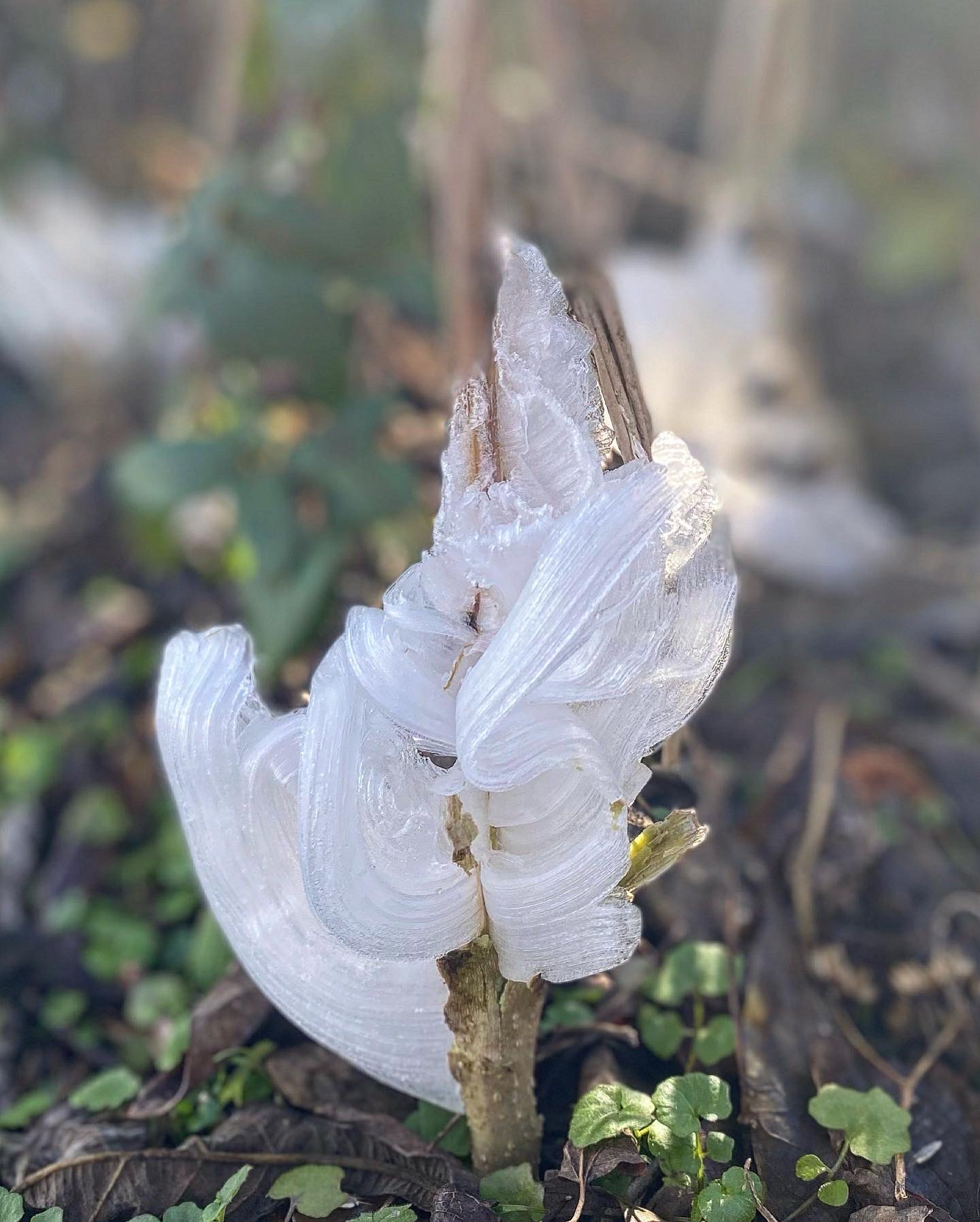
You’re walking through the woods on a morning that feels way too cold for comfort. The ground is crunchy. Your breath is a cloud. Then, you see it. It looks like someone dropped a box of white silk ribbons or maybe shattered a porcelain carnation right at the base of a weed. You take out your phone because, honestly, nobody is going to believe this isn't fake. Pictures of frost flowers are basically the internet's favorite way to prove that nature is weirder than anything we can generate with a computer.
It's a weird phenomenon. They aren't actually flowers. They aren't even made of snow.
These delicate, ribbon-like ice structures form during a very specific window in late autumn or early winter. It has to be just cold enough to freeze water, but the ground still needs to be warm enough for the plant's root system to be active. If you miss that window by even an hour, they’re gone. Vaporized. Melted by the first hint of a sunrise.
The Physics Behind the Petals
Scientists call this ice segregation. It sounds boring, but the process is violent in a tiny, microscopic way. When the water inside the stem of certain plants—like the Verbesina virginica (Frostweed) or Cunila origanoides (Dittany)—starts to freeze, it expands. We all know ice expands. But here, it doesn't just sit there. It cracks the long, thin outer skin of the stem.
Under the right conditions, capillary action keeps drawing water up from the roots. It’s like a straw that won’t quit. As that water hits the freezing air through the slits in the stem, it freezes instantly. It gets pushed out by the water coming up behind it.
Think of it like a 3D printer made of ice.
The result is these thin, curling "petals" of ice that can be incredibly intricate. Some look like chaotic bundles of white hair, while others form perfect, concentric circles that resemble a frozen rose. Dr. James Carter, a professor emeritus at Illinois State University, spent years documenting this. He’s one of the few people who has exhaustively mapped out which plants actually do this. It isn't every weed in your backyard. You need a specific type of stem structure that allows those long, vertical ruptures to happen.
Why Your Photos Probably Look Blurry
If you’ve ever tried to capture pictures of frost flowers, you know the struggle is real. The lighting is usually terrible because they only exist in the pre-dawn shadows. The second the sun hits them, the "petals" are so thin they sublimate—meaning they turn straight from a solid to a gas without even melting into a puddle.
You’re basically photographing a ghost.
Most amateur photographers make the mistake of getting too close without enough depth of field. Because the ice ribbons are translucent, your camera's autofocus usually loses its mind. It doesn't know whether to look at the white edge of the ice or the brown dirt behind it. Professional nature photographers usually use a macro lens and a tripod, but if you're just out for a hike, try putting your hand behind the "flower" to give your lens something solid to lock onto.
Where to Actually Find Them
Don't go looking for these in a blizzard. You won't find them.
You need a "hard freeze" after a relatively warm spell. The ground can't be frozen solid yet. In the United States, the Ozarks are a gold mine for this. People in Missouri and Arkansas see them all the time because the Frostweed plant is everywhere there.
- Look for low-lying areas where cold air settles.
- Check the base of plants, specifically the bottom two to six inches of the stem.
- Get there before 8:00 AM. Seriously.
If you see a field of them, it’s honestly a bit haunting. It looks like a graveyard of crystal spirits. But they are incredibly fragile. If you breathe on one too hard, it’ll shatter or wilt. They have the structural integrity of a soap bubble.
The Sea Ice Variation (The "Other" Frost Flower)
Now, just to make things confusing, there is another thing called a frost flower that happens in the ocean. These are arguably even cooler, but way harder to photograph unless you’re on a research vessel in the Arctic or Antarctic.
When sea ice forms, it pushes out salt. This creates a super-salty layer of brine on top of the ice. If the air is much colder than the ice—we’re talking a 20-degree difference—the moisture in the air hits those salt crystals and grows these jagged, spiked "flowers."
They are little chemical labs.
Researchers like Jody Deming at the University of Washington have found that these salty ice structures are actually teeming with bacteria. Even in the middle of a frozen wasteland, life finds a way to hang out in the tiny, salty pores of an ice flower. So, when you see pictures of frost flowers from the North Pole, you’re looking at a microscopic skyscraper for extremophile microbes.
What Most People Get Wrong
The biggest misconception is that this is just "hoar frost." It isn't. Hoar frost is when water vapor in the air turns to ice on a cold surface—like the frost on your windshield.
Frost flowers are different because the water comes from inside the plant or the ice. It’s an internal pressure thing, not just an atmospheric thing. That’s why they have those long, continuous ribbons. Hoar frost looks like needles or fuzz; frost flowers look like fabric.
Another mistake? Thinking they only happen in the dead of winter. Actually, the best time is the first real cold snap of the year. Once the plant's root system finally dies off and stops pulling water from the soil, the "fountain" shuts off. The show is over until next year.
Tips for Your Next Cold Hike
If you want to get your own shots, you've gotta be a bit of a weather nerd. Watch for a night where the temperature drops from 45 degrees down to 25 degrees in a few hours. That rapid change is the catalyst.
Bring a small piece of dark cardboard. Since these things are white and translucent, they look way better against a dark background than they do against brown leaves or grey dirt.
- Use a wide aperture (low f-stop) to blur out the messy forest floor.
- Underexpose your shot slightly. White ice is easy to "blow out," meaning you lose all the detail in a bright white blob.
- Don't touch them. Your body heat will ruin the structure instantly.
The most important thing to remember is that these are temporary art pieces. They are the definition of "blink and you'll miss it." There's something kinda poetic about that, right? In a world where everything is recorded and saved forever, these things exist for about three hours and then vanish back into the air.
If you find a patch of them, take your photos, but then just sit there for a second. Watch how the light moves through the ice ribbons. It’s one of those rare moments where nature feels like it’s showing off just for the sake of it.
Actionable Next Steps
To see this in person, start by identifying the plants in your local area that are known "extruders." If you live in the Eastern or Central U.S., look for White Crownbeard or Yellow Ironweed in late October. Clear a small path to a known patch so you can get there easily in the dark. Set a weather alert for the first night the temperature is forecast to hit 28°F after a rainy week. When that alarm goes off at 6:00 AM, don't hit snooze. Grab a flashlight, keep your camera settings ready for low light, and head to the base of the stems before the sun clears the treeline.