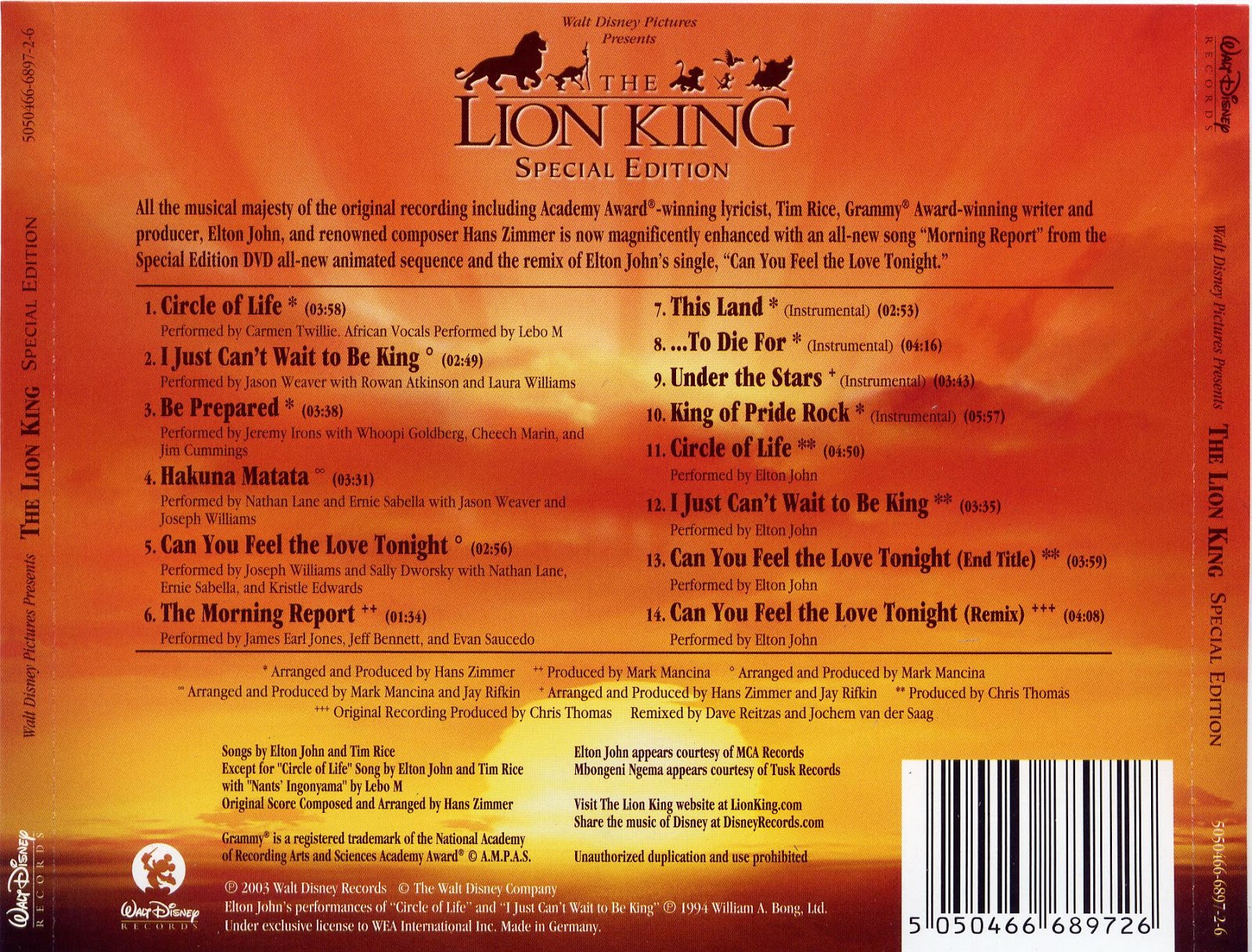
It shouldn't have worked. Honestly, back in 1994, Disney was on a roll with the "Broadway-style" formula that Howard Ashman and Alan Menken perfected, but The Lion King soundtrack was a weird pivot. You had a pop superstar in Elton John, a lyricist known for Jesus Christ Superstar in Tim Rice, and a German film composer named Hans Zimmer who, at the time, was mostly known for gritty action movies and dramas like Rain Man. It was a gamble.
People forget that The Lion King was the "B-movie" at Disney. The A-team was busy working on Pocahontas, which everyone thought would be the Oscar-winning prestige hit. But when that opening chant of "Nants ingonyama bagithi baba" hits? Everything changed.
The Zulu Chant That Changed Everything
That opening to "Circle of Life" is probably the most famous scream in cinema history. It wasn't even supposed to be there. Hans Zimmer brought in Lebo M., a South African composer and singer who was living in exile in Los Angeles at the time. Zimmer wanted something authentic. He didn't want a "Hollywood" version of Africa.
Lebo M. walked into the studio, saw the concept art, and just started singing. The lyrics aren't some mystical proverb, by the way. They basically translate to: "Here comes a lion, father / Oh yes, it’s a lion." It’s simple. It’s direct. It’s perfect.
But it’s the weight of that voice that matters. Zimmer’s decision to center the The Lion King soundtrack around Lebo M.’s choral arrangements gave the movie a soul. Without it, you just have a cartoon about talking cats. With it, you have a Shakespearean epic.
Elton John and the "Pop" Problem
Disney was nervous about Elton John. Could he write for a kids' movie? Tim Rice was the bridge. Rice had already stepped in to finish Aladdin after Howard Ashman passed away, so he knew how to navigate the Mouse House.
If you listen to the demos, Elton’s versions of these songs are pure 70s rock. "Can You Feel the Love Tonight" could have been a track on Goodbye Yellow Brick Road. In fact, there was a huge fight about that song. Initially, the producers wanted Timon and Pumbaa to sing the whole thing as a joke. Elton John reportedly told them they were going to "screw up" the most important moment in the movie. He won. The song stayed a ballad, and it won him an Oscar.
Why the Score is Actually the Secret Weapon
Everyone hums the hits, but the real heavy lifting on the The Lion King soundtrack is done by Hans Zimmer’s instrumental score. This was Zimmer's first and only Academy Award (until he won again for Dune decades later), and you can hear why.
He didn't treat it like a cartoon. He treated it like a tragedy.
Listen to the track "To Die For." That’s the music playing during the stampede. It’s chaotic. It’s terrifying. It uses a massive choir to create a sense of inevitable doom. Zimmer has often said in interviews that he wrote the music for his own father, whom he lost at a young age. That’s why the music feels so heavy. It’s not just "incidental" music; it’s an exploration of grief.
- The Mufasa Theme: It’s regal but lonely.
- The Stampede: Pure, driving percussion that feels like a heartbeat.
- The King of Pride Rock: A triumphant explosion of Lebo M.’s vocals and Zimmer’s strings.
The Rhythm of the Pridelands and the B-Sides
Most people think the soundtrack ends with the credits. It doesn't. If you’re a real fan, you know about Rhythm of the Pridelands.
This was a "sequel" album released shortly after the film. It featured songs that didn't make the cut or were inspired by the movie’s themes. "He Lives in You" came from this project. That song is so good they eventually put it in the Broadway musical and the animated sequel, Simba's Pride. It’s arguably better than some of the songs in the original movie. It captures that spiritual, ancestral vibe that makes this specific era of Disney music so distinct.
The 2019 Remake: What Went Wrong?
We have to talk about the Jon Favreau remake. They brought back the original The Lion King soundtrack elements, but something felt... off.
Beyoncé joined the cast and added "Spirit," which is a powerhouse vocal performance. But the remake suffered from a weird clash of styles. Pharrell Williams produced several tracks, trying to modernize the sound. The problem? The original was already timeless. When you take the raw, visceral energy of the 1994 recordings and polish them with modern "perfect" production, you lose the grit.
The original soundtrack sold over 15 million copies. It is the best-selling soundtrack album for an animated film in the United States. You can’t just "update" that with more bass and auto-tune.
How to Properly Experience This Music
If you're just listening to a low-bitrate stream on your phone, you're missing half the record. The dynamic range on the original 1994 release is insane.
- Find the "Legacy Collection" edition. It includes the 30-minute score tracks that were previously unreleased.
- Listen to "This Land" on high-quality headphones. The way the flute enters after the heavy strings is a masterclass in sound mixing.
- Check out the Broadway cast recording. Heather Headley’s version of "Shadowland" adds a layer of depth to Nala’s character that the movie never had time for.
The The Lion King soundtrack isn't just nostalgia. It’s a fluke of history where a pop legend, a theatrical lyricist, and a legendary composer all peaked at the exact same moment. It’s the sound of a studio taking a massive risk on an "African-inspired" epic that no one thought would be a hit.
Actionable Listening Steps
- Compare the Versions: Listen to Elton John’s "Circle of Life" (the pop version) back-to-back with the film version. Notice how the film version emphasizes the "we" (the choir) while Elton emphasizes the "I" (the individual journey).
- Deconstruct the Score: Put on "Under the Stars." Listen for the way Zimmer weaves the "Circle of Life" melody into a quiet, woodwind-driven lullaby. It’s a lesson in how to use a "leitmotif" to tell a story without words.
- Explore Lebo M.'s Solo Work: If you like the choral elements, his album Echoes of Africa is where many of those sounds originated.
The music holds up because it deals with big, messy human emotions. It’s about birth, death, betrayal, and finding your place in the world. As long as those things matter to people, this soundtrack will stay at the top of the pile.