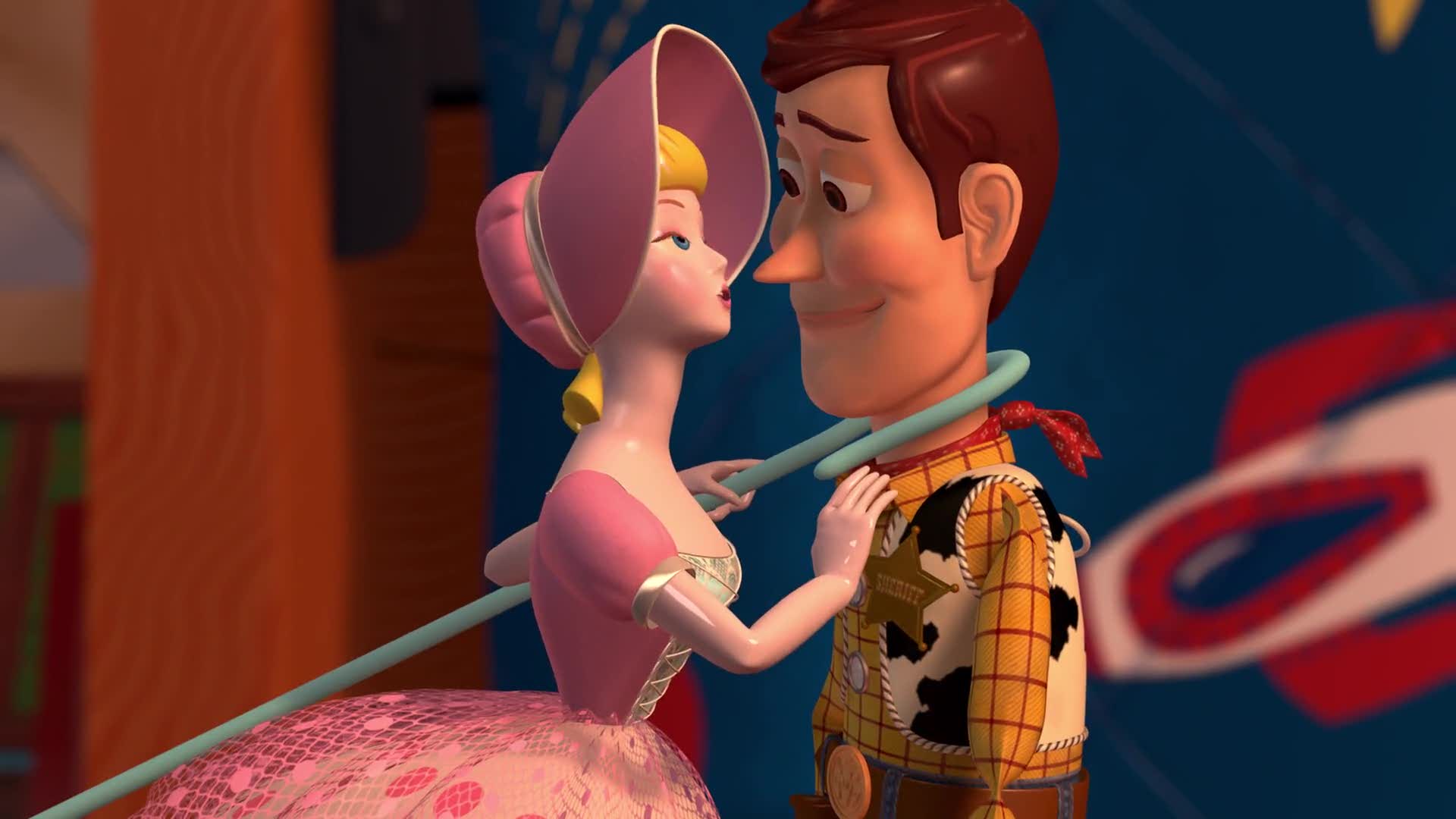
You remember that scene in the original Toy Story? Woody is stressed about Buzz, and Bo Peep just hooks him with her cane, pulls him close, and tells him she’ll get someone else to watch the sheep. It was a small, flirty moment. For years, that was the extent of it. Woody was the leader, Bo was the "voice of reason" on the bedside lamp, and they were just... together.
Then Toy Story 3 happened. She was just gone. A throwaway line about how they’d lost friends along the way—Slinky, Wheezy, Bo—and that was it. It felt cold. Fans spent years wondering how a porcelain figurine survived a yard sale or a move. When Woody and Bo Peep finally reunited in the fourth film, it wasn't just a romance; it was a total demolition of everything we thought we knew about being a toy.
Honestly, a lot of people still aren't over it.
The Mystery of the Missing Lamp
For nearly two decades, Bo Peep’s disappearance was the biggest "plot hole" in Pixar history. It turns out, her exit was a lot more intentional than just a budget cut.
Annie Potts, who has voiced Bo since 1995, actually pointed out in interviews that her character was always a bit of a "damsel" because of the era. But in Toy Story 4, we get the flashback. It’s raining. RC is stuck in a storm drain. After the rescue, a car pulls up. Bo is being given away.
Woody has a choice right then. He could jump in the box. Bo even asks him to. For a second, he almost does—and then he hears Andy. That loyalty to his "kid" was his entire identity. Seeing him choose Andy over Bo in that driveway makes their eventual reunion years later hit so much harder. It wasn't just a breakup; it was a philosophical divide that took nine years to bridge.
Why the "New" Bo Peep Upset People
If you look at the Bo Peep from the 90s, she’s very... soft. She has the big pink dress, the bonnet, the gentle voice. Fast forward to her reappearance, and she’s basically an action hero. She’s wearing a blue jumpsuit (which is actually just her bloomers, her skirt turned into a cape), she has a broken arm held together by tape, and she drives a motorized skunk.
Some fans called this "character assassination." They felt Pixar was just trying to make her "strong" for the sake of it.
But if you look at the logic, it makes sense. She’s porcelain. If you’re a porcelain doll living in the "wild" (playgrounds and antique shops), you either adapt or you end up in pieces. She didn't become tough because it was trendy; she became tough because she spent years as a "lost toy" dodging toddlers’ boots and rogue cats.
The Philosophy Shift
This is where Woody and Bo Peep really clash. Woody still believes a toy’s only purpose is to be there for a child, even if that child (Bonnie) ignores him. Bo thinks that’s a prison.
- Woody’s View: You belong to a room. You wait for playtime. You’re loyal until the end.
- Bo’s View: The world is huge. You can belong to a thousand kids at a park for fifteen minutes each and bring more joy than sitting in a dark closet.
It’s a heavy debate for a movie about talking plastic.
That Ending: Why Woody Left
The ending of Toy Story 4 is arguably more controversial than the furnace scene in the third movie. Woody says goodbye to Buzz. He gives up his badge. He decides to stay with Bo.
People hated this. "He would never leave his friends!" "What about Bonnie?"
But here’s the reality: Bonnie didn't want him. She literally took his sheriff badge and gave it to Jessie. Woody was suffering from a massive identity crisis. Staying with Bo wasn't just about romance; it was about retirement. He’d done his job. He raised Andy. He made sure Bonnie was okay. By joining Bo, he chose a life where he could help "lost" toys find homes at the carnival.
It’s actually a pretty mature take on aging and moving on. Sometimes your "purpose" changes, and that’s okay.
The "Lamp Life" Connection
If you haven't seen the Disney+ short Lamp Life, it fills in the gaps. It shows Bo’s journey from a dusty shelf in a baby’s room to a sorority house (where things got weird) to the antique shop. It explains why she’s so cynical about owners. She saw the worst of it. Woody only ever saw the best of it with Andy. That’s why they needed each other—she needed some of his heart, and he needed some of her grit.
What’s Next in Toy Story 5?
With Toy Story 5 confirmed for 2026, the big question is whether we’ll see them again. Pixar’s Andrew Stanton has hinted that the "technology" aspect will play a big role in the new film, but can you really have a Toy Story movie without the main cowboy?
If they bring Woody back, they have to address the Bo Peep situation. Do they come back to the gang? Or does the gang find them?
Actionable Insights for Fans:
- Rewatch the Flashback: Pay attention to the lighting in the opening of Toy Story 4. It’s the first time we see the toys in a "real-world" survival situation, which sets up Bo’s transformation.
- Check the Cracks: If you look closely at Bo’s character model in 4K, you can see tiny "crazing" in her porcelain skin. It’s a detail the animators added to show she’s been through hell.
- The Badge Symbolism: Notice that Woody doesn't just leave; he passes the torch. Giving the badge to Jessie is the final step in his arc of letting go of "the old ways."
The relationship between Woody and Bo Peep isn't a fairy tale. It’s a story about two people who grew apart, changed fundamentally, and then realized they were the only ones who truly understood each other’s history. Whether you love the ending or hate it, you can't deny it changed the franchise forever.