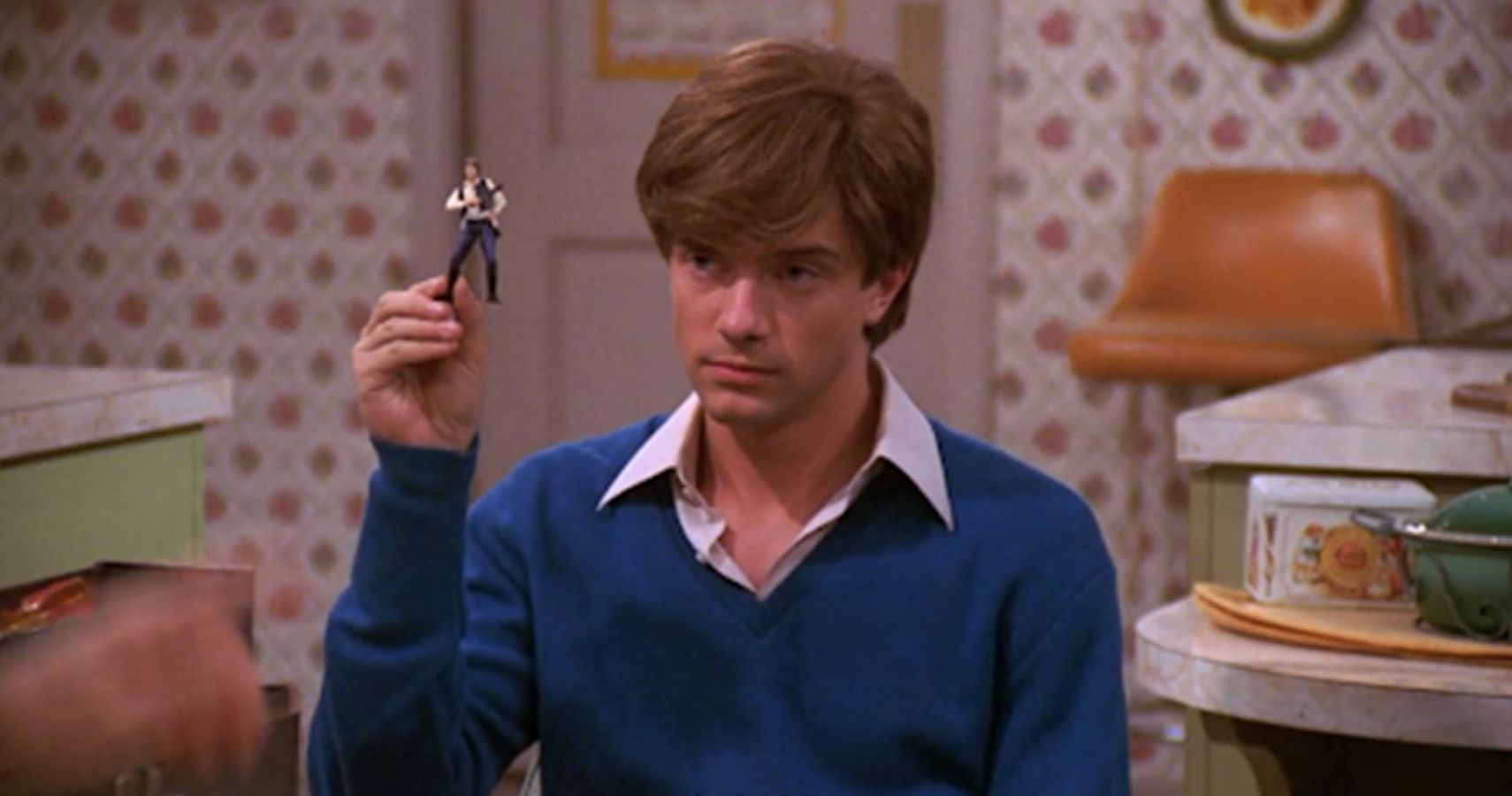
He’s the skinny kid in the basement. Topher Grace played Eric Forman with a specific kind of nervous, biting energy that defined a generation of sitcom protagonists, yet if you revisit the show today, Eric from That 70s Show feels surprisingly complicated. He wasn’t just a "nice guy" template. Honestly, he was kind of a jerk sometimes. But that’s exactly why he worked.
Most TV leads in the late 90s were either total losers or untouchable heartthrobs. Eric was neither. He was a sarcastic, Star Wars-obsessed teenager living under the thumb of a terrifying father, Red Forman. That dynamic is the heartbeat of the series. Red, a Korean War vet, didn't understand Eric’s softness. Eric didn’t understand Red’s hardness. It’s a classic American trope, but played with a level of genuine resentment that you don't usually see in multi-cam sitcoms.
The Scrawny Catalyst in the Vista Cruiser
Think about the pilot. Eric gets the keys to the Vista Cruiser. It’s freedom, but it’s conditional. That car becomes a character in itself, a vessel for the group's "circles" and a symbol of Eric's desperate need to be his own man while still living in his father's house.
He was the glue. Even though Kelso was the "funny one" and Hyde was the "cool one," the basement belonged to Eric. Without his specific brand of neurotic leadership, the group falls apart. We actually saw this happen in the disastrous eighth season when Topher Grace left the show to pursue a film career, starting with Spider-Man 3. The writers tried to replace him with Randy Pearson (played by Josh Meyers), and it flopped. Hard. You can't just swap out the moral—or immoral—center of a friend group. Fans hated it because Eric’s absence left a hole that snarky dialogue couldn't fill.
He was the guy who stayed behind. While others had grander ambitions or more chaotic lives, Eric was often stuck. He was stuck in Point Place, stuck in his relationship with Donna, and stuck in his own head.
Donna Pinciotti and the "Nice Guy" Myth
The relationship between Eric and Donna is often romanticized. It shouldn't be. Not entirely.
While they were clearly soulmates in the logic of the show, Eric exhibited some pretty toxic traits. Remember when he gave her a "promise ring" and then got incredibly defensive when she wasn't ready for that level of commitment? Or the time he basically called off their wedding because he had a mid-life crisis at age twenty? He was deeply insecure. Being the scrawny kid next to a girl who was taller, more athletic, and arguably cooler than him took a toll on his ego.
Donna, played by Laura Prepon, was frequently the more mature partner. Eric’s humor was his defense mechanism. When things got real, he’d crack a joke about A New Hope or mock Jackie’s vanity. It was funny for the audience, but if you look at it through a modern lens, he was often avoiding emotional labor.
- He struggled with Donna's independence.
- His jealousy over Casey Kelso (played by Luke Wilson) showed how fragile his confidence really was.
- He often prioritized his own comfort over Donna's goals, like when she wanted to move to Madison for college.
But here’s the thing: that makes him a real teenager. Teenagers are selfish. They are inconsistent. Eric Forman was a masterpiece of writing because he wasn't a saint. He was a kid trying to figure out how to be a man when the primary example of manhood in his life was a guy who threatened to kick his ass every ten minutes.
The Red and Eric Dynamic: A Study in 1970s Parenting
Kurtwood Smith is a legend. His portrayal of Red Forman is what gave Eric’s character depth. If Red had been a sweet, supportive dad, Eric would have just been a boring nerd. Because Red was a hard-nosed, "foot-in-ass" disciplinarian, Eric’s sarcasm became a survival tool. It was his only weapon.
He couldn't outmuscle his dad. He couldn't out-argue him. So, he used wit.
This created a specific type of viewer empathy. Anyone who grew up with a parent they couldn't quite please saw themselves in Eric. Even when he was being a "dumbass," you kind of rooted for him because he was the underdog in his own kitchen. The episodes where they actually bonded—like when they went to a wrestling match or worked on the car—are some of the most moving parts of the series. They showed that Eric wanted his father's respect more than anything else in the world, even if he'd never admit it.
Why Topher Grace Left (And Why It Mattered)
In 2005, Topher Grace decided he’d had enough of the polyester and the bell bottoms. He wanted to do movies. He’d already done In Good Company and P.S., and the industry was calling him the next big thing.
The writers sent Eric to Africa. It was a bizarre choice. Eric, the kid who was afraid of everything, suddenly goes to teach in Africa? It felt like a "jump the shark" moment. The show’s final season suffered immensely because the central conflict was gone. Without Eric to poke at Hyde or obsess over Donna, the rhythm was off. The "Circle" felt empty.
When he returned for the series finale, it was a brief, poignant moment on New Year’s Eve, 1979. It was the only way the show could truly end—with Eric back in the driveway, standing on the threshold of a new decade. It signaled the end of childhood. The 80s were coming, and the basement era was over.
The Legacy of the Forman Basement
What can we actually take away from Eric’s arc? He’s a reminder that being the "main character" doesn't mean you have to be the most likable person in the room. Eric was flawed. He was frequently a coward. He was occasionally judgmental.
But he was also incredibly loyal to his friends. He gave Hyde a place to live when his own mother abandoned him. He tolerated Kelso’s idiocy and Jackie’s shrieking. He was the heart of the "Forman Halfway House for Wayward Teens," as Red might call it.
If you're looking to understand the DNA of modern sitcom leads—from the neurosis of The Big Bang Theory characters to the dry wit of Parks and Recreation—you have to look at Eric Forman. He paved the way for the "nerd" to be the lead without having to undergo a "cool" makeover. He stayed a nerd until the very last frame.
How to Revisit the Eric Forman Era
If you’re planning a rewatch, don't just look for the laughs. Pay attention to the subtle ways Eric tries to carve out an identity that isn't Red's.
- Watch the body language: Topher Grace used a slouch and a specific way of holding his hands to convey Eric’s perpetual discomfort in his own skin.
- Track the Star Wars references: They aren't just jokes; they represent Eric's desire for a grander, more heroic life far away from a Wisconsin driveway.
- Observe the Hyde/Eric friendship: It’s one of the best depictions of "found brotherhood" on television.
Eric from That 70s Show remains a benchmark for how to write a relatable, frustrating, and ultimately beloved protagonist. He wasn't a hero. He was just a kid from Point Place, trying not to get a foot in his ass while he waited for his life to start.
To truly understand the character's impact, focus on the middle seasons—specifically seasons 3 through 5. This is where the writers nailed the balance between Eric’s biting sarcasm and his genuine fear of growing up. Note how his dialogue shifts when he's around Donna versus when he's around his father; it's a masterclass in "code-switching" for a suburban teenager. Avoid the temptation to skip to the end; the slow burn of his frustration with small-town life is what makes his eventual departure (as messy as it was written) feel earned. Stop looking for a perfect role model and start looking for the honesty in his mistakes. That's where the real Eric Forman lives.