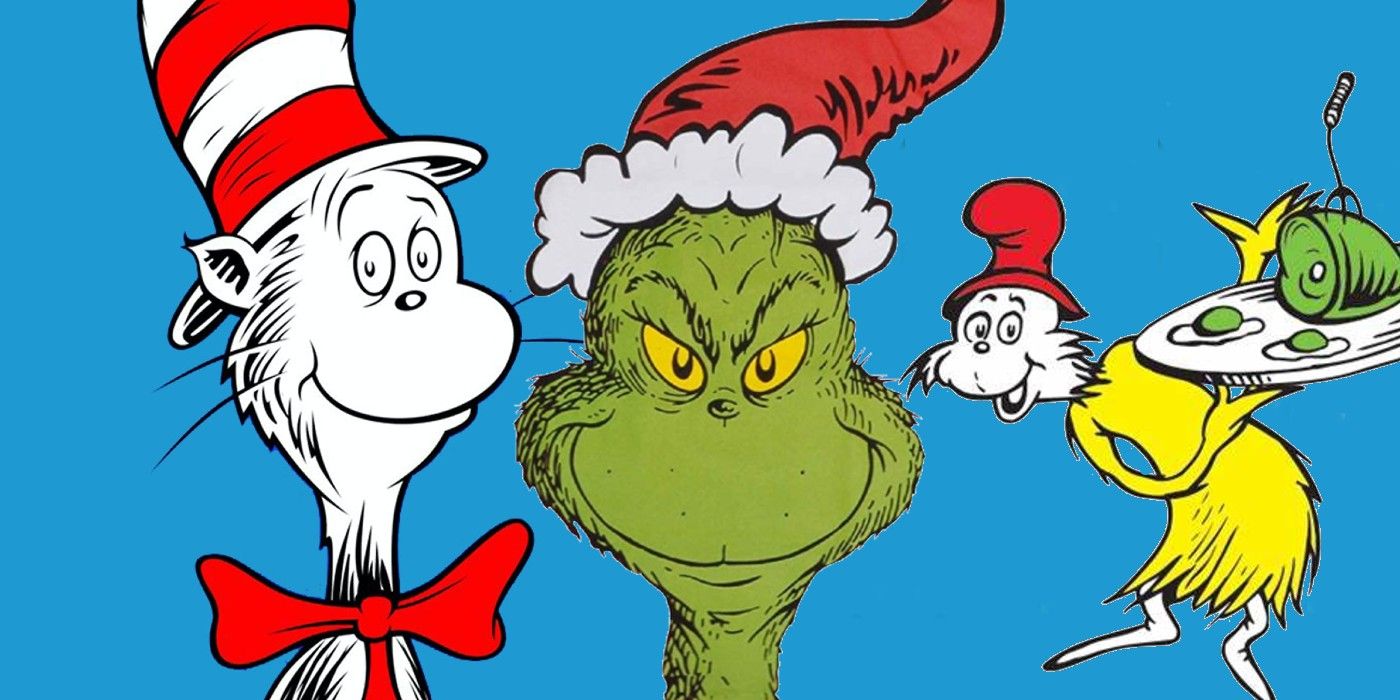
Dr. Seuss didn't just write a book back in 1957; he basically staged a coup against the "Dick and Jane" era of boring, repetitive primers. At the heart of that revolution are the characters in The Cat in the Hat, a small but chaotic ensemble that has managed to stay relevant for nearly seventy years. Honestly, when you look at the cast, it’s a masterclass in psychological tension. You’ve got the id (the Cat), the ego (the kids), and a very stressed-out superego in the form of a talking fish. It’s wild.
Most people remember the tall hat and the blue hair, but the nuances of these characters are what actually make the story work. Why does the boy never get a name in the original book? Why is the fish so angry? We’re going to dig into the actual roster—the real ones, from the page and the screen—to see what makes them tick.
The Cat: An Agent of Pure Chaos
The Cat is the engine. Without him, it’s just two kids staring at rain. He’s tall. He’s nimble. He’s wearing a red and white striped hat that has become shorthand for "mischief" globally. But if you really read the text, the Cat is kind of a gaslighter. He shows up uninvited when the parents are gone and insists that his "games" are good fun, even as he’s literally balancing a fishbowl on a cup while standing on a ball.
The Cat represents the disruption of the domestic sphere. Theodore Geisel (Dr. Seuss) was famously challenged by William Spaulding of Houghton Mifflin to write a book that "children couldn't put down," using only a limited vocabulary of about 230 words. The Cat was the solution to that boredom. He isn't a villain, exactly, but he’s certainly not a "good" guest. He’s the physical manifestation of the impulse to break rules when nobody is watching.
Interestingly, the Cat’s characterization changed a bit in the 1971 TV special and the 2003 live-action movie. In the book, he's cool and calculated. In the movie, Mike Myers played him as a frantic, Borscht Belt-style comedian. Most purists prefer the book version because there’s a quietness to his chaos that’s much creepier—and more effective.
Sally and Her Brother: The Audience Stand-ins
Then we have the kids. Sally and her brother (who remains nameless in the original 1957 book but is called Conrad in the 2003 film) are basically us. They are the audience. They’re bored. It’s cold. It’s wet.
They sit there.
They sit there.
They do nothing at all.
Until the Cat arrives. The dynamic between the two is subtle. Sally is often the follower, while the brother is the narrator and the one grappling with the moral dilemma of the situation. They are paralyzed by the conflict between the desire for fun and the fear of their mother’s return. It’s a very relatable childhood anxiety. When the Cat brings in Thing One and Thing Two, the kids finally snap out of their trance. It takes the threat of total household destruction for the boy to grab his net and take charge.
The Fish: The Voice of Reason (and Anxiety)
If you want to talk about the most stressed-out characters in The Cat in the Hat, the Fish wins by a mile. He is the only one who sees the danger from the start. "He should not be here," the fish says. "He should not be about. He should not be here when your mother is out!"
The Fish is basically the adult in the room, despite being a pet in a small bowl. In literary analysis, the Fish is often seen as the conscience. He’s the moral compass. He spends the entire book screaming (metaphorically) about the consequences of the Cat’s actions. What’s fascinating is that the Cat doesn't listen to him at all, often putting the Fish in physical danger—like when he balances the fishbowl on the tip of an umbrella.
Thing One and Thing Two: The Purest Forms of Play
The Things are released from a red box, and they are essentially "energy" personified. They don't have personalities so much as they have a function: to run. They fly kites in the house. They knock pictures off the wall. They have that iconic blue hair that looks like it’s being electrocuted.
The genius of Thing One and Thing Two is that they aren't malicious. They’re just... things. They do what they do without regard for the rules of the house. They represent the point where a mess becomes "too much." You can handle a cat on a ball. You can't handle two blue-haired creatures wrecking the hallway with kites. They force the kids to finally stand up for their home.
The Mother: The Looming Presence
Technically, the Mother is one of the characters in The Cat in the Hat, even though we only see her foot and a glimpse of her dress at the very end. Her presence dominates the entire narrative. The whole book is a race against her return.
She represents the "real world" and the consequences that come with it. The Cat’s "Clean-Up Machine" (the Pick-Up Machine) is the only reason the kids don't end up in serious trouble. The book ends with a classic Seussian question: "What would you do if your mother asked you?" It’s a prompt that forces the reader to think about honesty versus the secret world of imagination.
Why These Characters Still Matter in 2026
We’re still talking about these characters because they represent universal archetypes. Every classroom has a "Cat" (the kid who pushes boundaries), a "Fish" (the rule-follower who worries about everything), and a "Sally" (the observer).
Dr. Seuss’s estate and Dr. Seuss Enterprises have kept these characters alive through various media, but the core 1957 versions remain the gold standard. They weren't meant to be "cute." They were meant to be evocative. The Cat's smirk is a little too wide. The Things are a little too frantic. That edge is what keeps the book from feeling like a "baby" book.
Understanding the Character Dynamics
To truly grasp why the story works, you have to look at the power shift.
- Phase 1: The kids are powerless (boredom).
- Phase 2: The Cat has all the power (chaos).
- Phase 3: The Fish tries to seize power (logic), but fails.
- Phase 4: The Kids take power back (the net).
- Phase 5: The Cat yields power (the clean-up).
This structure is why the book is used in early childhood education to discuss boundaries. It’s not just about a cat in a hat; it’s about what happens when you let a stranger—or a strange idea—into your house.
Actionable Insights for Reading and Sharing
If you're revisiting these characters with a child or studying the work, here are a few ways to engage with the material more deeply:
- Spot the "Tell": Look at the Fish's face in every illustration. His expression tells the true story of the stakes involved.
- Discuss the "Nameless Boy": Ask why the narrator doesn't have a name. It usually makes the reader project themselves into the story more easily.
- The "Mother" Dilemma: Use the ending of the book to talk about the concept of "The Truth." Would you tell your parents about the Cat? It’s a great psychological litmus test for kids.
- Compare the Versions: If you watch the 2003 film, note how they added characters like Larry Quinn (the antagonist neighbor) to create more conflict. Notice how the simplicity of the original book's cast actually creates more tension than a bloated movie cast.
The characters in The Cat in the Hat are more than just ink on a page; they are the blueprint for modern children's storytelling. They proved that you could teach a child to read without boring them to tears, and that's a legacy that isn't going anywhere. For your next step, try reading the book aloud without looking at the pictures first—see if the "voice" of the Fish sounds as panicked as he looks. It changes the whole experience.