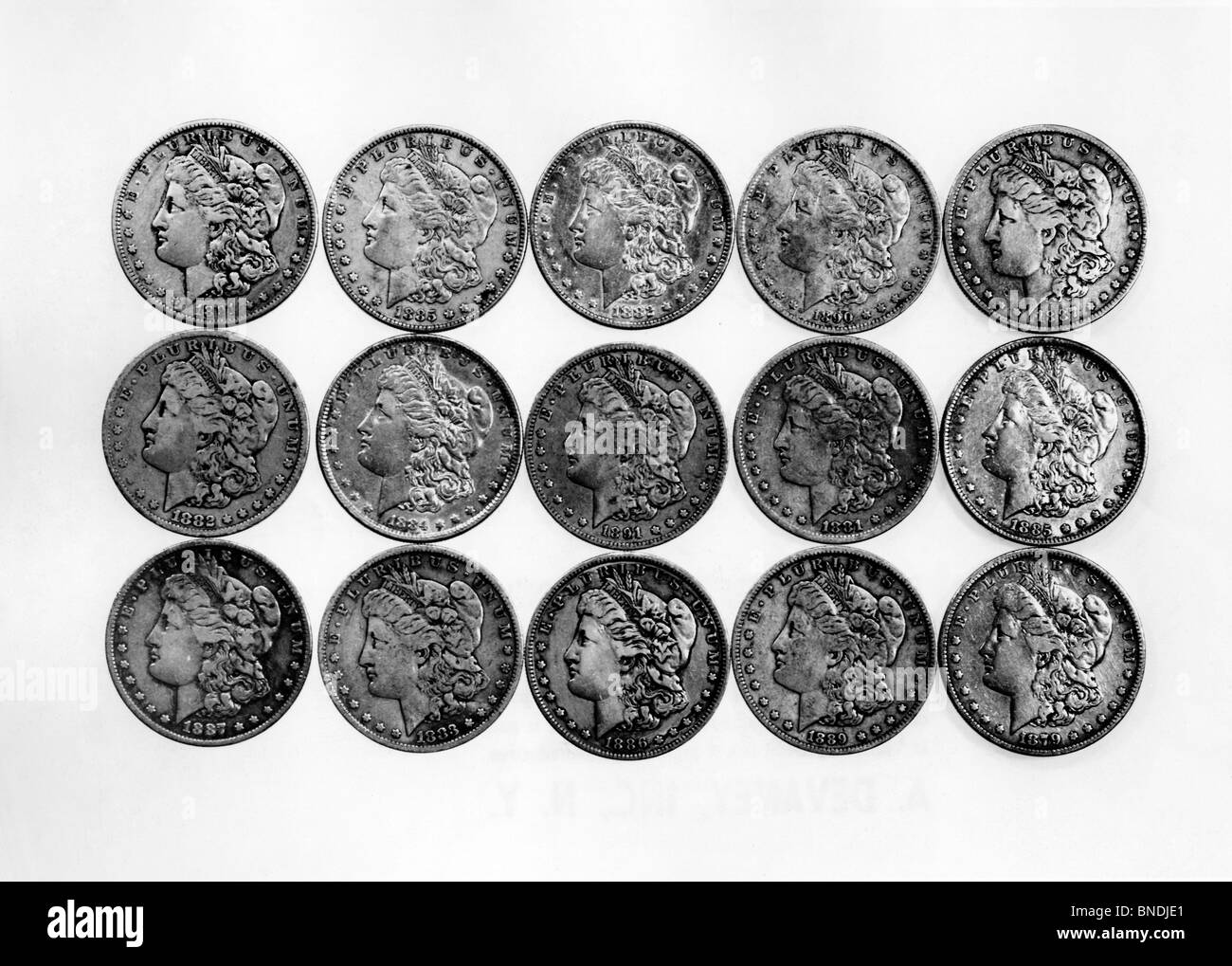
You probably have a jar somewhere. It’s sitting on a dresser or tucked inside a kitchen junk drawer, filled with heavy, gold-colored discs that feel like play money but are actually legal tender. US one dollar coins are the orphans of the American wallet. We’ve been trying to make them "happen" for decades, yet we keep crawling back to the crumpled, germ-ridden greenback. It’s a weird obsession for the U.S. Mint. They keep pumping them out, and we keep tossing them into the back of our sock drawers. Honestly, the story of why we can't quit the paper dollar—and why these coins are actually worth a closer look—is a mess of bad marketing, stubborn habits, and a few genuine rarities that could pay for your next vacation.
The Identity Crisis of the Modern Dollar
The biggest problem? They look like quarters. Well, they did at first. When the Susan B. Anthony dollar launched in 1979, it was a disaster. People hated it. It was round, silver-colored, and had a reeded edge, which meant if you were reaching into your pocket in a dark movie theater, you were basically flipping a coin on whether you were overpaying by 75 cents. It was a usability nightmare.
The Mint tried to fix this in 2000 with the Sacagawea dollar. They gave it a "golden" color (actually a manganese-brass alloy) and a smooth edge. It was beautiful. It was distinct. It still failed.
Why? Because the government refused to stop printing the $1 bill. You can’t force a new currency into a market if the old, comfortable version is still widely available. Most countries that successfully switched to high-denomination coins—like Canada with the "Loonie" or the UK with the pound coin—did it by simply yanking the paper version out of circulation. The U.S. didn't have the political stomach for that. Americans are weirdly sentimental about the paper dollar, even though it costs more to constantly replace those raggedy slips of paper than it does to mint a coin that lasts 30 years.
The Vending Machine Loophole
For a while, the only place you’d actually see US one dollar coins was at a post office vending machine or a transit kiosk. You’d put in a $20 bill to buy a $2 stamp, and the machine would spit out 18 heavy gold coins like a malfunctioning slot machine. It was annoying. You’d walk away with a sagging pocket, feeling like a medieval blacksmith.
Interestingly, the Presidential $1 Coin Program, which started in 2007, was supposed to ignite public interest. It did the opposite. By 2011, the government had a massive surplus. Literally billions of these coins were sitting in Federal Reserve vaults because nobody wanted them. The Secretary of the Treasury finally had to pull the plug on minting them for general circulation, shifting the program to a "collector only" basis. If you find a Presidential dollar dated after 2011 in your change, someone probably broke open a collector's set to buy a soda.
What Collectors Are Actually Hunting For
Most dollar coins are worth exactly one dollar. That's the boring truth. But if you’re looking at a pile of them, there are specific "error" coins and rare strikes that numismatists (coin nerds) go crazy for.
Take the 2000-P Sacagawea dollar. Most of them are common. However, there’s a legendary "Cheerios Dollar." Back in 2000, General Mills put a newly minted dollar coin in every 2,000th box of Cheerios as a promotion. Years later, collectors realized that some of those specific coins were struck with a detailed "enhanced tail feathers" pattern on the eagle that wasn't used on the mass-produced versions. One of these sold for over $10,000. If you have a Sacagawea dollar from a cereal box, don't spend it at the car wash.
Then there are the "mule" coins. These are the holy grail of modern US one dollar coins. A "mule" happens when a mint worker accidentally uses two different dies—like the front of a state quarter and the back of a Sacagawea dollar. It sounds impossible, but it happened. About 19 of these "SBA/Sacagawea" mules are known to exist. They are worth mid-six figures. They are essentially the winning lottery tickets of the coin world.
The Silver Factor
We also need to talk about the "Eisenhower" dollars. These are the massive, palm-sized "Ike" coins minted from 1971 to 1978. Most of the ones you see are copper-nickel, but some—specifically those minted in San Francisco (look for the "S" mint mark)—contain 40% silver. They aren't going to make you rich, but their melt value is significantly higher than a buck.
The Logistics of a Failed Transition
The GAO (Government Accountability Office) has been screaming for years that switching to coins would save the U.S. billions of dollars over several decades. A paper bill lasts about 6.6 years on average. A coin lasts 30+. The math is simple.
But the lobbying is complicated. The Crane & Co. paper company has been the exclusive supplier of U.S. currency paper since 1879. They have a pretty strong interest in keeping the paper dollar alive. On the other side, you have the mining industry and vending machine associations pushing for the coin. It’s a classic Washington stalemate.
Why the Innovations Didn't Stick
- Weight: Carrying $10 in coins is heavy. Carrying $10 in bills is weightless.
- Infrastructure: Think about every cash register drawer in America. They have slots for pennies, nickels, dimes, and quarters. There isn't a dedicated spot for a dollar coin. Clerks usually shove them under the drawer tray, effectively removing them from circulation the moment they are spent.
- The "Gold" Problem: People kept mistaking them for quarters, even after the color change. In low light, brass and cupro-nickel look remarkably similar.
The Future of the Dollar Coin
Is the dollar coin dead? Not exactly. The American Innovation $1 Coin Program is currently running (2018–2032), releasing four new designs every year to celebrate significant inventions or innovators from each state. These aren't meant for your grocery bill; they are primarily for collectors.
They’ve also become a niche tool for certain communities. Some budgeters use them for "sinking funds" because it’s harder to spend a heavy coin on a whim than it is to swipe a card or spend a bill. There's also a weirdly loyal following among tooth fairies—a gold coin feels a lot more magical under a pillow than a wrinkled single.
Honestly, unless the U.S. government finally decides to retire the $1 bill—which seems unlikely given the current political climate—the dollar coin will remain a novelty. It's a piece of history you can carry in your pocket, a failed experiment in efficiency that nonetheless produced some of the most beautiful artwork in the history of the U.S. Mint.
Actionable Steps for the Casual Holder
If you find yourself holding a stack of US one dollar coins, don't just dump them at the bank. Do this first:
- Check the Dates: If it’s a Presidential dollar dated 2012 or later, it was never intended for circulation. These often carry a small premium to collectors, even in used condition.
- Look for the "S": On Eisenhower dollars, a small "S" above the date means it might be 40% silver. Use a tissue test: if you hold a silver coin next to a regular one, the edge of the silver one will look distinctly white/bright, while the nickel one will show a dark copper strip.
- Inspect the Edges: Modern dollar coins have "incuse" edge lettering (the date and mint mark are engraved into the side). If you find a coin with a smooth edge that is missing this lettering, it’s a major mint error worth hundreds of dollars.
- Check Sacagawea's Eagle: If you have a 2000-P, look at the tail feathers through a magnifying glass. If the feathers have sharp, defined veins and a clearly defined central shaft, you might have an "Enhanced Tail Feathers" variety.
- Spend the Rest: If they are just regular 1979 Susans or 2000-2011 Presidents, use them. They are great for tipping or paying for parking. You might even spark a conversation with a cashier who hasn't seen one in years.