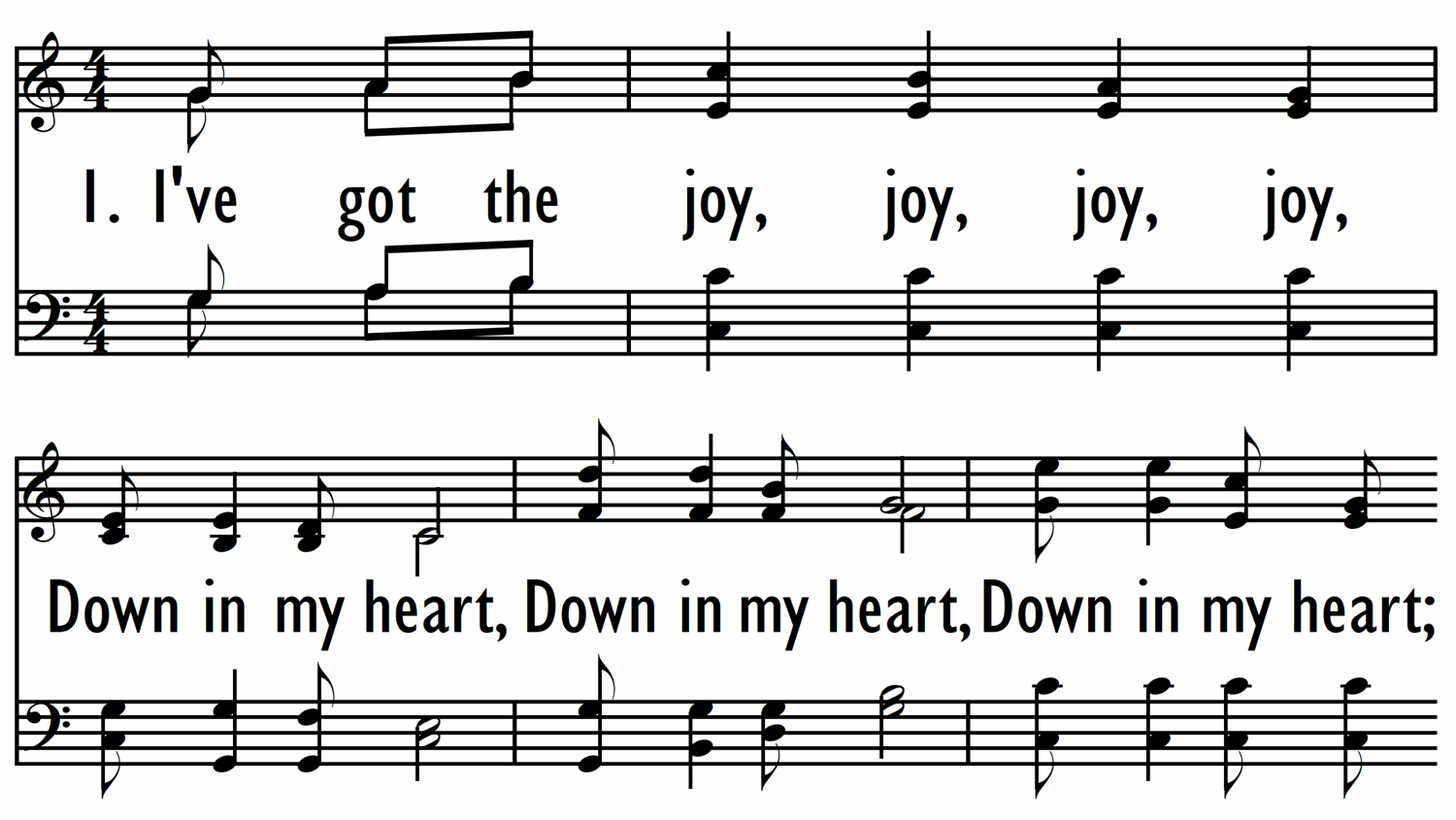
You know the feeling. You’re doing the dishes or sitting in traffic, and suddenly, like a ghost from a 1990s Sunday School basement, it hits you. I have the joy joy joy joy down in my heart. It’s relentless. It’s upbeat. For some, it’s a nostalgic hug; for others, it’s the ultimate "earworm" that won't leave without a fight. But where did this song actually come from? Honestly, most people assume it’s just some ancient folk tune or a generic campfire song, but the history of this specific melody is actually tied to the early 20th-century revival movements and a very specific songwriter named George Willis Cooke.
It’s catchy. Almost too catchy.
The song, officially titled "Joy in My Heart," wasn't just written for kids to wiggle around to during Vacation Bible School. It was part of a larger movement of "choruses"—short, repetitive songs designed to be learned instantly by large crowds. We’re talking about a time before digital lyrics or projectors. If you wanted a thousand people to sing together in a tent in 1920, the song had to be dead simple. Cooke nailed it. He created a piece of music that bypassed the brain and went straight into the permanent storage of the human psyche.
The Anatomy of an Earworm: Why It Works
Why does I have the joy joy joy stay stuck in your head for three days? It’s not an accident. Musicologists often point to the "repetition-variation" loop. You have a simple rhythmic hook—the triple "joy"—followed by a geographical location: "down in my heart." Then, the song does something clever. It asks a question or adds a qualifier. Where? Down in my heart to stay.
It's a closed loop.
The melody follows a basic pentatonic-adjacent structure, which is the most natural scale for the human voice. It’s why almost every culture on earth has folk songs that sound vaguely similar. When you sing "I have the joy joy joy," you aren't just singing a hymn; you're engaging with a piece of psychological engineering. Dr. Victoria Williamson, an expert on the psychology of music, has noted that earworms (or "involuntary musical imagery") usually have these exact traits: a fast tempo, a generic melodic contour, and some unusual intervals that catch the ear.
George Willis Cooke and the 1920s Vibe
Let’s talk about George Willis Cooke for a second. He wasn’t a pop star. He was a man of his time, deeply embedded in the Sunday School movement. During the early 1900s, there was a massive push to make religious education "fun" for children. Before this, kids were often expected to just sit still and listen to long, boring sermons. Then came the era of the "Action Song."
Cooke’s "Joy in My Heart" was a revolution in that niche. It wasn't just about the words; it was about the energy. By the time the song was copyrighted and popularized, it had become a staple in the Joyful Melodies songbook.
Interestingly, the song has mutated.
If you grew up in a Baptist church in the 70s, you probably sang it one way. If you went to a summer camp in the 90s, you probably added the "And if the devil doesn't like it he can sit on a tack" verse. That’s the "folk process" in action. People take a core piece of media and layer their own weird, sometimes slightly aggressive, humor onto it. It’s fascinating how a song about internal peace somehow evolved to include a verse about a supernatural entity sitting on office supplies.
The Science of Why We Can't Forget It
Neurologically, songs like I have the joy joy joy get lodged in the "phonological loop." This is a short-term memory system in your brain that acts like a continuous tape recorder. Usually, this loop clears out after a few seconds. But with highly repetitive music, the "tape" gets stuck. Your brain keeps playing it back, trying to "resolve" the melody.
Some researchers suggest that the best way to break this loop is to actually listen to the entire song from start to finish. Most people only have the chorus on repeat. By hearing the end, you give your brain the "closure" it needs to stop the playback.
But here’s the kicker: with "Joy in My Heart," there isn't really a complex musical resolution. It’s designed to be a cycle. It’s meant to be sung "around the campfire" where the end leads right back into the beginning.
Beyond the Sunday School Basement
While we mostly associate the song with kids, it actually shares a lot of DNA with the "Happy" songs of the Great Depression era. Think about the context of the 1920s and 30s. Life was incredibly hard for a lot of people. Singing about having a "joy that the world didn't give and the world can't take away" wasn't just a cute sentiment. It was a survival strategy.
It’s easy to be cynical about "enforced happiness" in music. We’ve all seen those movies where a creepy kid starts singing a nursery rhyme right before something bad happens. But the original intent of I have the joy joy joy was radical resilience. It was an assertion of internal state over external circumstance.
Misconceptions and Cultural Footprints
One of the biggest misconceptions is that this song is a "traditional spiritual." While it shares some stylistic elements with African American spirituals—specifically the call-and-response potential and the focus on internal fortitude—its documented origins are firmly in the published hymnal tradition of the early 20th century. However, it’s been covered by everyone from Bill Gaither to VeggieTales, blurring the lines of its heritage.
The song has even popped up in mainstream media, often used as a shorthand for "innocent" or "wholesome" (or, conversely, "brainwashed"). It’s a cultural touchstone. Even if you haven't stepped foot in a church in twenty years, you likely know the hand motions.
Why? Because physical memory (proprioception) is even stronger than auditory memory. When you pair "down in my heart" with a hand gesture pointing to your chest, you're encoding that information in two different parts of your brain. It's basically the ultimate mnemonic device.
The Modern Legacy: Is It Still Relevant?
In a world of complex Spotify algorithms and hyper-produced pop, where does a 100-year-old chorus fit in?
Believe it or not, music therapists still use songs like this. For patients with dementia or memory loss, "I have the joy joy joy" is often one of the last things to fade. The simplicity that makes it an "annoying" earworm for a teenager makes it a vital lifeline for someone losing their connection to language. The brain preserves rhythm and simple melody long after it loses the ability to process complex sentences.
It’s also a case study in "sticky" content. If you’re a creator or a writer, there’s a lot to learn from George Willis Cooke. He didn't use big words. He didn't use complex metaphors. He used:
- Simple repetition (Joy, joy, joy)
- Direct emotion (I have...)
- Concrete imagery (Down in my heart)
- A clear "why" (To stay)
Breaking the Cycle (If You Want To)
If you currently have the song stuck in your head because you read this article (sorry!), there are a few scientifically backed ways to get it out.
First, try chewing gum. Seriously. The act of moving your jaw interferes with the "inner voice" that replays the song. Second, solve a moderately difficult puzzle. Not something so hard that you get frustrated, but something that requires enough working memory to "bump" the song out of the phonological loop. Anagrams or a Sudoku usually do the trick.
But maybe just let it play. There are worse things to have stuck in your head than a song about being happy, even if it is a bit saccharine.
Actionable Takeaways for the Curious
If you want to explore the history of simple, "sticky" music further, or if you're just trying to manage your own earworms, here is what you can actually do:
- Trace the Source: Look up the "Joyful Melodies" hymnal if you can find a digital archive. It’s a fascinating look at what people thought was "pop" music for kids a century ago. It puts modern children's entertainment like CoComelon into a much broader historical context.
- The "Finish the Song" Technique: If I have the joy joy joy is driving you crazy, find a recording of the full version (including the verses about "peace like a river") and listen to it all the way through. Force your brain to acknowledge the "The End."
- Analyze Your Own "Stickiness": Think about the jingles or songs that stay with you. Usually, they share the same three traits: they are easy to sing (small vocal range), they repeat a key phrase three times, and they involve a physical sensation or location.
- Use It for Memory: If you’re trying to teach a kid (or yourself) something important, try setting it to the tune of "Joy in My Heart." It’s an ancient hack, but the brain's hardware hasn't changed much in 100 years.
The reality is that I have the joy joy joy isn't just a relic of Sunday School. It’s a piece of enduring psychological design that taps into how humans process sound, memory, and communal emotion. It survives because it’s efficient. It stays because it’s simple. And honestly, in a world that feels increasingly complicated, there’s something almost rebellious about a song that refuses to be anything other than relentlessly, stubbornly joyful.