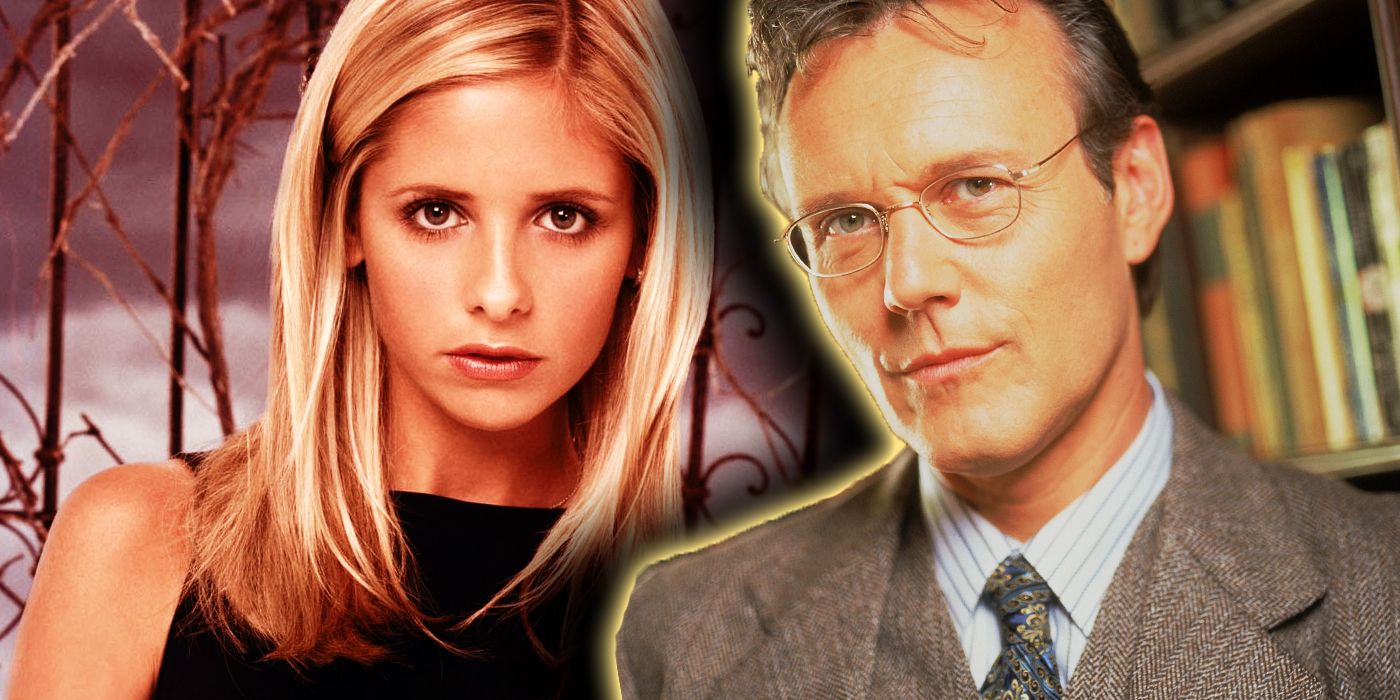
Let’s be honest. When you first watched Buffy the Vampire Slayer, Rupert Giles probably seemed like a bit of a stick-in-the-mud. He was the guy in the tweed jacket who cleaned his glasses way too much. He spent half his time tripping over stacks of books and the other half looking confused by 90s slang. He was just a librarian. A stuffy, British librarian.
But then, everything changed.
The moment Giles stopped being just "the guy with the books" and started being the heart of the show is when Buffy truly found its feet. If you've ever found yourself rewatching old episodes just to hear him say "The Earth is doomed," you're not alone. There is something about Rupert Giles that stays with you. It’s not just the father-figure vibes, although that’s a huge part of it. It's the fact that he was the most dangerous person in Sunnydale, and he kept it hidden under a layer of tea and research.
The "Ripper" Problem: Why Giles Isn't Who You Think
Most fans know about the "Ripper" phase. It's the stuff of legend. Back in the 70s, before he was a watcher, Giles was a total mess. He dropped out of Oxford. He messed around with dark magic. He hung out with Ethan Rayne and basically summoned demons for fun.
The thing is, "Ripper" wasn't just a phase he grew out of. It was a part of him he spent every single day trying to suppress. When you see him cleaning those glasses, he’s often just trying to compose himself. He’s hiding the guy who once beat up a cop while high on "Band Candy."
Honestly, that’s why his relationship with Buffy works so well. They’re both people who have been told who they have to be by a bunch of old men in London. The Watchers’ Council? They’re basically the worst corporate HR department in history. They treated Slayers like disposable tools. Giles was the only one who saw Buffy as a person.
Think about the episode "Helpless." The Council makes Giles drug Buffy on her 18th birthday so she loses her powers. It’s a test. A cruel, messed-up test. Giles does it because he’s a "good soldier," but the guilt absolutely destroys him. That’s the moment he chooses Buffy over the Council. He gets fired, sure, but it’s the most honorable thing he ever does.
Why Anthony Stewart Head Was the Perfect Choice
You can't talk about Giles without talking about Anthony Stewart Head. Before Buffy, he was mostly known in the UK for those Nescafé commercials. He brought this incredible nuance to the role that a lesser actor would have missed.
He had to play the comic relief. He had to play the mentor. He had to play the occasional action hero. But mostly, he had to play the guy who was quietly breaking inside.
There’s a scene in "The Body"—you know the one, after Buffy’s mom dies—where Giles walks into the room and just stops. He doesn't say anything. He just looks. In that one moment, you see the entire history of his relationship with the Summers family. He wasn't just the Watcher anymore; he was part of the family.
That One Time He Actually Killed Someone
People forget how dark Giles could get. In the Season 5 finale, "The Gift," Buffy is facing off against Glory. Glory is a god. She’s unbeatable. But her human form, Ben, is just a guy.
Buffy can’t kill Ben. She’s the hero. She has a code.
Giles doesn't have that problem. He waits until Buffy is gone, walks over to a dying Ben, and tells him, "She’s a hero, you see. She’s not like us." And then he suffocates him.
It is cold. It is brutal. It is 100% Ripper. And it’s exactly what needed to happen to save the world.
The Great Season 6 Debate: Did He Abandon Her?
This is the part that still divides the fandom. In Season 6, Giles decides to leave Sunnydale and head back to England. Buffy has just been brought back from the dead. She’s depressed. She’s broke. She’s working at a fast-food joint.
And Giles leaves.
On the surface, it feels like total abandonment. He says he’s doing it so she can "learn to stand on her own," but man, the timing was terrible.
The real-world reason was simpler: Anthony Stewart Head missed his family. He’d been living in LA for years while his partner and daughters were in the UK. He needed to go home. So the writers had to find a way to write him out.
Does it make sense for the character? Kinda. Giles knew that as long as he was there, Buffy would always look to him for the answers. He wanted her to be a woman, not just a girl with a Watcher. But seeing him sing "Standing" in the musical episode, you can tell it’s killing him to go.
What We Can Learn From the Librarian
Giles taught us that knowledge isn't just power—it's a responsibility. He spent his life surrounded by books, but he never let them blind him to the people in front of him.
If you're a fan of the show, there are a few things you should probably do to honor the legacy of Rupert Giles:
- Actually read the books. Giles was a technophobe for a reason. There’s something about a physical page that Google just can't replicate.
- Stand up to the "Council" in your own life. Whether it's a bad boss or a toxic family tradition, sometimes you have to get "fired" to do the right thing.
- Learn a second skill. Giles was a librarian, but he could also hotwire a car and play a mean guitar. Be a multi-hyphenate.
- Clean your glasses. Seriously. It’s a great way to buy yourself five seconds of thinking time in a high-pressure situation.
Rupert Giles was never just a supporting character. He was the anchor. Without him, the Scooby Gang would have just been a bunch of kids in a cemetery. He gave them a reason to fight, and more importantly, he gave them a home.
Next time you’re feeling overwhelmed, just imagine a British man in a tweed jacket telling you to "buck up" and handed you a cup of tea. It usually helps.
Actionable Insights for Fans:
If you want to dive deeper into the lore of the Watchers, check out the Buffy the Vampire Slayer Season 8 comics. They explore what happens when Giles has to rebuild the Council from scratch. Also, if you haven't seen Anthony Stewart Head in Ted Lasso, go watch it immediately. He plays a character who is basically the "Anti-Giles," and it's a masterclass in acting. Finally, consider visiting the Highgate Cemetery in London if you're ever in the UK—it’s where a young Rupert Giles first encountered the darkness that would define his life.