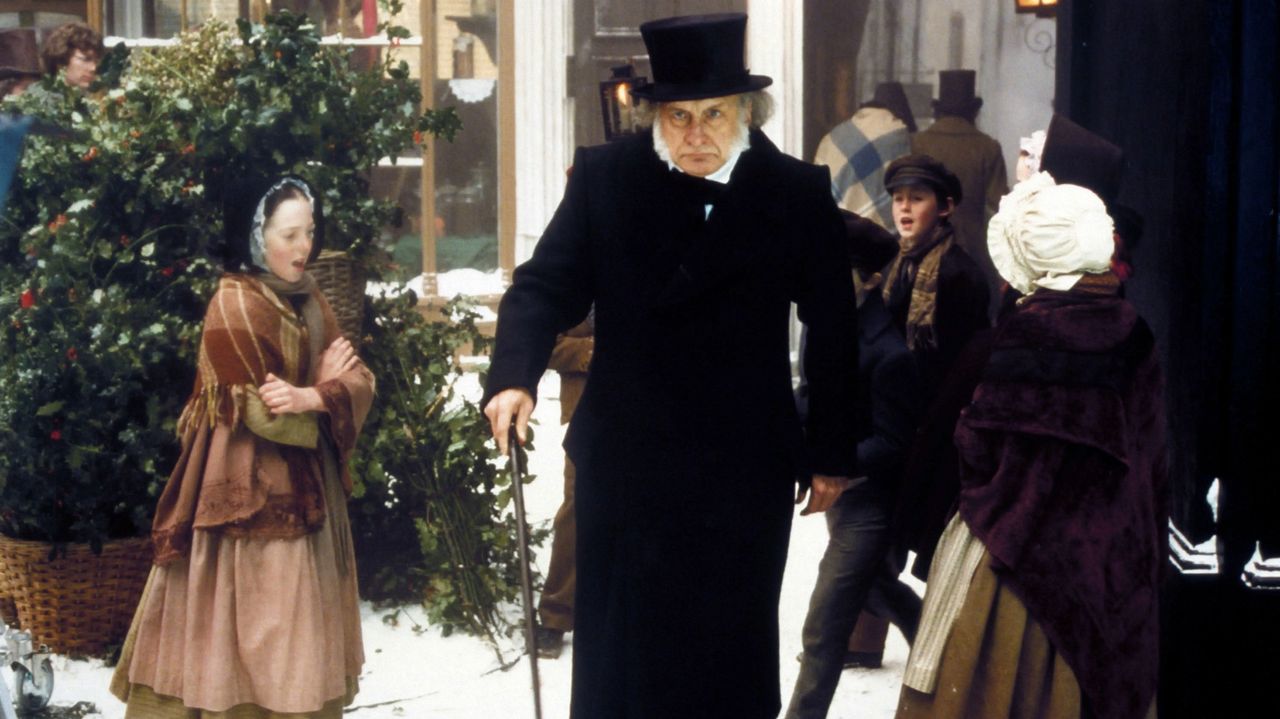
George C. Scott wasn't exactly known for being "cuddly." When you think of the man, you think of General Patton or the fierce intensity of Dr. Strangelove. So, when it was announced he’d be playing Ebenezer Scrooge in the Christmas Carol 1984 movie, some people were skeptical. They shouldn't have been. What resulted was arguably the most definitive, grounded, and genuinely chilling adaptation of Charles Dickens' 1843 novella ever put to film.
It wasn't a big-screen blockbuster. This was a "made-for-TV" movie. Usually, that’s a kiss of death for longevity, but this version, directed by Clive Donner, bucked every trend. It felt big. It felt expensive. Most importantly, it felt real.
The Scrooge Who Wasn't Just a Caricature
Most actors play Scrooge like a cartoon villain. They hunch over, they cackle, they make "Bah Humbug" sound like a catchphrase from a Saturday morning special. Scott did something different. He played Scrooge as a shrewd, successful, and deeply miserable businessman. He wasn't a wizard or a monster; he was a guy who simply valued the bottom line over the human soul.
Watching the Christmas Carol 1984 movie today, you notice how Scott uses his voice. It's a gravelly, authoritative rasp. When he tells the charity collectors that the poor should head to the prisons or workhouses to "decrease the surplus population," he doesn't say it with a sneer. He says it with the cold, detached logic of an accountant. That’s way scarier.
Honestly, the chemistry—if you can call it that—between Scott and the rest of the cast is what anchors the film. David Warner plays Bob Cratchit with a quiet, desperate dignity that makes your heart ache. He isn't just a pathetic servant; he's a father trying to keep his family’s head above water in a brutal Victorian London.
Filming in Shrewsbury: The Look of 1840s London
A huge reason this version works is the setting. They didn't build a cheap set on a backlot in Burbank. They filmed on location in Shrewsbury, England. The cobblestones are real. The freezing mist coming off the river is real. You can almost smell the coal smoke and the damp wool.
Director Clive Donner had actually been an editor on the 1951 version starring Alastair Sim. He knew the source material inside out. By choosing Shrewsbury, he captured a medieval-meets-industrial aesthetic that feels lived-in. When Scrooge walks home through the dark streets, you feel the isolation. It’s oppressive. The cinematography by Tony Imi uses a lot of natural light, or at least light that looks natural, which gives the whole thing a painterly, slightly grim atmosphere.
Those Ghosts Are Actually Terrifying
Let’s talk about the spirits. Most versions make the Ghost of Christmas Past look like a glowing fairy or a gentle old man. In the Christmas Carol 1984 movie, Angela Pleasence plays the spirit with an eerie, detached intensity. She’s unsettling. She doesn't feel sorry for Scrooge; she’s just showing him the cold, hard facts of his own loneliness.
Then there’s Edward Woodward as the Ghost of Christmas Present. He’s massive. He’s jovial, sure, but there’s a lurking anger beneath his "Ho Ho Ho." When he reveals the two children, Ignorance and Want, hidden beneath his robes, it’s a genuine horror movie moment. They look like feral animals. It’s a direct slap in the face to the audience, reminding them that Christmas isn't just about turkeys and singing; it's about the systemic failures of society.
Finally, the Ghost of Christmas Yet to Come. No face. No voice. Just a pointing, iron-gloved hand and a metallic, screeching sound that rings in your ears. It’s minimalist and perfect.
Why the 1984 Script is Superior
Roger O. Hirson wrote the teleplay, and he stayed remarkably close to Dickens' original dialogue while trimming the fat. He understood that the story is a "Ghost Story of Christmas," not just a moral fable.
There's a specific scene where Scrooge visits his nephew Fred’s house during the "Present" sequence. In many versions, this is just a bit of fluff. Here, we see Scrooge watching the party, and for a fleeting moment, Scott lets the mask slip. You see the regret. You see the man he could have been if he hadn't let greed swallow him whole. It’s subtle acting that you just don't get in the musical versions or the CGI spectacles.
Factual Nuances: Production and Reception
- The Premiere: It first aired on CBS on December 17, 1984, in the United States and was released theatrically in the UK.
- The Composer: The haunting, beautiful score was composed by Nick Bicât. It manages to be festive and mournful at the exact same time.
- The Cast: Aside from Scott and Warner, you have Susannah York as Mrs. Cratchit and a young Anthony Walters as Tiny Tim. Even the smaller roles, like Frank Finlay as Jacob Marley, are played with a "theatrical" weight that elevates the material.
- The Emmy: George C. Scott was nominated for an Emmy for Outstanding Lead Actor in a Limited Series or Special. He didn't win, but the performance became the gold standard anyway.
Common Misconceptions About the 1984 Version
People often confuse this with the 1951 Alastair Sim version or the 1938 Reginald Owen one. While the 1951 film is a masterpiece of German Expressionist-style filmmaking, the Christmas Carol 1984 movie is more historically grounded.
Some critics at the time thought Scott was too "American" for the role. They were wrong. Scrooge is a universal archetype of the industrial age. Scott’s Mid-Atlantic accent actually works in his favor, making him feel like a self-made man who has distanced himself from his roots. He isn't an aristocrat; he’s a shark.
Another thing: people remember it being "dark." It is. But that darkness makes the final redemption actually mean something. When Scrooge wakes up on Christmas morning and starts laughing—that famous, wheezing, rusty laugh—it feels earned. He hasn't just had a bad dream; he’s had a spiritual breakdown and a reconstruction.
The Lasting Legacy of the "Squire" of Scrooge
It's 2026, and we are still talking about a television movie from over forty years ago. Think about that. Most TV movies vanish into the ether within six months. This one persists because it respects the audience. It doesn't talk down to kids, and it doesn't bore adults.
It also captures the specific "Victorian Gothic" vibe that Dickens intended. It’s a story about death, poverty, and the terrifying possibility that it might be too late to change. When Scott screams, "I am not the man I was!" at his own gravestone, you believe his desperation.
How to Best Experience This Classic Today
If you're planning a rewatch, don't just have it on in the background while you're scrolling through your phone. The Christmas Carol 1984 movie demands attention because so much of the story is told through Scott's facial expressions and the atmospheric lighting.
- Find the Restored Version: Look for the 4K or high-definition scans. The old DVD releases were often grainy and didn't do justice to Tony Imi’s dark, moody cinematography.
- Watch the Background: Pay attention to the extras in the Shrewsbury scenes. The production design is incredibly detailed, showing the vast gap between the wealthy merchants and the "surplus population."
- Compare the Jacob Marley Scene: Watch how this version handles the arrival of Marley compared to others. The use of the door knocker and the ringing bells is timed perfectly to build dread, rather than just jumping to a special effect.
- Listen to the Silence: This film isn't afraid of quiet moments. Some of the most powerful beats are just Scrooge sitting alone in his cavernous, cold house.
The Christmas Carol 1984 movie remains the benchmark for how to adapt a classic. It proves that you don't need million-dollar CGI or a singing Muppet (though we love those too) to tell a profound story about the human condition. You just need a great script, a perfect location, and an actor who isn't afraid to be genuinely unlikable for the first hour of the film.
Next time you're cycling through holiday movies, skip the fluff. Go for the one where Scrooge actually looks like he’s lived a hard, bitter life. You’ll find that the "Merry Christmas" at the end feels a whole lot warmer when you've felt the chill of the 1984 London winter.
Practical Next Steps for Fans
- Visit the Filming Locations: If you’re ever in the UK, go to Shrewsbury. You can still see "Scrooge's grave" (the prop stone left behind) at St. Chad's Church.
- Read the Original Preface: Compare the movie’s tone to Dickens’ own words in his 1843 preface, where he hopes his "Ghostly little book" shall not "put my readers out of humour with themselves, with each other, with the season, or with me."
- Check the Credits: Look for the name of the executive producer, Robert Halmi Sr. He was a legend in the world of TV movies and was responsible for some of the most literate adaptations of the 80s and 90s.