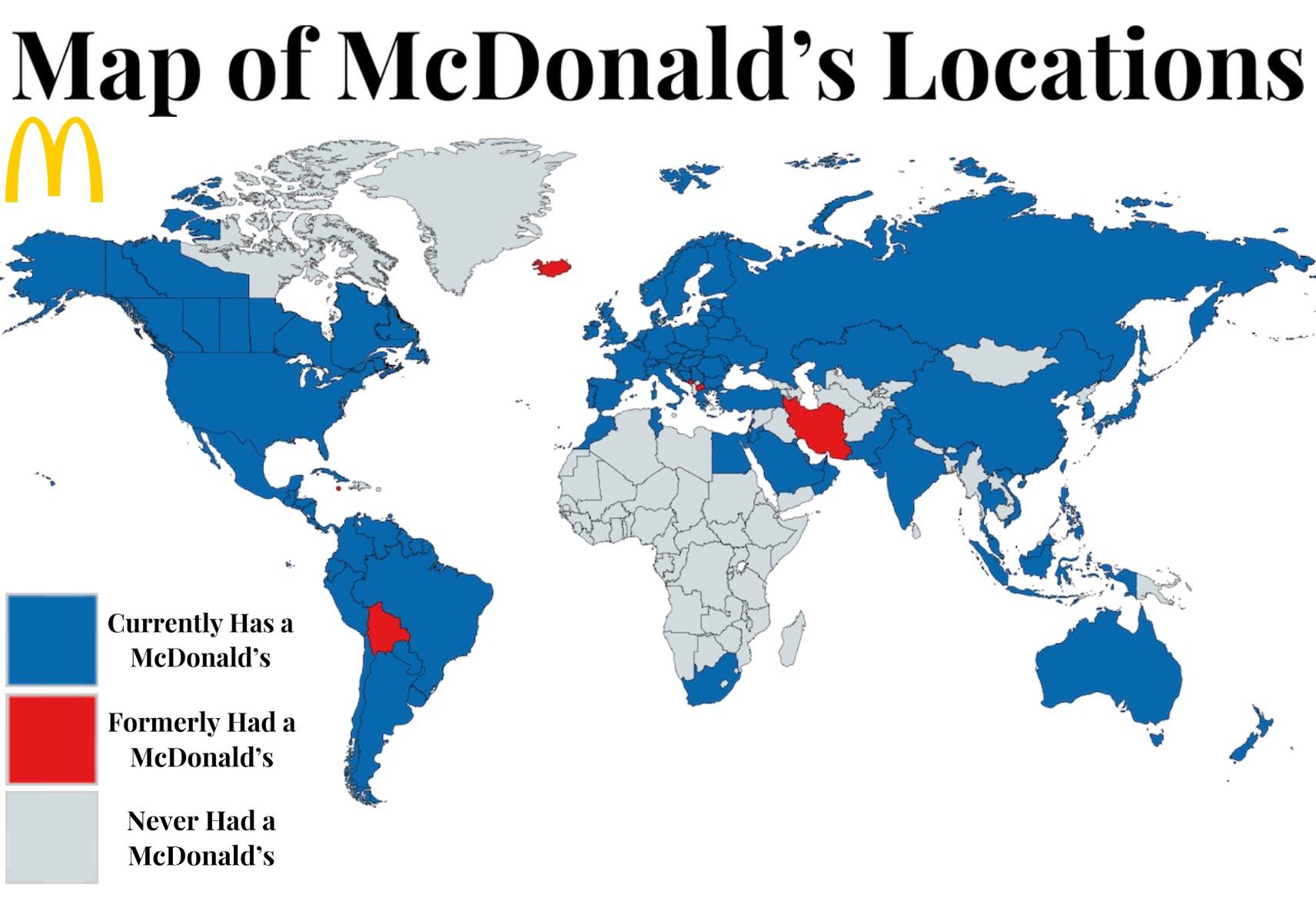
You’re driving through the middle of the Nevada desert. It's late. You're tired. Suddenly, those glowing yellow arches appear like a neon oasis against the black sky. It feels like they're everywhere, doesn't it? Honestly, looking at a map of all McDonald's in the world, you’d think the entire planet has been seasoned with salt and beef tallow. But that’s not exactly the case.
There are currently over 44,000 McDonald's locations scattered across more than 100 countries. That sounds like a lot—and it is—but the distribution is weirdly uneven. If you zoom out on a global map, you’ll see massive clusters that look like bright constellations over North America, Europe, and East Asia. Then, you see these giant, dark "McDeserts" covering most of Africa and Central Asia.
Why? It’s not just about who likes burgers. It’s about supply chains, local politics, and whether a country has a stable enough middle class to support a $6 Big Mac.
Where the Arches Are (And Where They Aren’t)
The United States is obviously the king of the mountain here. With over 13,500 locations, we’ve got about a third of the world’s supply. But the real growth isn't happening in Ohio or Florida anymore. It's in China.
Right now, China has roughly 6,800 stores and they are opening new ones at a breakneck pace. They’re aiming for 10,000 by 2028. It's a massive shift in the map of all McDonald's in the world that most people haven't processed yet. Japan holds the third spot with nearly 3,000 locations, followed closely by France and Germany.
The Countries That Said No (or Just Couldn't)
It's actually more interesting to look at the blank spots on the map. You can't get a McFlurry in Iceland. You used to be able to, but the 2009 financial crisis made it too expensive to import the raw ingredients. The currency collapsed, and the arches packed up and left.
Then you have places like Bermuda. They actually have a law—the Foreign Restaurants Act of 1977—that basically bans foreign fast-food chains to protect their local culture and aesthetics. There was one McDonald's on a US Naval air station there once, but when the base closed, the burgers went with it.
Bolivia is another famous "no-go" zone. McDonald's tried. They really did. But after a decade of losing money because locals preferred their own traditional flavors and price points, the company pulled the plug in 2002. It wasn't a political ban; it was just a business failure. People just didn't want it.
The 2026 Expansion: 50,000 Stores is the New Goal
If you think the map is crowded now, just wait. The company has publicly stated they want to hit 50,000 restaurants globally by 2027. To get there, they are opening about 1,000 new stores a year.
In 2026, we're seeing a huge push into what they call "International Developmental Licensed" markets. Basically, these are places where a local partner runs the whole show for a specific country. This is how they're growing so fast in Southeast Asia and parts of the Middle East.
Does the Map Actually Correlate with Wealth?
Economists have used the "Big Mac Index" for years to measure currency value, but the physical map of locations is also a pretty good proxy for infrastructure. To run a McDonald's, you need:
- Reliable electricity (those fryers pull a lot of juice).
- Cold-chain logistics (you can't have lettuce rotting in a truck).
- Predictable supply of specific potato varieties.
This is why much of the African continent remains a blank space on the map. Aside from South Africa (which has over 350 stores), Egypt, and Morocco, the arches are largely absent. It’s not a lack of hunger; it’s a lack of the massive industrial backbone required to keep the "consistency" McDonald's is famous for.
Looking at the Data: The McDonald's "Heat Map"
If you were to look at a high-resolution density map, you'd notice some fascinating quirks.
In the US, you are rarely more than 100 miles from a McDonald's. In fact, there's a specific spot in South Dakota—the "McFarthest Point"—that is roughly 107 miles from the nearest Golden Arches. That's the maximum distance you can possibly be from a Chicken McNugget in the lower 48 states.
Contrast that with India. India has over 1.4 billion people but only about 660 McDonald's. The density is incredibly low compared to the population. Plus, the menu is totally different—no beef, obviously. You're looking at Maharaja Macs made of veg or chicken.
The "Blue Banana" and European Saturation
In Europe, the stores follow a pattern called the "Blue Banana," a corridor of urbanization that stretches from North West England through the Benelux countries into Switzerland and Northern Italy. The density here is wild. France, despite its reputation for "haute cuisine," is actually one of the most profitable markets for the company. They've successfully branded it as "McDo," a trendy, almost upscale place to hang out with free Wi-Fi and McCafé macaroons.
Tech is Redrawing the Map in 2026
The way we look at a map of all McDonald's in the world is changing because the stores themselves are changing.
In 2026, the "CosMc's" pilot programs are expanding. These are smaller, beverage-focused outlets designed to compete with Starbucks. They don't need a massive footprint, which means they can fit into urban corners where a traditional McDonald's couldn't.
Also, the "Digital-Only" stores are popping up. These are tiny locations with no dining room—just a kitchen and a pickup window for delivery drivers. On a map, these look like regular points, but they change the "vibe" of the brand in a neighborhood. They are more like data hubs than restaurants.
Real-World Insights for Travelers
If you're using a global map to plan a trip or just curious about where the world is headed, keep these things in mind:
- Regional Exclusives are the Real Draw: Don't go to a McDonald's in Italy for a cheeseburger. Go for the Panzerotti. In the Philippines, get the McSpaghetti. The map is a gateway to localized food history.
- The "McPeace" Theory is Dead: There used to be a theory that no two countries with a McDonald's would ever go to war. History (and recent events in Eastern Europe) has pretty much debunked that, showing that even fries can't stop geopolitical shifts.
- Price Parity is Coming: By late 2026, the company is rolling out new pricing tools to make costs more consistent across franchises. No more $18 Big Mac meals in one town and $10 in the next.
The map of all McDonald's in the world is more than just a list of burger joints. It’s a literal visualization of globalization, logistics, and where the world's money is moving. While some countries are fighting to keep them out, others are building thousands of them as fast as they can.
Actionable Next Steps
If you want to explore this further, you can actually use a few real-world tools to see the data for yourself:
- OpenStreetMap: This is the most accurate "live" map. Since it's community-edited, new McDonald's openings usually show up here within days. Use the "Query Features" tool and search for "amenity=fast_food" and "brand=McDonald's."
- Statista Global Reports: If you're a data nerd, look up their 2025/2026 growth charts. It shows the specific "CAGR" (Compound Annual Growth Rate) for different regions.
- The McDonald's Global Corporate Site: They have a "Where We Operate" section that lists every territory. It’s the only way to confirm if a "new" country has officially joined the list.
The arches aren't going anywhere. If anything, they're just getting started in the "dark" spots of the map.