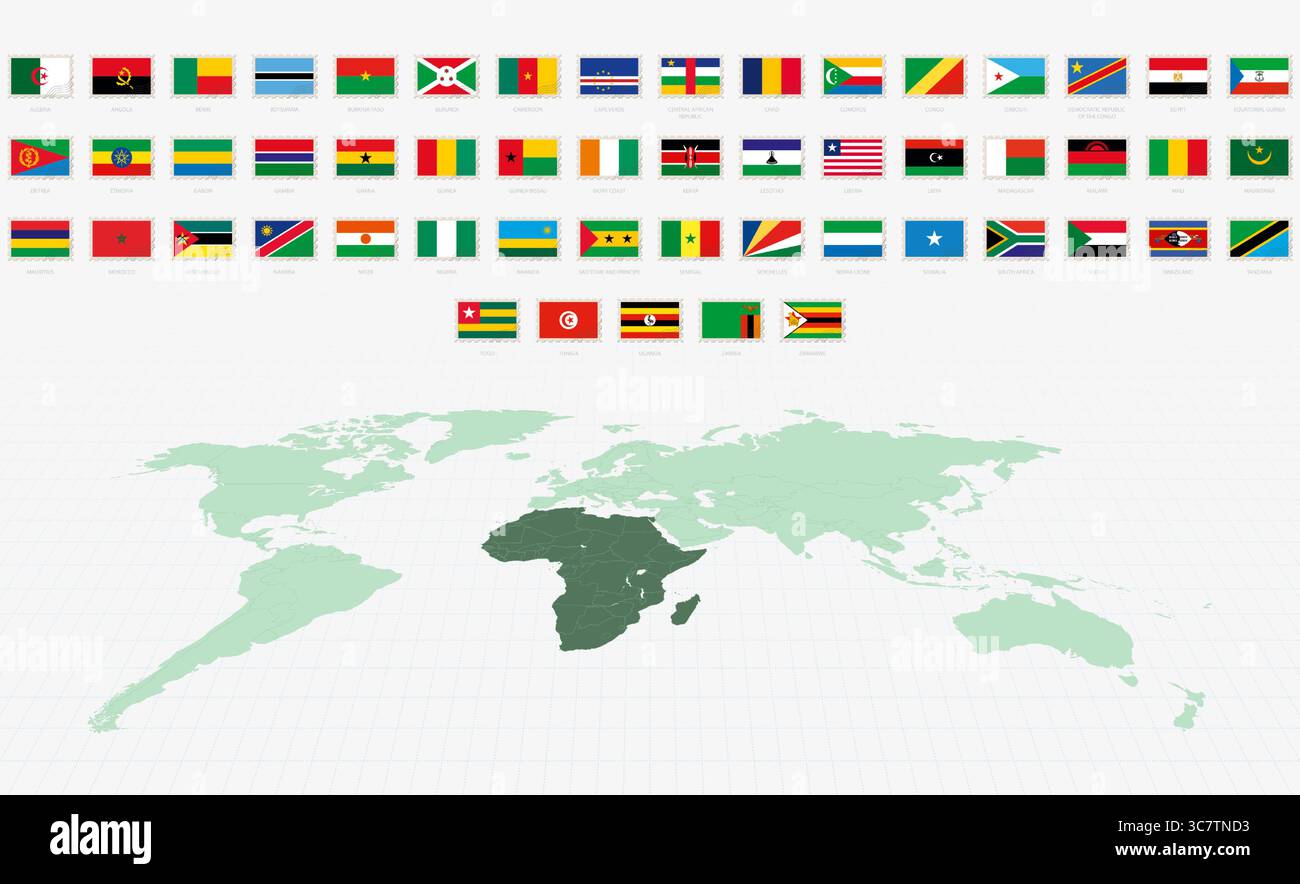
Look at a map of African flags for more than five seconds and you’ll start seeing patterns. It’s not just a random assortment of colors. There’s a logic to it, though it’s messy and deeply tied to the 1960s. You see a lot of green, yellow, and red. A lot. This isn't because African designers lacked imagination; it’s because those colors carry a weight that most Western flags—usually stuck on the red, white, and blue theme—don't quite touch.
Most people look at these maps to memorize names for a trivia night. But if you actually want to understand what you're looking at, you have to look at Ethiopia.
The Ethiopia Connection and the Pan-African Palette
Why does a map of African flags look so uniform in some regions? It mostly comes down to Ethiopia’s resistance against Italian colonization. Because Ethiopia remained independent (mostly), other African nations looked at their green, yellow, and red banner as a beacon. When Ghana became the first sub-Saharan colony to shake off British rule in 1957, they took those colors. Then everyone else did too.
It’s called the Pan-African colors.
Green usually stands for the lush land. Yellow represents the mineral wealth—think gold and diamonds. Red is the blood spilled for liberation. It’s a literal color-coded history of the 20th century. But then you have the outliers.
Look at Botswana. Their flag is light blue and black. No red. No green. No "struggle" colors. They wanted to represent water—pula—because in a desert nation, rain is more precious than gold. It’s a refreshing break on the map, honestly.
Deciphering the Symbols You See Everywhere
If you scan a map of African flags, you'll notice stars are basically the default setting. But they don't all mean the same thing. In the flag of Ghana, that black star isn't just a decoration; it’s the "Black Star of African Liberty." It was influenced by Marcus Garvey’s Black Star Line.
Then you have the crescents.
Northern Africa—nations like Algeria, Libya, Tunisia, and Mauritania—uses the crescent and star. This is a direct nod to Islamic heritage. If you see a crescent on a flag map, you’re almost certainly looking at the Maghreb or the Sahel regions. It’s a geographic marker disguised as a religious symbol.
The Strange Case of Mozambique’s Weaponry
Most flags feature symbols of peace, like olive branches or suns. Mozambique went a different route. Their flag features a modern assault rifle—an AK-47.
It’s polarizing.
Some people think it’s too violent for a national symbol. The government’s stance? It represents defense and vigilance. It’s a stark reminder that for many of these countries, the "map" wasn't drawn with a pen, but carved out through decades of bush wars and guerrilla movements. You won't find a Kalashnikov on a European flag map. It makes Mozambique one of the most instantly recognizable spots on any map of African flags.
The French Influence You Might Have Missed
Ever notice how many African flags are vertical stripes? Think Guinea, Mali, or Ivory Coast. That’s the "tribar" or "tricolor" layout. It’s a direct architectural lift from the French Tricolore.
Even though these countries were fighting against French colonial rule, they adopted the French style of flag design to signal that they were now "modern" republic states. It’s a weird bit of historical irony. They used the master’s tools to build their own house, visually speaking.
Nigeria, however, went with vertical stripes but skipped the third color. Just green, white, green. It’s simple. It’s clean. It was designed by a student named Michael Taiwo Akinkunmi in 1959. He originally put a sun in the middle, but the judges took it out. Sometimes, less is more when you're trying to stand out on a crowded map.
Southern Africa: Breaking the Rules
When you get to the bottom of the map of African flags, the rules change. South Africa and South Sudan have some of the most complex designs on the planet.
The South African flag, adopted in 1994, was supposed to be a temporary fix. It has six colors. Six! Most vexillologists (flag nerds) say you should never use more than three. But South Africa’s "Rainbow Nation" identity required a convergence. The "Y" shape signifies different paths meeting as one. It shouldn't work, aesthetically, but it’s widely considered one of the best flags in the world because it defies the standard Pan-African or European colonial templates.
Why Some Flags Look Nearly Identical
It’s a nightmare for students. Chad and Romania? Virtually the same flag. Ivory Coast and Ireland? Just flipped.
On a map of African flags, the similarity between Mali and Senegal can be a headache. Senegal just has a little green star in the middle. These similarities exist because many of these nations were part of short-lived federations. Mali and Senegal were briefly the "Mali Federation." When they split, they kept the "divorce" colors but added a star to say "I'm single now."
How to Use This Knowledge
If you're looking at a map of African flags for educational purposes or just personal interest, stop trying to memorize them by rote. Group them.
- The Revolutionaries: Red, gold, and green (Ethiopian influence).
- The Islamic North: Crescents and stars.
- The "Modern" Republics: Vertical stripes (French influence).
- The Rebels: Unique colors like Botswana’s blue or South Africa’s six-color palette.
When you see the flags this way, the map stops being a jumble of colors and starts being a story of how a continent reclaimed its identity.
Practical Steps for Identifying Flags on the Fly
- Check the Layout: Is it horizontal or vertical? Vertical usually means former French territory.
- Look for the "Big Three": If it’s green, yellow, and red, it’s likely in West or Central Africa.
- Find the Blue: Blue is rare in African flags. If you see it, you’re likely looking at a coastal or island nation like Somalia, Mauritius, or Cape Verde, or a country where water is the primary national concern like Botswana.
- Isolate the Symbols: A machete and a gear? That’s Angola’s nod to the Soviet-era influence on their revolution. A crane? Uganda. A shield and spears? Kenya.
Understanding the map of African flags is basically a shortcut to understanding African geopolitics. You don't need a PhD; you just need to look at the colors and ask why they're there. Most of the time, the answer involves a revolution, a religion, or a very specific type of weather.
To get better at this, try using a blank "silent" map and see if you can place the symbols before the colors. The symbols—the spears of Kenya or the star of Zimbabwe—are often more tied to the specific culture than the colors themselves, which were often chosen for solidarity rather than individuality.
Start by identifying the five most unique flags: South Africa, Kenya, Mozambique, Botswana, and Seychelles. Once you have those "anchors" on your map, the rest of the Pan-African green-red-yellow block becomes much easier to sort out by process of elimination.