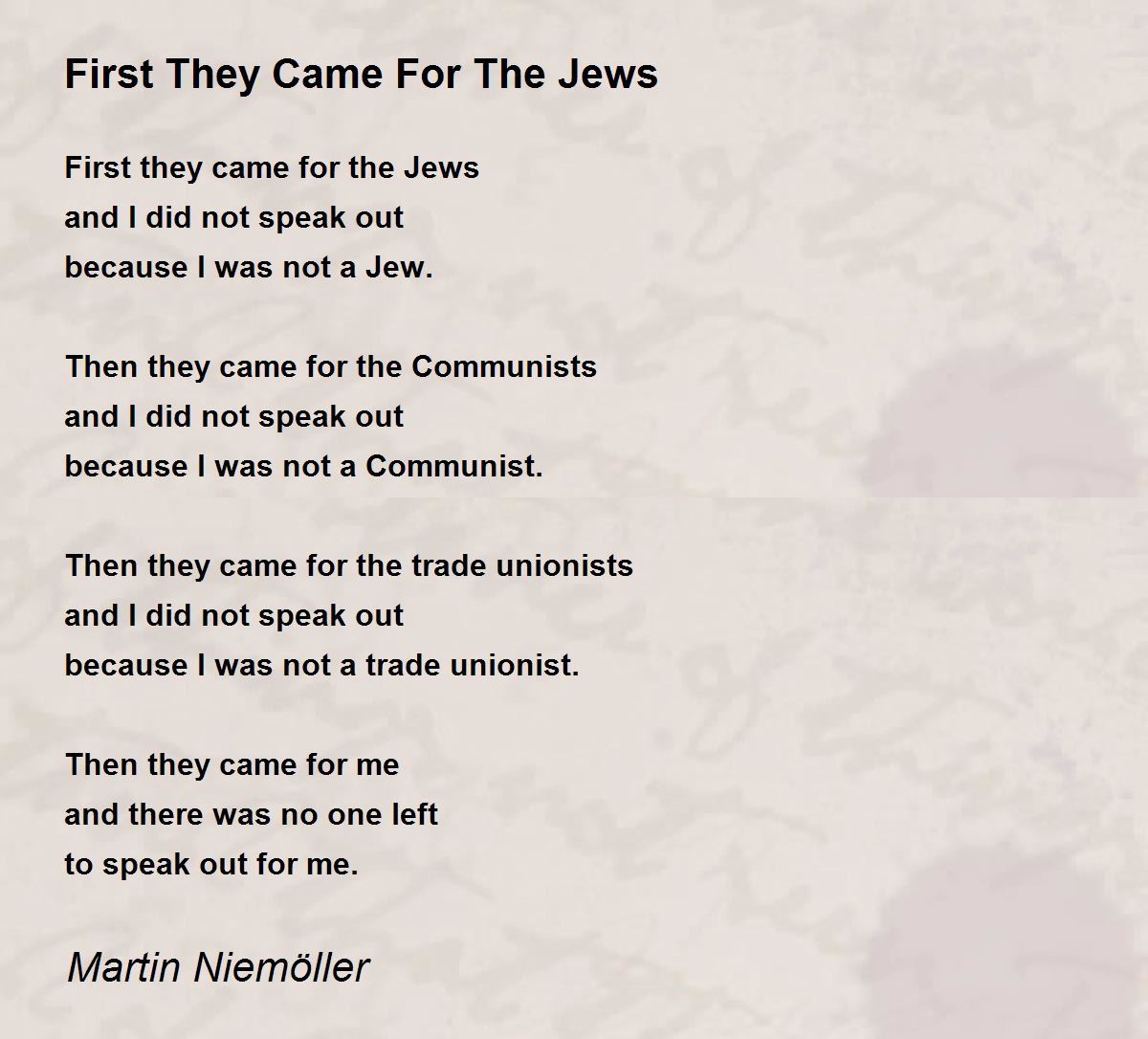
You’ve seen it on posters. It’s on murals in D.C. and etched into the walls of the Holocaust Museum. Someone probably posted a version of it on your Facebook feed during the last election cycle. Most people call it the First They Came poem, and while its rhythm feels like a piece of classic literature, it wasn't actually written as a poem at all. It was a confession.
It’s one of those rare pieces of writing that has become more famous than the man who spoke it. People use it to defend almost every political cause under the sun, from gun rights to healthcare to privacy laws. But here’s the thing: most of the versions you see online are edited, sanitized, or just plain wrong.
Martin Niemöller, the man behind the words, wasn't some lifelong human rights activist. He was a complicated, flawed, and—for a long time—deeply problematic German pastor who actually supported Hitler for years before he finally saw the light from inside a concentration camp cell. That’s the version of the story we usually skip. We like the "poem" because it makes us feel like we’d be the heroes, but Niemöller wrote it because he was the one who stayed silent.
The Messy Origins of First They Came
The year was 1946. Germany was a literal ruin. Niemöller was speaking to a group of people in the Confessing Church in Frankfurt, trying to explain how a "civilized" nation could descend into such absolute madness. He didn't sit down with a quill and parchment to write a viral poem for the ages. He was giving an impromptu speech about guilt.
Honestly, he didn't even use the exact same list of victims every time he spoke. Sometimes he’d mention the "incurables"—people with disabilities whom the Nazis murdered in the T-4 program. Other times he’d focus on the occupied countries. But the core sentiment remained: the systematic removal of "the other" only works if the majority thinks they aren't next.
Who was Martin Niemöller?
He wasn't a liberal. Not even close.
Niemöller was a U-boat commander in World War I. He was a nationalist. He was a "man of his time" in all the worst ways, meaning he held antisemitic views that were common in the German conservative circles of the 1920s. When Hitler rose to power, Niemöller initially welcomed it. He thought Hitler would restore German pride.
It wasn't until the Nazis started interfering with the church—specifically trying to ban converted Jews from the pulpit—that he started to push back. He ended up spending seven years in Sachsenhausen and Dachau. He survived, but he emerged a changed man, haunted by the realization that he only started caring when the fire reached his own doorstep.
What the Poem Actually Says (And What’s Missing)
If you look at the version at Yad Vashem or the United States Holocaust Memorial Museum, it usually starts with the Communists. In the Cold War era, especially in the U.S., that first line was often chopped off or changed to "Socialists" because people were scared of sounding like "Reds."
But Niemöller was specific. The Communists were the first target of the Nazi regime. They were sent to Dachau as early as 1933.
First they came for the Communists
And I did not speak out
Because I was not a CommunistThen they came for the Socialists
And I did not speak out
Because I was not a SocialistThen they came for the trade unionists
And I did not speak out
Because I was not a trade unionistThen they came for the Jews
And I did not speak out
Because I was not a JewThen they came for me
And there was no one left
To speak out for me
There is a huge debate among historians about whether he originally included "the Jews" in the very first oral versions of this speech. Some researchers, like Harold Marcuse, have spent years tracking down the evolution of the text. It seems Niemöller added the Jews to the list as he processed his own complicity. He realized that ignoring the "politicals" paved the way for the racial genocide.
Why the Internet Loves to Rewrite History
Go to a protest today and you’ll see a sign that says, "First they came for the immigrants." Or "First they came for the unvaccinated." Or "First they came for the journalists."
It’s a linguistic template. A "mad-lib" for political grievance.
Is this a bad thing? Kinda. It's a double-edged sword. On one hand, the First They Came poem works because it identifies a universal truth about human psychology: we are incredibly good at ignoring the suffering of people we don't identify with. We prioritize our own tribe. We tell ourselves that as long as we follow the rules, the leopard won't eat our face.
On the other hand, when we swap out "Communists" for "Gun Owners" or whatever the grievance of the day is, we risk trivializing the actual Holocaust. There’s a massive difference between a policy debate and a state-sponsored campaign of industrial murder. When we use Niemöller’s words for every minor political inconvenience, the words lose their weight. They become a cliché.
The Psychology of the Silent Bystander
Social psychologists call this the Bystander Effect, but Niemöller was talking about something more sinister. This wasn't just people standing around a puddle watching someone drown. This was a "salami tactic" of authoritarianism.
The Nazis didn't round up everyone at once. They sliced the population thin.
They started with the people that the "respectable" middle class already disliked. The radicals. The union agitators. The people who were "causing trouble." By the time they got to the people who considered themselves "good Germans," the infrastructure of the police state was already so strong that resistance was suicide.
Niemöller’s point was that silence isn't neutral. Silence is a choice. It’s an active endorsement of the status quo.
The Controversy You Haven't Heard About
Niemöller remained a controversial figure until his death in 1984. He became a pacifist and a nuclear disarmament advocate, but he never quite escaped his past. Some people never forgave his early support of the Nazi party. Others found his post-war "guilt" speeches to be a bit too little, too late.
But maybe that’s why the poem is so effective. It doesn't come from a saint. It comes from a guy who messed up.
If a saint tells you to be brave, you might think, "Well, sure, you're a saint." If a guy who spent years in a concentration camp because he waited too long to speak up tells you to be brave, it hits different. It’s a warning from a victim who was also, in part, an architect of his own cage.
Common Misconceptions to Clear Up
- It’s not a poem. It’s a series of prose statements. We just format it like a poem because it has a repetitive structure that makes it easy to memorize.
- The order matters. The progression from political enemies to social groups to the individual is the whole point of the narrative.
- Catholics weren't always in there. While many versions include "Then they came for the Catholics," Niemöller (a Protestant) didn't always include them. The version used by the USHMM is generally considered the most "historically grounded" version for educational purposes.
How to Actually Apply This Without Being "That Person"
Look, using the First They Came poem in a Twitter argument is usually a shortcut to nowhere. It’s the ultimate "Godwin’s Law" move. But if you actually want to take something away from Niemöller’s confession, it’s not about finding the perfect analogy for today’s news.
It’s about checking your own "not my problem" meter.
When you see a group being marginalized—even if you think their politics are annoying, or you don't like their lifestyle, or they seem "too radical"—that is the moment Niemöller is talking about. The test of the poem isn't how you feel when people come for your friends. It's how you react when they come for the people you don't like.
Actionable Insights for the Modern Reader
If you want to move beyond just quoting the poem and actually live out the lesson, here are a few ways to stay engaged:
- Read the full history. Don't just stick to the five-line quote. Look into the "Stuttgart Declaration of Guilt" from 1945. It provides the heavy context for why the German church felt it had failed so spectacularly.
- Identify the "Firsts." In any era, there is always a group that is the "easiest" to target because they have the least social capital. Pay attention to who is being talked about as "lesser" or "disposable" in current discourse.
- Support Local Journalism. Authoritarianism thrives in the dark. The "silence" Niemöller spoke of is often a result of people simply not knowing what's happening. Support the people whose job it is to make sure you know.
- Practice Micro-Courage. You don't start by standing up to a dictator. You start by speaking up in a meeting when someone is being talked over, or by correcting a factual lie in a casual conversation. Bravery is a muscle.
The First They Came poem isn't a piece of art to be admired. It’s a post-mortem on a collapsed society. Use it as a mirror, not a weapon. If you find yourself using it to prove why your political enemies are like Nazis, you might be missing the point entirely. Niemöller’s message was simpler and much more convicting: the person who should have spoken up was you.