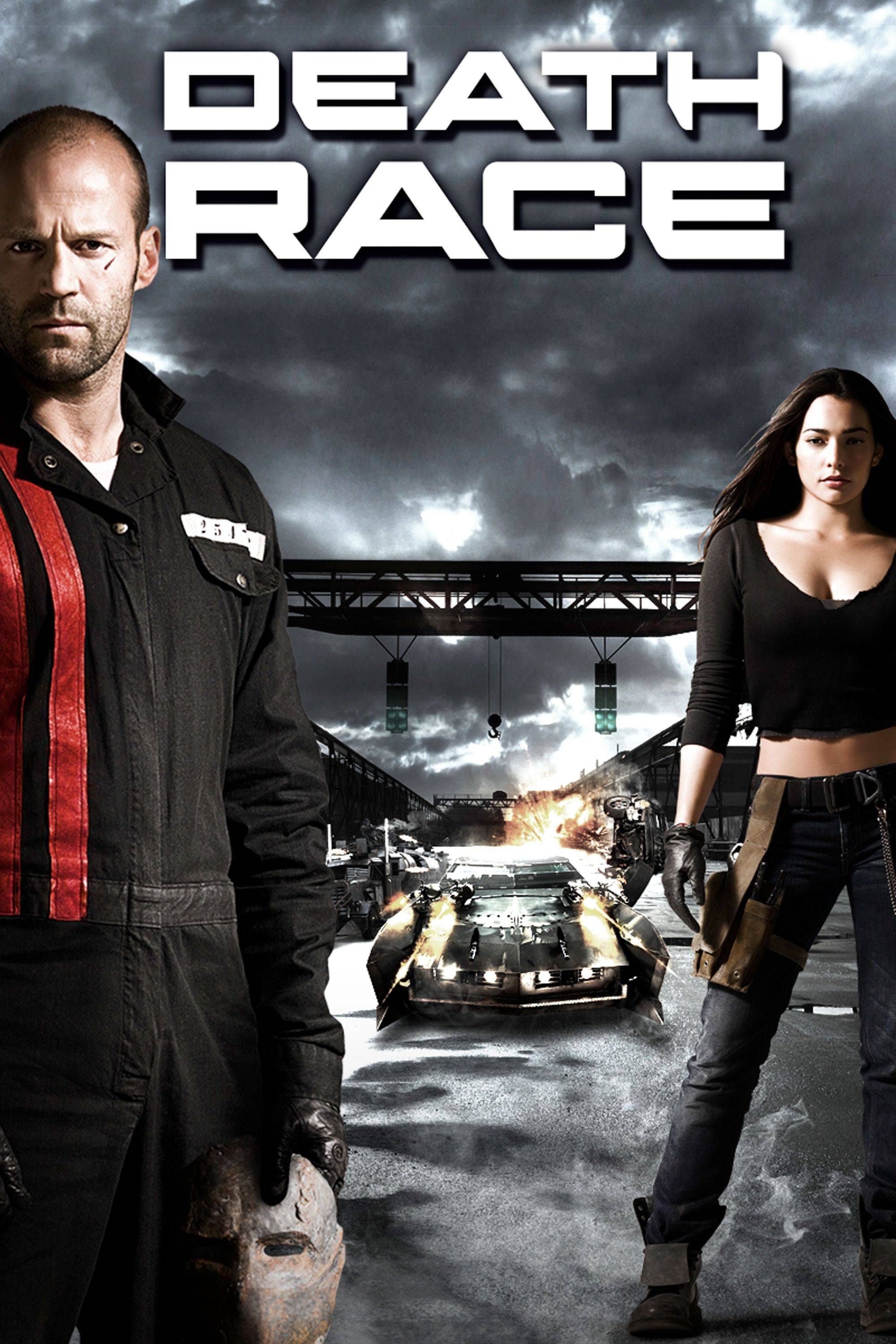
Roger Corman didn't care about your feelings or your budget. In 1975, he put out a movie that basically told the entire American political system to shove it, and he did it using spray-painted kit cars and a guy in a leather gimp mask named Frankenstein. If you're looking for the Death Race original movie, you’re looking for Death Race 2000. Forget the 2008 Jason Statham flick for a second. That was a gritty prison drama. The 1975 original? It’s a neon-soaked, blood-splattered satire that manages to be more relevant today than it was during the Ford administration.
It’s weird. It’s loud.
The movie cost about $300,000 to make. To put that in perspective, that’s less than the catering budget on a modern Marvel film. Yet, it grossed over $5 million at the box office because people in the 70s were hungry for something that felt dangerous. Paul Bartel directed it, but Corman’s DNA is all over the celluloid. He knew exactly what he was doing: selling violence to the masses while mocking the masses for wanting to see it.
The Transcontinental Road Race and the Point System
Most people assume the Death Race original movie is just about driving fast. It isn't. It’s about the "Transcontinental Road Race," a state-sponsored sport in a dystopian United States (now called the United Provinces) used to keep a pacified, jobless population from revolting. Think The Hunger Games, but with much cooler cars and way more spandex.
The rules are simple. You drive from New York to New Los Angeles. But you don't win just by being fast. You win by hitting people.
The point system is where the movie gets its legendary "mean streak." It’s not just random. The movie explicitly lays out the scoring:
- Women are worth 10 points more than men in every age bracket.
- Teenagers fetch 40 points.
- The elderly? They’re the jackpot at 100 points.
There’s a famous scene—honestly, one of the darkest bits of comedy in cinema history—where a hospital staff lines up patients in wheelchairs on the road for a "Euthanasia Day" surprise for the drivers. It’s grotesque. It’s also a biting commentary on how society views the "unproductive" members of the population. David Carradine plays Frankenstein, the reigning champ who is supposedly more machine than man after dozens of crashes. Opposite him is a very young, very intense Sylvester Stallone as "Machine Gun" Joe Viterbo. Stallone is hilarious here. He spends half his screen time screaming at his navigator and the other half trying to look tougher than Carradine.
Why the Satire Actually Works
If this were just a movie about running people over, we wouldn't be talking about it fifty years later. The Death Race original movie works because it targets the media. In the film, the race is covered by a breathless, sycophantic TV crew that treats every civilian death like a touchdown. They interview the families of the victims, who act honored that their loved ones were killed for the national pastime.
It feels uncomfortably close to modern reality TV or the way social media algorithms prioritize conflict.
Stallone vs. Carradine: A Study in B-Movie Ego
By 1975, David Carradine was already a star thanks to Kung Fu. He brought a weird, Zen-like stillness to Frankenstein. He barely moves his face. He doesn't have to. The suit does the work. But the real story behind the scenes was Stallone. This was just a year before Rocky changed his life forever.
Stallone wasn't happy on set. He allegedly hated the car he had to drive—a custom rig built on a Volkswagen chassis that kept breaking down. He and Carradine didn't exactly hang out. Stallone wanted to play Joe Viterbo as a serious, menacing threat, while the director wanted a cartoon. The result is a performance that feels like a coiled spring. You can see the hunger in his eyes; he knew he was destined for better things than a Corman exploitation flick, but he gave it 100% anyway.
The cars themselves were barely functional. They were essentially fiberglass shells glued onto VW Beetles or Karmann Ghias. If they went over 40 miles per hour, they felt like they were going to disintegrate. Yet, on screen, through the magic of clever editing and high-speed cameras, they look like futuristic killing machines.
The Political Subtext You Might Have Missed
The "United Provinces" is ruled by Mr. President, a cult-of-personality figure who speaks to his "dear children" via video screens. He blames the country's problems on the French (who he claims destroyed the economy) and a group of "resistance" rebels led by a descendant of Thomas Paine.
The rebels aren't just there for plot padding. They want to stop the race because they realize it’s an "opiate for the masses." They try to sabotage the cars and kidnap Frankenstein. The twist? Frankenstein actually hates the President too. He’s been winning the race just so he can get close enough to the President to blow him up with a "hand grenade" hidden in his prosthetic hand.
It’s surprisingly sophisticated for a movie that features a car with a giant plastic bull head on the front.
Production Chaos and Roger Corman’s Thrift
Corman was famous for never wasting a dime. If a car crashed, they didn't just fix it; they filmed it from three angles and used it in three different movies. The production of the Death Race original movie was no different. They filmed mostly in California, using winding mountain roads to stand in for the entire cross-country trek.
The violence was a major point of contention. The original cut was even bloodier, but they had to trim some of the more "visceral" impacts to avoid an X rating. Even so, the MPAA wasn't thrilled. What saved it was the humor. Because the movie is so obviously over-the-top—with its bright colors and campy dialogue—the censors viewed it more as a "live-action cartoon" than a snuff film.
Bartel, the director, actually pushed for more comedy, while Corman wanted more action. This friction created a weird, hybrid tone. One minute you're watching a legitimate car chase, and the next, a navigator is accidentally killing their driver with a navigation tool. It’s tonal whiplash at its finest.
How It Compares to the Paul W.S. Anderson Remake
When people search for the Death Race original movie, they often stumble upon the 2008 version. Look, the 2008 movie is a fine action flick. It’s got great stunts and Statham is always reliable. But it lacks the soul of 1975.
The remake turned it into a prison break story. It stripped away the transcontinental element and, more importantly, it stripped away the satire. In the remake, the "race" is just a way for a corrupt warden to make money. In the original, the race is a fundamental part of the American identity. The original is a critique of the audience; the remake is just entertainment for the audience.
Also, the cars in the remake look like tanks. They’re heavy, armored, and gray. The cars in the 1975 original look like toys from a fever dream. Frankenstein’s "Monster" car is green with scales and teeth. Joe’s car is a "Matilda the Hun" themed nightmare with a massive knife on the front. There’s a creativity in the low-budget original that big-budget CGI just can't replicate.
Real-World Influence and Legacy
Death Race 2000 is the godfather of the vehicular combat genre. Without it, you don't get Twisted Metal. You don't get Carmageddon (the video game that literally stole the point system). You probably don't even get the more eccentric parts of Mad Max: Fury Road.
It’s a cult classic for a reason. It captures a specific moment in the mid-70s when the hippie movement had died, the government was embroiled in scandal, and people were feeling cynical about the future. It took that cynicism and turned it into a high-speed circus.
Practical Next Steps for the Curious Viewer
If you’re actually going to watch the Death Race original movie, don’t go in expecting Fast & Furious. Here is how to actually enjoy it:
- Find the Shout! Factory Blu-ray: The restoration is incredible. The colors pop in a way that the old VHS tapes never could. You can actually see the detail in the ridiculous costumes.
- Watch for the cameos: John Landis (who went on to direct The Blues Brothers and Animal House) has a small role as a mechanic.
- Pay attention to the radio chatter: The world-building isn't in the visuals; it’s in the background noise. The "news reports" during the race provide all the context you need about the collapsing society outside the cockpit.
- Don't skip the sequels... cautiously: There is a "true" sequel called Death Race 2050 (2017) produced by Corman himself. It returns to the campy, satirical roots of the original and is surprisingly decent if you like the B-movie vibe.
The movie ends with Frankenstein literally running over the President and then driving off into the sunset with his girl. It’s not subtle. It’s not "prestige cinema." But it is one of the most honest movies ever made about the relationship between violence and entertainment. If you want to understand where modern action cinema came from, you have to look at the blood on Frankenstein’s bumper.
Honestly, just go watch it. Even if you hate it, you’ve never seen anything quite like it. It’s a relic of a time when movies were allowed to be ugly, cheap, and smart all at the same time. In an era of polished, focus-grouped blockbusters, the jagged edges of Death Race 2000 feel refreshing.
Go find a copy. Watch the "Euthanasia Day" scene. Realize that we haven't changed nearly as much as we think we have since 1975. That's the real horror of the movie—and its greatest triumph.
Actionable Insight: To truly appreciate the film's impact, compare it to the 1975 film Rollerball. Both came out the same year and dealt with deadly future sports, but while Rollerball is somber and serious, Death Race 2000 uses humor as a weapon. Watching them back-to-back gives you a perfect snapshot of mid-70s dystopian anxiety. Check your local library's Kanopy stream or physical media section, as these cult titles frequently cycle through specialized horror/sci-fi platforms like Shudder.