H.G. Wells was basically a prophet. In 1897, while people were still getting around in horse-drawn carriages and reading by candlelight, he sat down and wrote a story about heat rays and chemical warfare that still feels weirdly relevant today. Most people think they know the original War of the Worlds, but they usually just picture Tom Cruise running away from a giant tripod or maybe those spindly machines from the 1953 movie.
The book is different. It’s gritty. It’s dark. It's actually a pretty brutal critique of British imperialism, which is something a lot of folks miss when they’re just looking for cool aliens.
Honestly, the real power of the story isn't just the Martians. It's the sheer helplessness. Imagine being a regular person in the late 19th century. You’ve got no cell phone. No internet. No way to know if the next town over even exists anymore. All you see is a "falling star" in the night sky, and a few days later, your entire civilization is being systematically disassembled by creatures you can't even begin to understand.
The Martians weren't just monsters; they were a mirror
When Wells wrote the original War of the Worlds, he was making a very specific point. He wanted to show his British readers what it felt like to be on the receiving end of a colonial invasion. At the time, the British Empire was the big dog on the porch. They had the best tech, the best guns, and they were busy taking over places all over the globe.
Wells flipped the script.
He made the British the "primitive" ones. The Martians arrive with Heat-Rays—which basically sound like modern lasers—and "Black Smoke," a type of poisonous gas that predated the horrors of World War I by nearly two decades. It’s wild how much he got right about the future of warfare.
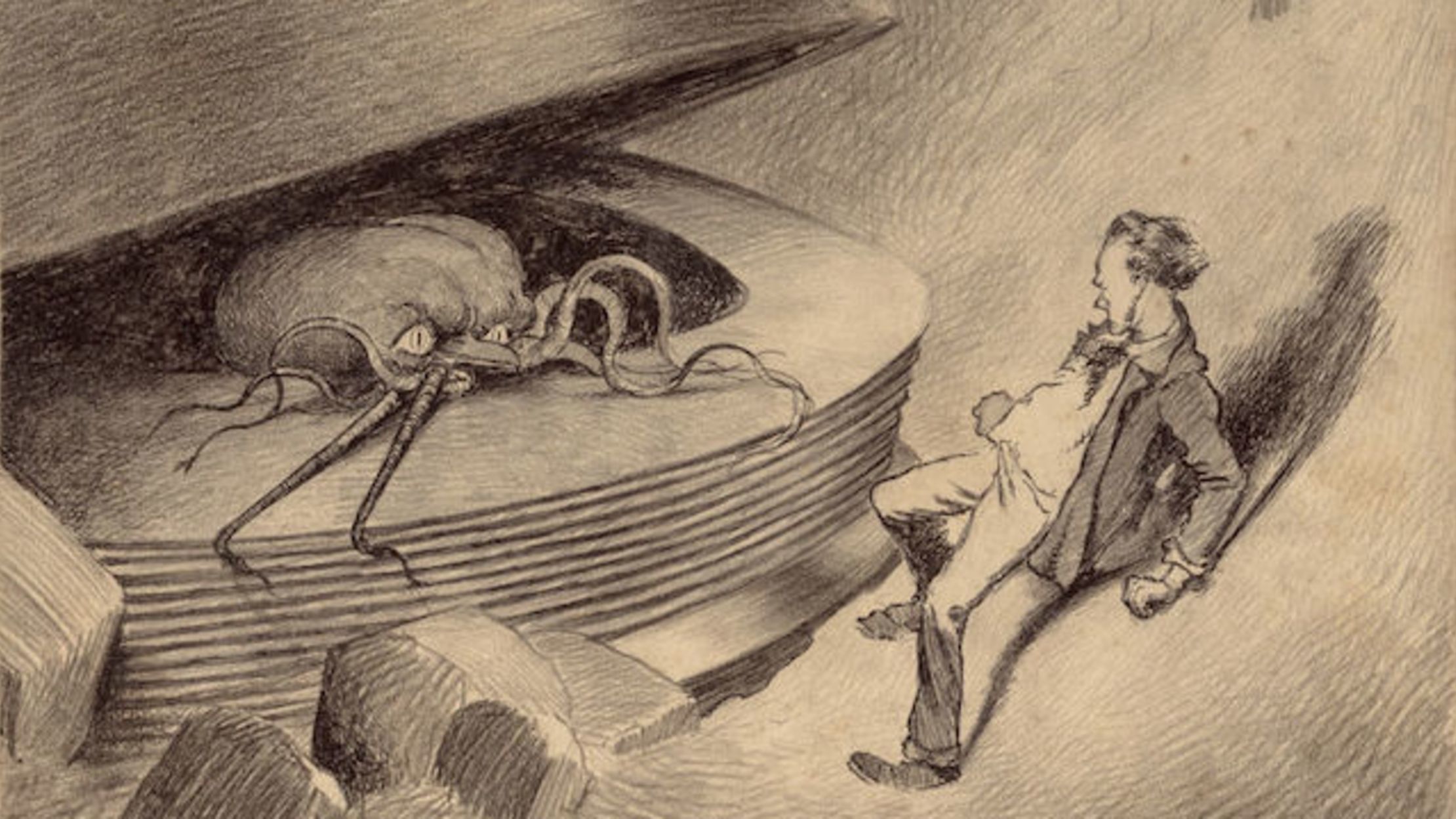
The Martians themselves are described as these oily, leathery heads about four feet across. They don't have bodies in the way we do. They’re just brains with tentacles. They don't sleep. They don't have sex. They literally just "inject" the blood of living creatures into their own veins to survive. It’s gross. It’s alien. It’s way more disturbing than the sleek, robotic designs we see in modern movies.
Science or fiction?
What’s crazy is that Wells tried to ground everything in the science of his day. People actually thought there might be life on Mars back then because of Percival Lowell’s "canals." Lowell was an astronomer who claimed to see straight lines on the Martian surface. He thought they were irrigation ditches built by a dying civilization.
Wells took that idea and ran with it.
He didn't just make them "evil." He made them desperate. Mars was cooling down. Their oceans were evaporating. They had to find a new home, and Earth was the closest habitable rock. It wasn't personal; it was survival. That makes it kind of scarier, doesn't it? They weren't there to talk or negotiate. They were there to clear the land.
That 1938 radio broadcast actually changed history
You can't talk about the original War of the Worlds without mentioning Orson Welles. On Halloween night in 1938, he did a radio play version that sounded like a series of live news bulletins.
"Ladies and gentlemen, I have a grave announcement to make."
That’s how it started.
People who tuned in late missed the disclaimer that it was all fake. They heard "reporters" being incinerated live on air. They heard "eyewitnesses" describing giant metal machines stepping across the Hudson River. People actually panicked. Some fled their homes. Others called the police.
There's a lot of debate now about how much people actually panicked—some historians like W. Joseph Campbell argue that the newspapers exaggerated the chaos to make radio look dangerous—but the fact remains that it proved how vulnerable we are to media manipulation. It was the "fake news" moment of the 1930s.
Why the ending is the ultimate plot twist
The way the original War of the Worlds ends is legendary. Spoilers for a 120-year-old book, I guess? The Martians win. They absolutely crush the human military. The British Navy tries to fight back with the Thunder Child, an ironclad warship, and it manages to take down a couple of tripods, but it’s ultimately a drop in the bucket.
Humans are done for.
And then... they just start dying. Not because of a secret weapon or a heroic sacrifice. They die because of bacteria.
The Martians had spent millions of years refining their biology and eliminating disease on Mars. They were "sterile." When they got to Earth, they had zero immunity to the trillions of microscopic germs that live in our air and water. The "humblest things" on Earth saved us. It’s a brilliant bit of irony. We were saved by the very things we spend our lives trying to kill with soap and antibiotics.
The legacy of the tripods
Think about how many things wouldn't exist without this story. Independence Day? That’s just a flashy remake of the original War of the Worlds. Signs? Same thing. Every "alien invasion" story where the invaders are technologically superior but have a weirdly simple weakness owes everything to H.G. Wells.
Even the design of the tripods has stayed iconic. There’s something inherently terrifying about a three-legged machine. It’s unnatural. It doesn't move like a human or an animal. It’s a mechanical nightmare.
How to actually experience the original today
If you want to get into the original War of the Worlds, don't just watch the movies. Start with the source material. It's surprisingly short and fast-paced.
- Read the book: It’s in the public domain, so you can find it for free online. Pay attention to the narrator’s psychological breakdown—it’s way more intense than the action scenes.
- Listen to the Jeff Wayne Musical Version: I know, "musical" sounds weird, but this 1978 prog-rock album is a masterpiece. It uses Richard Burton’s voice for the narration and it’s genuinely spooky. The "Eve of the War" track is a total banger.
- Check out the 1938 script: You can find the original script for the Orson Welles broadcast. Read it and imagine hearing it through a static-filled radio in a dark living room. It’s easy to see why people lost their minds.
The story works because it taps into a primal fear: the fear of being replaced. Not by someone "evil," but by someone better, faster, and more efficient. It reminds us that for all our skyscrapers and satellites, we’re still just biological organisms living on a very small, very vulnerable planet.
If you're looking for a weekend project, find a map of London from the late 1890s and track the narrator's path. Wells used real locations—Woking, Weybridge, Sheen—and seeing the actual geography of the destruction makes the whole thing feel uncomfortably real. It’s a great way to see how the story isn't just a fantasy; it’s a localized catastrophe that felt like the end of the world to the people living through it.
After you finish the book, look up some of the original illustrations by Warwick Goble from the 1898 Pearson’s Magazine run. They’re haunting. They capture that Victorian "steampunk" vibe before steampunk was even a word. It gives you a much better sense of the atmosphere Wells was going for than any modern movie ever could.