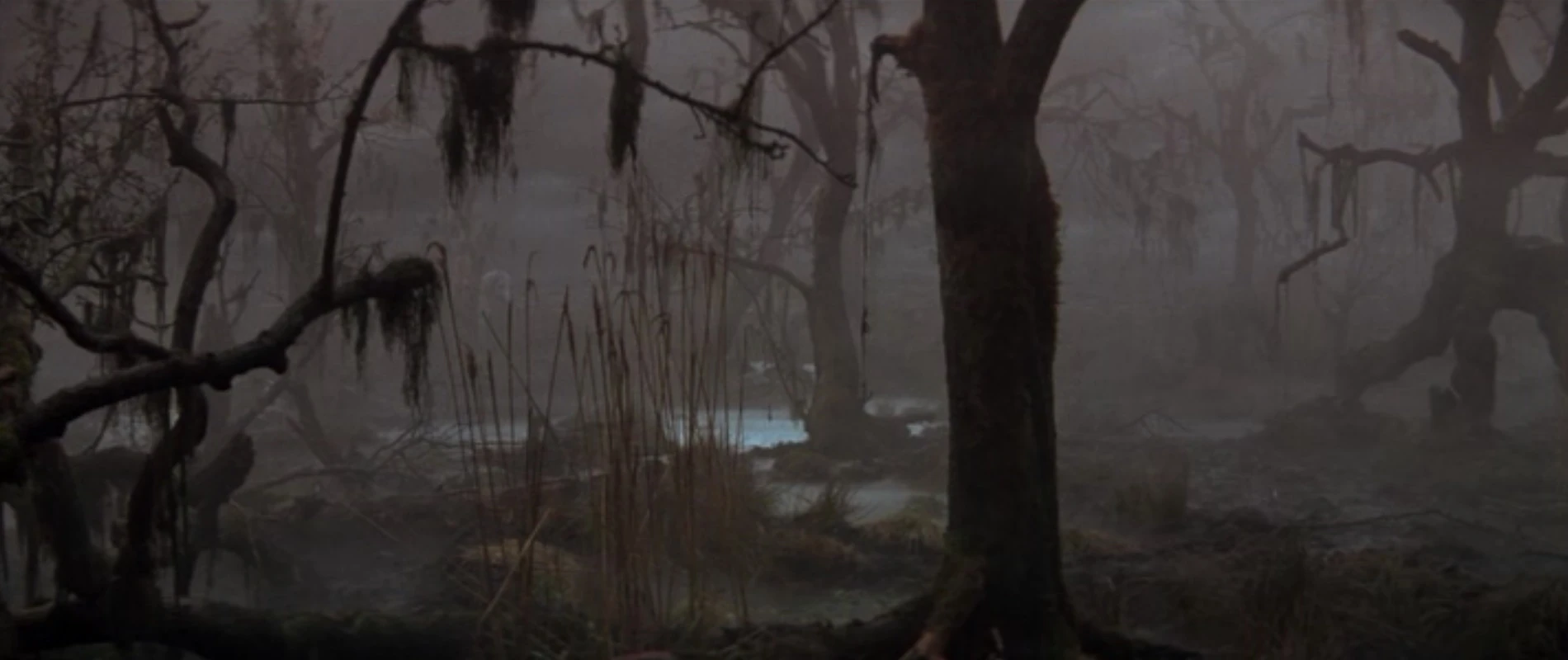
If you grew up in the eighties, you probably have a specific brand of emotional scarring. It isn’t from falling off a bike or getting a bad grade. No, it’s usually tied to a very specific, very muddy scene involving a horse named Artax. The Neverending Story swamp of sadness isn't just a movie set; it’s a cultural touchstone for collective childhood trauma. It’s that moment where the hero’s horse—his best friend, really—just gives up and sinks into the muck.
It’s brutal.
But why? Why does a puppet horse sinking into a German film studio's peat moss mixture still make grown adults tear up thirty years later? It’s not just about the animal. It’s about the concept of despair. The Swamp of Sadness is a psychological landscape where if the sadness overtakes you, you sink. You die. Literally. It’s a heavy metaphor for a "kids' movie," and honestly, it’s something modern cinema rarely dares to touch with such raw, unfiltered gloom.
What Actually Happens in the Neverending Story Swamp of Sadness
Atreyu is on a quest. He’s the warrior-boy sent to save Fantasia from "The Nothing," which is basically a giant storm of non-existence. To get the answers he needs, he has to cross the Swamps of Sadness to find Morla the Ancient One. This isn't your average wetland. The rules of this place are simple but terrifying: the swamp feeds on gloom. If you let the sadness get to you, you become heavy.
Atreyu is a warrior. He’s got that "main character" plot armor that keeps his chin up. Artax? Not so much. As they trek through the gray, fog-choked mire, the horse starts to slow down. The music shifts from adventure to this low, mourning dirge composed by Giorgio Moroder and Klaus Doldinger.
You see the moment it happens. Artax stops. Atreyu pulls the reins. He screams. He begs. He tells the horse he loves him. But the horse has already succumbed to the "heavy" feeling. In the world of Michael Ende’s original 1979 novel, this scene is even more descriptive and arguably more painful, as the horse actually speaks to Atreyu, telling him to leave because the weight of the sadness is too much to bear. In the 1984 film directed by Wolfgang Petersen, the silence of the horse is what makes it feel so lonely.
The Urban Legend of the Real Horse
We have to address the elephant in the room—or the horse in the mud. For years, a persistent urban legend suggested that the real horse playing Artax actually died during the filming of the Neverending Story swamp of sadness scene. People claimed the hydraulic platform failed and the animal drowned in the mud while the cameras rolled.
Let’s set the record straight: that is 100% false.
Noah Hathaway, the actor who played Atreyu, has debunked this in multiple interviews over the decades. The horse, whose real name was Nasha, was perfectly fine. It took weeks of training to get the horse to stay still while the platform lowered it into the water/mud mixture. Nasha was actually treated like royalty on set. After filming wrapped, the production team actually gifted the horse to Hathaway, though because of the logistics of moving a horse from Germany to the US, the horse stayed on a farm in Germany for the rest of its very long, very pampered life.
The fact that this rumor persisted for decades shows just how convincing the filmmaking was. We felt like we were watching something die because the emotional stakes were so high.
The Psychology of the Sink
Why does this scene work? Why does it rank alongside the death of Mufasa or Bambi’s mother?
It’s the lack of a villain.
Usually, in a movie, if something bad happens, there is someone to fight. You can shoot a monster. You can outrun a bad guy. But you can’t fight sadness. The Neverending Story swamp of sadness represents a battle with the self. It’s an internal struggle made external. For a child watching that, it’s the first time they realize that sometimes, you can lose a battle even if you’re "good."
Atreyu doesn't lose Artax because he’s weak or because he made a mistake. Artax loses because he loses hope. That’s a sophisticated, dark lesson for a PG movie. It’s the personification of depression. The more you let it in, the deeper you sink, and eventually, the mud closes over your head.
The Role of Morla the Ancient One
Right after the tragedy, Atreyu meets Morla. Morla is a giant turtle who lives in the "Hornberg" and is basically allergic to youth and enthusiasm. Morla is the logical conclusion of the swamp. She’s lived there so long that she doesn’t care about anything. She has "the blues" on a geological scale.
- She sneezes at Atreyu.
- She talks to herself in the plural ("We haven't spoken to anyone in thousands of years").
- She represents total apathy.
If the swamp is the act of falling into depression, Morla is what you become if you stay there too long: cynical, indifferent, and completely isolated. She tells Atreyu that it doesn't matter if the Nothing takes Fantasia because "it doesn't matter anyway." It’s the ultimate "whatever."
Behind the Scenes: Creating the Muck
Filming the Neverending Story swamp of sadness was a logistical nightmare at Bavaria Studios in Munich. They didn't just dig a hole and fill it with water. They had to create a visual palette that looked dead.
The set designers used a lot of real vegetation that was treated to look decayed. They used tons of peat and specialized coloring agents to get that specific, sickly gray-brown hue of the water. Because the movie was filmed in a studio, they had total control over the fog. The fog in that scene isn't just for atmosphere; it’s meant to feel claustrophobic. It makes the world feel like it’s only ten feet wide, which mirrors Atreyu’s narrowing options.
Noah Hathaway actually got hurt during some of the swamp filming. He was stepped on by a horse and caught in some of the machinery at different points of the production. He’s mentioned in various conventions that the "misery" you see on his face wasn't just acting—he was exhausted, cold, and genuinely over being in the mud.
How the Novel Differs (And It's Darker)
If you think the movie is sad, you should probably skip the book. Or rather, you should read it, but bring tissues. Michael Ende’s book describes the Neverending Story swamp of sadness with a level of poetic gloom that film can't quite capture.
In the book, Artax talks.
When the horse starts to sink, he explains to Atreyu that the sadness is like a weight pulling on his legs. He tells Atreyu to keep going. He actually encourages his friend to leave him behind so that the quest can continue. There’s a dialogue about the nature of the swamp that makes the horse’s "giving up" feel more like a conscious choice to succumb to the weight of the world.
The movie makes it look like a physical struggle. The book makes it an intellectual and spiritual surrender.
The Cultural Legacy: Why We Can't Let Go
We live in an era of "core memories." For many, the Neverending Story swamp of sadness is the foundation of their emotional resilience. It was the first time a generation of kids was told: "Hey, sometimes things suck, and you can't fix it."
It’s interesting to see how this scene has been parodied and referenced in modern media.
- Family Guy has joked about it.
- The Simpsons has referenced the bleakness of the film.
- Countless memes use Artax in the mud to describe how a Monday morning feels.
But despite the jokes, the original scene holds up. The practical effects—the real horse, the real mud, the hand-built Morla puppet—have an organic weight that CGI just can't replicate. When you see the water rippling around Artax’s nose as he takes his last breath, your brain knows it’s looking at something physical. That physical reality makes the emotional reality hit ten times harder.
Handling the "Swamp" in Real Life
While the movie is a fantasy, the metaphor is incredibly real. If you’re feeling like you’re in your own version of the Neverending Story swamp of sadness, there are actually some "Atreyu-style" tactics to keep in mind.
First, recognition is everything. Atreyu knew he was in the swamp, which is why he was able to fight the "heavy" feeling. He had the Auryn—the magical medallion—to guide him. In the real world, the Auryn is your support system.
Honestly, the lesson of the swamp isn't that you shouldn't be sad. It's that you shouldn't let the sadness become your entire identity. Artax didn't die because he was "bad"; he died because he stopped believing there was a "dry land" waiting for him.
Actionable Steps for Moving Forward
If you're revisiting this classic or showing it to your kids for the first time, keep these things in mind to actually enjoy the experience rather than just being depressed:
Watch the Restoration: If you can, find the 4K restoration of the film. The detail in the swamp scene is incredible, and you can see the craftsmanship of the Morla puppet much more clearly. It turns the "trauma" into an appreciation for film history.
Read the Michael Ende Novel: Seriously. The movie only covers the first half of the book. The second half explains why the Nothing exists and what happens when you actually get what you wish for. It provides a lot of context that makes the swamp feel like just one small part of a much larger journey.
Separate Fact from Fiction: Remember the horse didn't die. It’s a common "trauma bond" for Gen X and Millennials, but knowing Nasha lived a long life in the German countryside makes the scene much easier to stomach on a rewatch.
Talk About the Themes: If you’re a parent, don't skip the scene. Use it to talk about feelings. It’s one of the best metaphors ever filmed for explaining how depression or "the blues" can feel heavy and hard to escape.
The Neverending Story swamp of sadness remains one of the most potent sequences in cinema because it’s honest. It doesn't sugarcoat the journey. It tells us that the road to saving the world—or ourselves—is often muddy, lonely, and heartbreaking. But it also shows us that even when we lose our "Artax," we have to keep moving toward the Ivory Tower.
Fantasia depends on it.