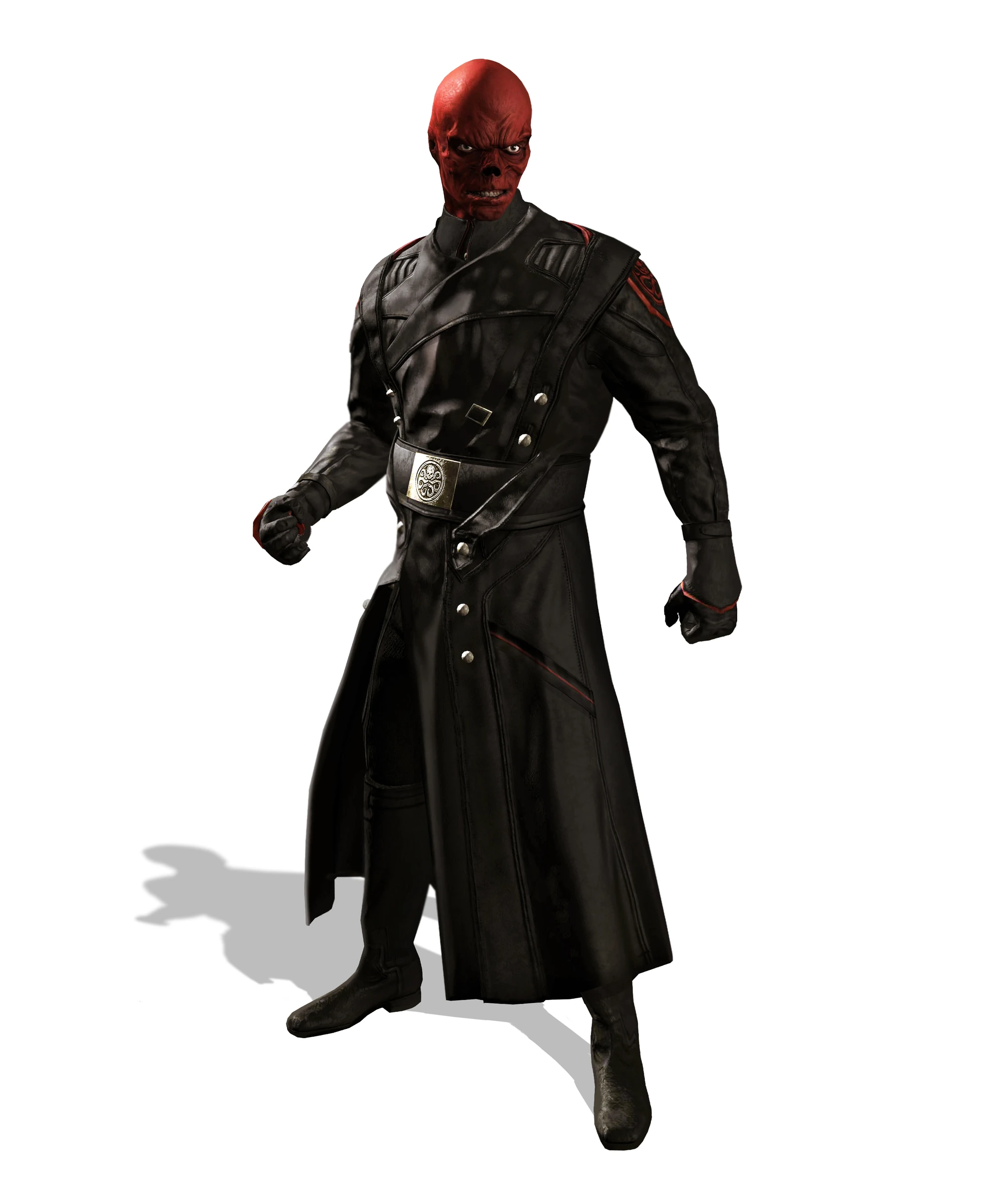
Johann Schmidt isn't just a guy in a green jumpsuit with a scary face. When people think about the Marvel Universe Red Skull, they usually just see him as the foil to Steve Rogers, a relic of World War II who refused to die. But if you actually dig into the decades of continuity, Schmidt is arguably the most successful villain in the entire Marvel mythos. Think about it. He didn't just want to win a war; he wanted to dismantle the very idea of heroism.
He’s terrifying.
Most villains have a "why." Magneto wants to protect mutants. Thanos wants "balance." The Red Skull? He just wants total, absolute subjugation. He is the personification of hatred in a way that feels uncomfortably grounded, even when he’s swapping bodies with clones or chasing cosmic cubes.
The Weird, Dark Origin of Johann Schmidt
Back in 1941, Joe Simon and Jack Kirby created a monster. But the version we see in the MCU—played brilliantly by Hugo Weaving—is a bit tidier than the comics. In the source material, Schmidt was a bellhop. Seriously. He was a disgruntled, hateful young man working at a hotel when he had a chance encounter with Adolf Hitler. The dictator supposedly saw a "pure" hatred in the boy and decided to train him to be the ultimate weapon of the Reich.
It’s a chilling concept. It suggests that evil isn't always born from great power; sometimes, it’s just a miserable person given a platform.
He wasn't always wearing a mask, either. Initially, the "Red Skull" was literally a mask Hitler gave him to strike fear into the Allies. Later on, things got weird. Between the experimental gases, the transfers of consciousness, and the literal dust of death, the skull became his actual face. It’s a physical manifestation of his internal rot.
Why He Keeps Coming Back (It’s Not Just Comics Logic)
You’ve probably noticed that the Marvel Universe Red Skull is harder to kill than a cockroach. There’s a specific reason for this that goes beyond "editorial wants more sales." Schmidt is obsessed with legacy. He’s the ultimate opportunist.
Take the 1950s version. For a while, Marvel (then Atlas Comics) had a different Red Skull named Albert Malik. He was a Soviet agent who took up the mantle. This caused all sorts of confusion until writers later clarified that the original Schmidt was in suspended animation, much like Captain America. This "replacement" trope actually serves a narrative purpose: it shows that the Red Skull is an idea as much as a man.
When Schmidt finally returned, he didn't just go back to his old ways. He adapted.
- He used the Cosmic Cube (the Tesseract's comic book daddy) to rewrite reality.
- He swapped bodies with Steve Rogers at one point.
- He even cloned Steve Rogers and put his own mind into the Captain America-clone body.
That last one is particularly messed up. Imagine your worst enemy living inside a perfect copy of your own skin. That’s the level of psychological warfare we’re talking about.
The Modern Era: Brains, Telepathy, and Genosha
If you haven't kept up with the comics in the last decade, you might have missed the Red Skull’s most controversial and effective power-up. After the death of Professor Charles Xavier, Schmidt did the unthinkable. He dug up Xavier’s body, cut out his brain, and grafted pieces of it onto his own.
Yeah. It’s as gross as it sounds.
This gave the Marvel Universe Red Skull high-level telepathy. He wasn't just a strategist anymore; he could literally force people to hate each other. This led to the Uncanny Avengers storyline and the AXIS event. He turned Genosha—once a mutant haven—into a concentration camp. It was a stark, modern reminder that Schmidt’s brand of evil is uniquely equipped to exploit social divisions.
He doesn't need an army if he can make you punch your neighbor.
Breaking Down the MCU vs. Comics Disconnect
Honestly, the MCU version of the Red Skull is a bit of a tragedy—not because of the character, but because we didn't get enough of him. In Captain America: The First Avenger, he’s the head of HYDRA, searching for god-like power. When he touches the Tesseract, he’s vanished.
Then Infinity War happens.
Seeing him as the Stonekeeper on Vormir was a shocker. He became a ghost, a "wraith" cursed to lead others to a prize he can never possess. It’s a poetic punishment, sure, but it’s very different from the comic version who would have probably found a way to trick Thanos into falling off the cliff instead.
In the comics, HYDRA and the Red Skull have a "it's complicated" relationship status. Sometimes he leads it. Sometimes he thinks they're too disorganized. Sometimes he prefers his own cult, the Exiles. The MCU made HYDRA and the Red Skull synonymous, but in the broader Marvel Universe Red Skull history, he is often a lone wolf who uses organizations as disposable tools.
The Captain America Dynamic: A Never-Ending Cycle
You can't talk about Schmidt without Steve Rogers. They are the ultimate binary.
Rogers represents the potential for a person to be better than their circumstances. Schmidt represents the desire to crush everyone else down to your level. It’s why the Red Skull is so obsessed with corrupting Steve. He doesn't just want to kill Cap; he wants to prove Cap is a lie.
There was a moment in the Streets of Poison arc where the Skull actually tried to keep Captain America healthy because he didn't want his rival to die from a drug addiction. He wanted to be the one to end him. That’s a level of petty that most villains—like Dr. Doom or Magneto—rarely stoop to.
Actionable Insights for Fans and Collectors
If you're looking to dive deeper into the lore or start a collection centered around this iconic villain, here’s how to navigate the massive amount of content out there.
Essential Reading for the "Real" Red Skull:
Start with Captain America: No Escape. It’s a classic. If you want the modern, terrifying stuff, look for Rick Remender’s Uncanny Avengers run. It showcases the "Xavier-brain" era and is genuinely unsettling. For a look at his origin, Red Skull: Incarnate is a limited series that explores his rise in pre-war Germany without glamorizing the evil.
Collecting Tips:
Don't just hunt for Captain America #1 (unless you have a million dollars). Look for the 1960s Silver Age appearances in Tales of Suspense. Specifically, issues #79 through #81 feature the first appearance of the Cosmic Cube, which redefined the character's power level.
Spotting the Variations:
Remember that there are technically multiple "Red Skulls" in the Marvel Universe Red Skull canon.
- Johann Schmidt: The OG.
- Albert Malik: The 1950s communist version (who killed Peter Parker's parents—yes, really).
- Sinthea Schmidt (Sin): His daughter, who took over the mantle for a while and is arguably just as cruel.
Why It Matters Today
Red Skull remains a relevant villain because he represents the "final boss" of intolerance. While other villains have shades of grey, Schmidt is the darkness that the heroes have to define themselves against. He's a reminder that some ideologies can't be reasoned with; they have to be stopped.
Understanding the Red Skull isn't about liking him. It’s about understanding the stakes of the Marvel Universe. When he shows up, the petty squabbles between the Avengers usually stop, because they realize that if he wins, there’s nothing left to fight over.
Next Steps for the Deep Dive:
- Check the Back Issues: Look for Captain America #350. It’s a massive turning point where the original Schmidt returns in a new body.
- Analyze the Media: Re-watch the Vormir scenes in Endgame. Note the difference in his voice (Ross Marquand took over for Hugo Weaving) and his detached, soul-crushed demeanor.
- Gaming: If you play Marvel Snap or Marvel Champions, pay attention to his card mechanics. They almost always involve "negative" power or hindering the opponent’s deck—a perfect mechanical representation of his "Dust of Death" philosophy.
The Marvel Universe Red Skull isn't going anywhere. Whether he's a ghost on a distant planet or a telepathic madman in a bunker under Washington D.C., he remains the definitive shadow to the American Dream.