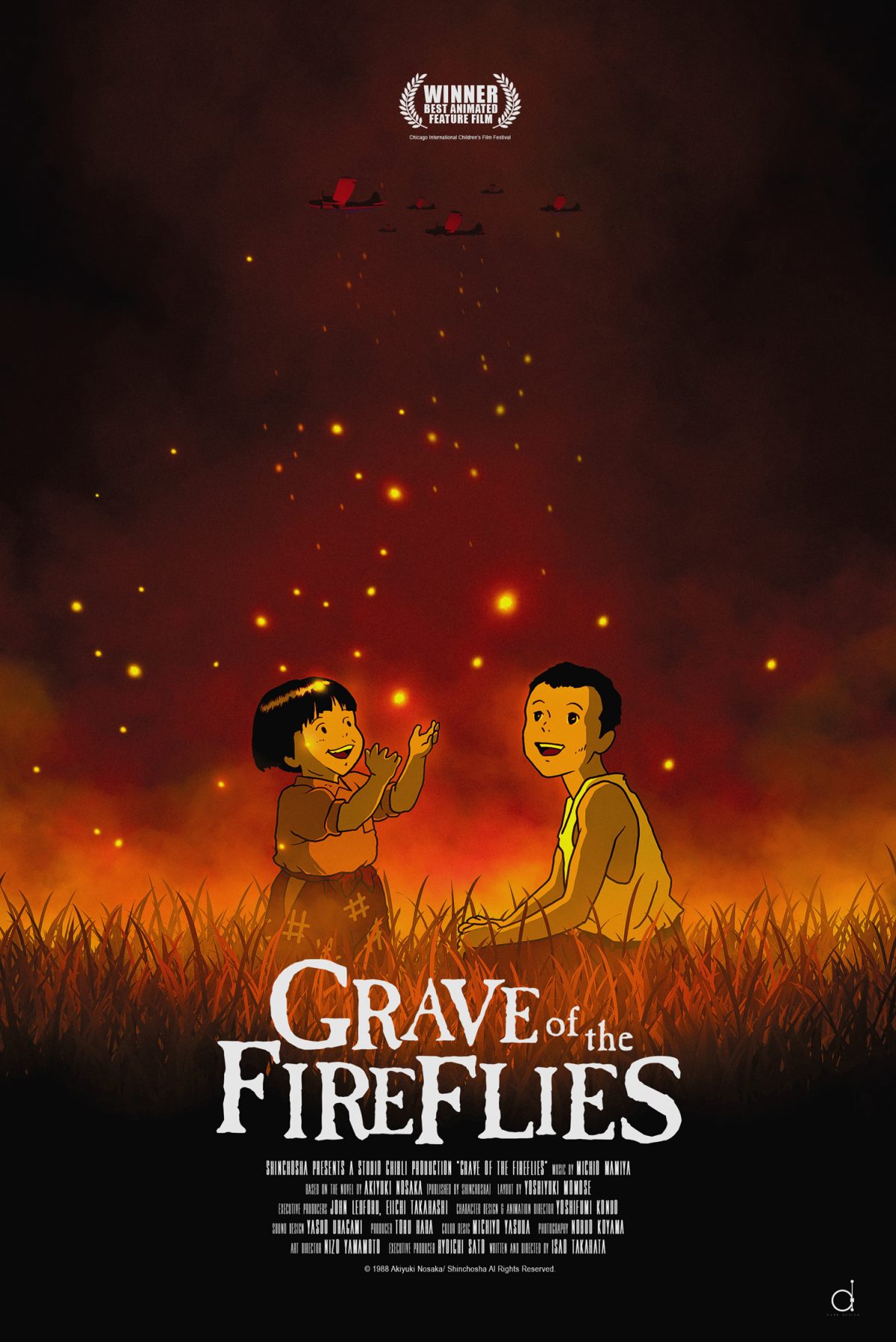
Most people think of Studio Ghibli when they hear the title. They see the crying eyes of Seita and the tragic silhouette of Setsuko and immediately think of Isao Takahata’s 1988 masterpiece. But there’s another version. Honestly, it’s the version that often gets buried under the weight of the animation's legacy. The Grave of the Fireflies live action 2005 film isn't just a frame-by-frame recreation of the anime. It’s a completely different beast, produced by NTV to commemorate the 60th anniversary of the end of World War II. It shifts the perspective in a way that makes it almost harder to watch, if you can believe that.
It hurts.
Watching real actors—especially children—starve on screen brings a level of visceral discomfort that even the most beautiful hand-drawn cells can't quite capture. While the 1988 film is a poetic, heartbreaking descent into a dreamscape turned nightmare, the 2005 live-action movie is grounded in a harsh, unforgiving reality. It focuses heavily on the "Aunt" character, played by Nanako Matsushima, transforming her from a simple antagonist into a complicated woman trying to survive a literal apocalypse.
The Aunt’s Perspective Changes Everything
In the Ghibli version, the aunt is basically the villain. We see her through Seita's eyes. She's cold, she steals their mother’s kimonos for rice, and she begrudges them every spoonful of porridge. But the Grave of the Fireflies live action 2005 chooses a more nuanced path. It asks a terrifying question: What would you do if your own children were starving and two extra mouths showed up at your door?
The film is framed through the eyes of the aunt’s granddaughter in the modern day, looking back at the family's history. This layer of meta-narrative helps bridge the gap for a 21st-century audience. We see the aunt, Hisako, not as a monster, but as a person under extreme pressure. She is a widow. She is watching her society collapse. She is terrified.
When Seita refuses to work or help the war effort—clinging to his pride as the son of a Naval officer—the friction feels more like a tragic misunderstanding than a battle between good and evil. It makes the ending feel even more avoidable. That’s the real tragedy here. If Seita had just swallowed his pride, or if the aunt had just a little more grace, they might have lived. But war doesn't leave room for grace.
Casting and the Weight of Realism
Mao Inoue and Hoshi Ishida carry a lot of the emotional weight, but let’s talk about Mao Sasaki, who played Setsuko. Casting a child for this role is a massive undertaking. In animation, Setsuko is an avatar of innocence. In the live action, she is a sweaty, dirty, crying toddler.
The physical deterioration is handled with a lot of restraint, which actually makes it scarier. You see the ribs. You see the skin getting paler. It’s a quiet horror. The director, Toyoya Sato, didn't lean into the "blood and guts" of war. Instead, he leaned into the silence of it. The way the fireflies look in live action—tiny, flickering points of light against the oppressive darkness of the Japanese countryside—serves as a metaphor for how thin the line is between life and death.
Some fans of the original story find the 2005 version a bit slow. It's over two hours long. It takes its time. But that's the point. Survival isn't a fast-paced thriller. It’s a slow, agonizing grind. It’s waiting for a train that never comes. It’s boiling water for a soup that has nothing in it.
Why This Version Ranks Differently in History
It is important to remember that Akiyuki Nosaka’s original semi-autobiographical novel is the source material for both films. Nosaka wrote it as an apology to his own sister, who died of malnutrition during the war. He felt he was the reason she died.
The Grave of the Fireflies live action 2005 stays very true to that sense of personal guilt. While the Ghibli film feels like a universal anti-war statement, the 2005 film feels like a specific family tragedy. It’s about the breakdown of the Japanese family unit under the pressure of the Imperial cult and the firebombing of Kobe.
You’ve probably seen the "drops" tin. It’s the iconic image of the franchise. In the live action, seeing that rusted tin in a real child's hand brings a different kind of weight. It’s no longer a symbol; it’s a piece of trash that represents a final, desperate hope for sugar in a world that has turned bitter.
Differences You'll Notice Immediately
- The Framing Device: The 2005 version starts in the modern era (2005) with the aunt's granddaughter, whereas the anime starts in the train station with Seita's ghost.
- The Aunt's Motivation: She isn't just "mean." She is a woman who loses her husband to the war and is trying to keep her own children alive.
- Visual Tone: The anime is lush and colorful, even in its sadness. The live action is muted, grey, and brown. It feels dusty.
- Runtime: At roughly 148 minutes, it is significantly longer than the animated version, allowing for more "slice of life" (or slice of death) moments that build the atmosphere.
Dealing with the "Live Action Curse"
We all know the reputation of live-action adaptations of beloved anime. Usually, they're terrible. They lack the soul of the original. But this wasn't an adaptation of the anime; it was an adaptation of the book. That distinction matters.
The film was a television special, so it doesn't have the "Hollywood" sheen of a massive blockbuster. This actually works in its favor. It feels intimate. It feels like a stage play that spilled out into the ruins of a city. If you go into it expecting the fluid, magical realism of Ghibli, you’ll be disappointed. But if you go into it expecting a grim, historical drama about the cost of pride and the failure of community, it hits like a freight train.
The 2005 version also tackles the propaganda of the time more directly. We see the school system, the neighbor's associations, and the crushing social pressure to "die for the Emperor." Seita’s refusal to participate in this isn't just lazy—it's a rebellion. A rebellion that ultimately costs him everything.
How to Watch and What to Look For
Finding the Grave of the Fireflies live action 2005 today can be a bit of a hunt. It isn't on the major streaming platforms like Netflix or Max as often as the Ghibli version. You usually have to look for physical media or specialized Asian cinema distributors.
When you do watch it, pay attention to the sound design. The cicadas. The distant hum of B-29 bombers. The sound of a hollow tin being shaken. These sounds are the heartbeat of the film. They remind you that while the fireflies are beautiful, they are also short-lived.
If you're a student of history or a cinema buff, this version is essential. It provides a counterpoint to the "innocent victim" narrative by showing how complicit or trapped every adult was in the machinery of war. It's a hard watch. You will probably cry. You might even get angry at the characters. But that’s why it’s good.
Practical Steps for Fans
If you want to truly understand the depth of this story beyond just the surface-level sadness, there are a few things you should do:
- Read the original novella by Akiyuki Nosaka. It’s short, brutal, and provides the internal monologue that neither film can fully capture. It’s available in several English translations, often paired with his other work, American Hijiki.
- Compare the "Aunt" scenes back-to-back. Watch the scene where the kimonos are traded in the 1988 version and then in the 2005 version. Note how the dialogue changes your sympathy for her.
- Research the firebombing of Kobe. The events in the film aren't just "war movie tropes." On March 16–17, 1945, over 8,000 people were killed and 650,000 were left homeless. Knowing the scale of the actual history makes Seita’s journey feel even more precarious.
- Look for the 2008 live-action version. Yes, there is another one. Directed by Taro Hyugaji, it offers yet another perspective on the story. Comparing the 2005 TV special with the 2008 theatrical release shows how different directors interpret the theme of "survival."
The legacy of this story isn't just about making people sad. It’s a warning about the fragility of society. The 2005 film reminds us that when the structures of the world fail, we are left with nothing but our own choices—and sometimes, those choices have no right answer. It’s a haunting piece of television that deserves to be remembered alongside its animated cousin.