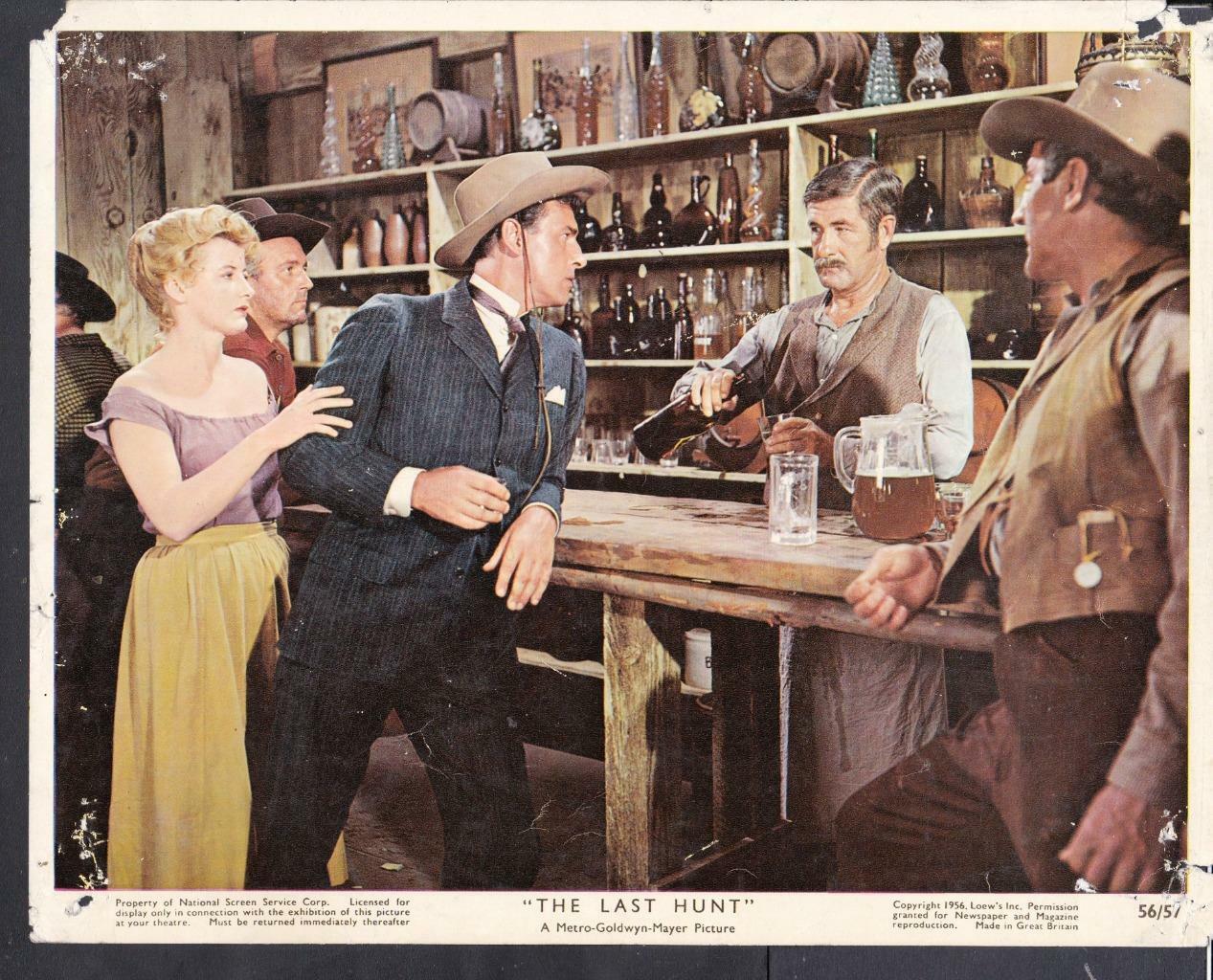
Richard Brooks was a man who didn't care much for Hollywood fluff. When he set out to adapt Milton Lott’s novel about the end of the American buffalo, he wasn't looking for a singing cowboy or a clean-cut hero in a white hat. He wanted grit. He wanted blood. He basically wanted to show the world that the West was won through a messy, systematic slaughter. To do that, he needed a specific kind of intensity, and the cast of The Last Hunt 1956 delivered a performance that, quite frankly, still feels a bit uncomfortable to watch today.
It's a weird movie.
Most Westerns from the mid-fifties are starting to lean into that psychological "adult" territory, but The Last Hunt goes further. It’s mean. It’s cold. Much of that comes down to Robert Taylor playing against type as a genuine psychopath. If you only know Taylor from his more dashing, romantic roles, his turn here as Charlie Gilson is going to give you whiplash. He’s obsessed with killing. Not just hunting for food or hides, but the actual act of taking life.
The Heavy Hitters: Robert Taylor and Stewart Granger
The dynamic between the two leads is the engine that drives the whole film. Stewart Granger plays Sandy McKenzie, a man who is tired. He's tired of the killing, tired of the trail, and honestly, he seems tired of himself. Granger was usually the swashbuckler, the guy with the perfect hair and the charming smile. Here, he’s weathered. He represents the conscience of the film, but he’s a passive conscience for a long time, which makes the tension between him and Taylor even more unbearable.
Robert Taylor, though? He steals the show by being absolutely loathsome.
Charlie Gilson isn't a misunderstood villain. He’s a racist, a misogynist, and a thrill-killer. There’s a scene where he talks about the "pleasure" of the kill that likely made 1956 audiences squirm in their seats. Taylor plays him with this tight, coiled energy, like a spring that’s about to snap and take everyone’s eye out. It was a risky move for a major MGM star. Usually, the studio wanted to protect their leading man’s image. Brooks, however, pushed Taylor to embrace the darkness, and the result is one of the most underrated villainous turns in the history of the genre.
Then you have the buffalo.
I know, they aren't "actors" in the SAG sense, but they are a massive part of the cast of The Last Hunt 1956. MGM actually filmed during a real government-sanctioned thinning of the herd in Custer State Park, South Dakota. When you see a buffalo die on screen in this movie, it’s often real footage. It adds a layer of documentary-style horror to the performances. You can see the genuine reaction on the actors' faces. It’s not movie magic; it’s a graveyard.
Supporting Players Who Actually Matter
The film doesn't just rely on the two big names. The supporting cast fills in the gaps of a dying frontier.
Lloyd Nolan plays Woodfoot, the crusty, one-legged skinner. Every Western needs a "grizzled veteran," but Nolan brings a pragmatic, almost cynical edge to it. He isn’t there for comic relief. He’s there to show the physical toll this life takes. He knows the era is ending. He knows the buffalo are disappearing. He just wants to get paid before the whole thing collapses.
Then there’s Russ Tamblyn.
Before he was snapping his fingers in West Side Story or getting weird in Twin Peaks, Tamblyn was Jimmy O’Brien, the "half-breed" youth caught between two worlds. His character is a bit of a trope by modern standards, sure. But in 1956, using a character like Jimmy to highlight Charlie’s blatant racism was a bold narrative choice. Tamblyn brings a youthful vulnerability that contrasts sharply with the coldness of the older men. He’s the future, and in Charlie Gilson’s eyes, the future is something to be extinguished.
Anne Bancroft and the Problem of "The Indian Girl"
We have to talk about Anne Bancroft.
Look, it was 1956. The practice of casting white actors in Indigenous roles—often referred to as "redface"—was standard industry practice, but that doesn't make it less jarring now. Bancroft plays "The Indian Girl" (she isn't even given a name for much of the film). While the casting is a relic of a flawed era, Bancroft’s performance is actually quite internal and dignified. She doesn't have much dialogue, but she uses her eyes to convey a deep sense of dread. She’s essentially a captive for a large portion of the movie, and she portrays that trauma with a subtlety that was rare for the time.
Her presence is the ultimate catalyst for the final breakdown between Sandy and Charlie. Charlie views her as property; Sandy sees her as a human being. It’s a simple conflict that carries the weight of the entire film’s morality.
Behind the Scenes: Why the Casting Worked
Richard Brooks was known for being "difficult." He was a writer-director who demanded realism, and he dragged this cast out into the freezing wilderness of South Dakota. The environment played a role in the acting. You can see the cold. You can see the mud. When the characters look exhausted, it’s because the actors were likely freezing their tails off.
- Location: Custer State Park, South Dakota.
- Technicolor/Cinematography: Russell Harlan captured the vastness, making the characters look small and insignificant against the plains.
- The Script: Brooks wrote the screenplay himself, stripping away the romanticism found in John Ford movies.
The cast of The Last Hunt 1956 had to inhabit a world where there were no heroes, only survivors and predators. Stewart Granger later remarked in his autobiography, Sparks Fly Upward, that the filming was grueling and that the reality of the buffalo slaughter stayed with him. That's the vibe of the whole movie. It’s a "feel-bad" Western.
The Ending Most People Forget
The climax of the film is famous—or infamous—depending on who you ask. Without spoiling the beat-by-beat, it involves a "buffalo robe" and a long, cold night. The way Robert Taylor’s character meets his end is perhaps the most poetic justice ever filmed in a Western. It’s a silent, frozen conclusion that relies entirely on Taylor’s physical acting.
He doesn't get a big monologue.
He doesn't get a final shootout.
He just gets the cold.
It underscores the film’s message: Nature doesn't care about your ego or your manifest destiny. It just is.
Why You Should Revisit the Film Today
If you're a fan of Yellowstone or 1883, you owe it to yourself to see where that DNA comes from. The Last Hunt is the ancestor of the "Revisionist Western." It challenged the myth of the frontier while the myth was still being actively written.
The performances are grounded in a way that feels surprisingly modern. Robert Taylor’s performance, in particular, should be studied by anyone interested in how to play a "heel." He didn't try to make Charlie Gilson likable. He made him terrifyingly human.
Actionable Insights for Western Enthusiasts
If you are looking to dive deeper into this specific era of filmmaking or the work of this cast, here is how to get the most out of it:
- Compare Taylor’s Performances: Watch The Last Hunt back-to-back with Ivanhoe (1952). The contrast between his chivalrous hero and Charlie Gilson is a masterclass in range.
- Study Richard Brooks: Look into his other works like In Cold Blood or Elmer Gantry. You’ll see a recurring theme of men struggling with their own inherent darkness.
- Check the Source Material: Read Milton Lott’s novel. It provides much more historical context on the hide-hunting industry of the 1880s, which explains why the characters are so desperate.
- Watch the Background: Pay attention to the buffalo herds. Knowing that much of that was real footage changes how you perceive the "scope" of the film. It wasn't just a set; it was a disappearing reality.
The movie isn't always easy to find on streaming, but it pops up on TCM (Turner Classic Movies) frequently. It remains a stark reminder that the "Old West" wasn't just about gunfights at noon; it was about the messy, cold, and often cruel business of changing a landscape forever. The cast didn't just play roles; they captured the funeral of an era.