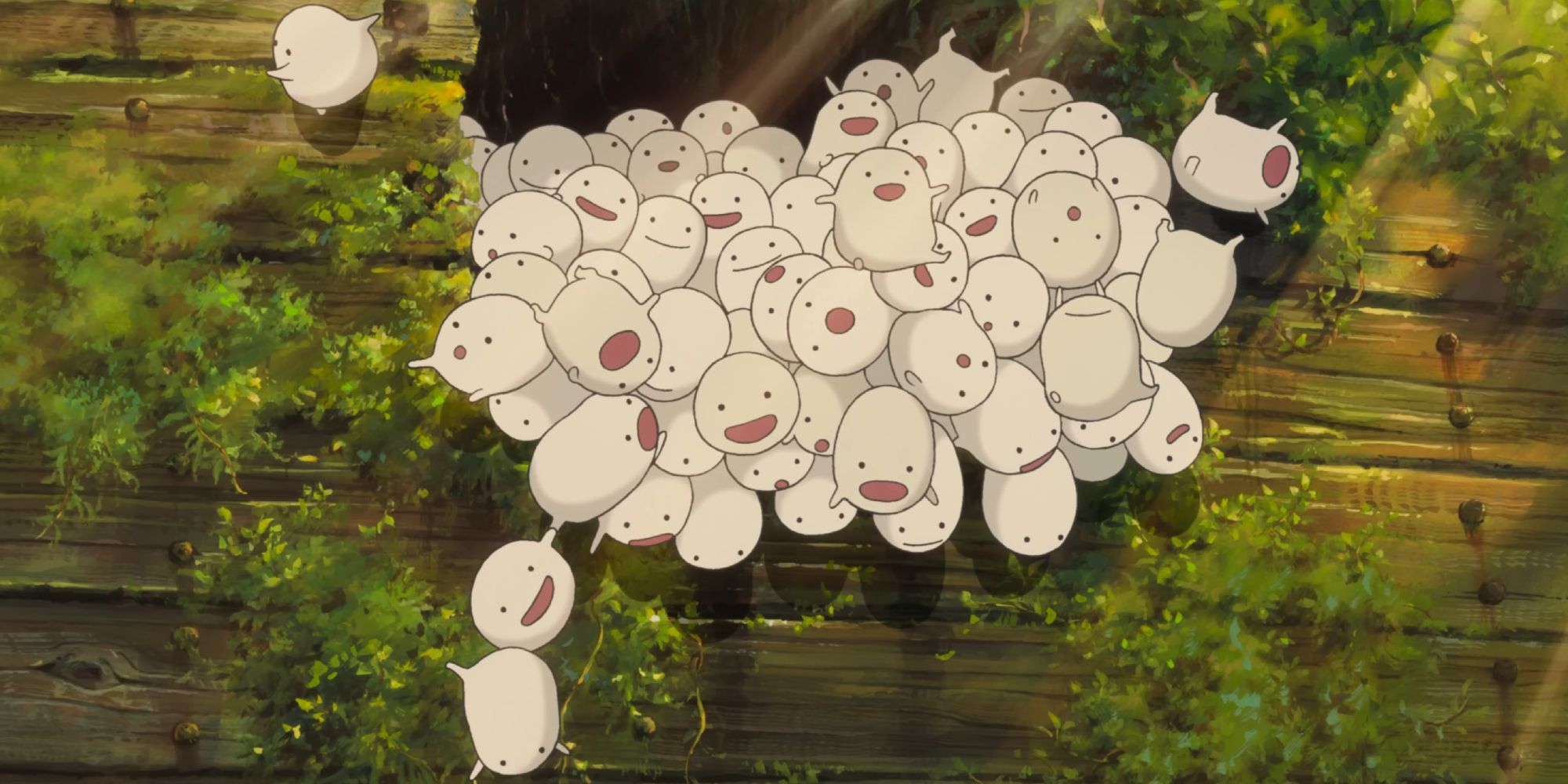
You know that feeling when you're watching a Hayao Miyazaki movie and something tiny appears on screen that just stops your heart? It happened with the Totoro soot sprites. It happened with the forest spirits in Princess Mononoke. And honestly, it happens the second those floating white blobs—the The Boy and the Heron Warawara—drift into view in Miyazaki's latest (and supposedly last) masterpiece.
They’re cute. Ridiculously cute.
But if you’ve spent any time dissecting Studio Ghibli films, you know "cute" is usually a Trojan horse for something much deeper, darker, or more philosophical. The Warawara aren't just there to sell plushies at the Ghibli Museum in Mitaka, though they certainly do that. They represent the literal cycle of human existence in a way that feels both ancient and kind of terrifying if you think about it for more than five seconds.
What Exactly Are the Warawara?
In the world of The Boy and the Heron (or Kimitachi wa Dō Ikiru ka), the Warawara are DNA-like precursors to human souls. They live in the "Lower World," a strange, liminal space that Mahito enters. They look like soft, glowing marshmallows with tiny faces.
They eat. They grow. They float.
Kiriko, the younger, tougher version of the maid Mahito knows in the real world, explains their purpose pretty bluntly. They must gather enough nutrients—specifically from the internal organs of the giant fish she catches—to gain the energy to float up into the sky. Once they reach the top, they pass through a gate to be born as humans in the "Upper World."
It’s a bizarrely literal take on reincarnation. Usually, we think of souls as wispy, ethereal things. Miyazaki makes them physical. They are hungry. They are vulnerable. They are essentially helpless until they’ve been fed enough "life force" to make the jump into our reality.
The Brutality of the Life Cycle
One of the most jarring scenes in the movie involves the Warawara being hunted. As they ascend toward the sky to be born, a flock of starving pelicans descends on them. It’s hard to watch. You’ve just spent ten minutes falling in love with these bouncy little souls, and suddenly they’re being gulped down by the dozen.
This isn't just Miyazaki being mean.
It’s a reflection of his worldview. Life is hard. Nature is indifferent. For something to be born, something else usually has to die or be sacrificed. The pelicans aren't "evil" in the traditional sense; they are trapped in a dying world where the only thing they can eat is the very essence of future life.
Then comes Himi. She’s the fire-wielder who protects the The Boy and the Heron Warawara by blasting the pelicans with magical flames. It looks like a heroic rescue until you realize that her fire is also incinerating some of the Warawara in the crossfire.
Mahito watches this with a mix of awe and horror. It's a heavy-handed but effective metaphor for the "unintended consequences" of preservation. Even the acts we do to save life can cause destruction. If you’re looking for a simple "good vs. evil" story, you’re in the wrong theater.
Why Do They Look Like That?
There’s a reason the Warawara feel familiar. Their design is a direct callback to the Kodama from Princess Mononoke. Both are small, white, and represent the "spirit" of a place or a concept.
But while the Kodama are tied to the forest, the Warawara are tied to humanity.
Their roundness makes them feel safe. They lack limbs, which emphasizes their dependence on others. Think about it: they can’t even move upward without enough "guts" (literally fish guts) in their bellies to provide lift. They are the ultimate symbols of potential.
Interestingly, Toshio Suzuki, the legendary producer at Ghibli, has hinted in various interviews that Miyazaki’s late-career obsession with these "small beings" stems from his thoughts on the next generation. Miyazaki is in his 80s. He’s looking at the world he’s leaving behind. The Warawara are the blank slates—the kids who haven't been "stained" by the world yet.
The Warawara vs. The Pelicans: A Nuanced Conflict
Most viewers hate the pelicans. I get it. They're scary and they eat the cute things.
However, the dying pelican that Mahito speaks to offers a different perspective. These birds were brought to the Lower World against their will. They are starving. The sea is empty. Eating the Warawara is their only means of survival.
This creates a moral gray area that defines the entire movie. The The Boy and the Heron Warawara are innocent, yes, but their journey to birth is paved with the suffering of other creatures. It’s a messy, complicated ecosystem. It’s basically Miyazaki saying, "Welcome to the world, kid; it’s beautiful and it’s a nightmare."
The Sound of the Souls
If you listen closely to the sound design when the Warawara are on screen, it’s remarkably quiet. Unlike the soot sprites, which have a frantic, scratchy energy, the Warawara move with a soft, humming stillness.
Joe Hisaishi’s score during these moments is minimalist. It doesn't tell you how to feel. It just lets the visual of these thousands of souls rising like lanterns breathe.
In Japanese folklore, there is a concept of hitodama—ghostly fireballs that represent souls leaving the body. Usually, these are seen after death. Miyazaki flips this. He shows the hitodama (in the form of Warawara) before life. They are the "before-glow."
Why the World Obsessed Over Them So Fast
The movie had no trailer. No marketing. Just one poster of a bird.
When it finally dropped, the The Boy and the Heron Warawara became the breakout stars because they represent the "Ghibli Magic" we all missed. They provide the whimsy that balances out the film’s heavy themes of grief, war, and legacy.
They also serve a narrative purpose for Mahito. By witnessing the struggle of the Warawara, Mahito starts to move past his own obsession with death (specifically his mother’s death) and begins to understand the sanctity—and the cost—of life. He realizes that being born is a feat of strength and luck.
Spotting the Details: A Guide for the Second Watch
If you’re going back for a rewatch, keep an eye on these specific details regarding the Warawara:
- The Inflation: Notice how they physically puff up before they take flight. It’s almost like a biological process, like a pufferfish or a balloon.
- The Swirl: When they rise, they don't go in a straight line. They move in a DNA-like double helix. This is a subtle nod to the biological nature of life and heredity.
- The Interaction with Himi: Watch how Himi looks at them. There’s a maternal connection there that pays off massively once you realize who Himi actually is in the timeline of the "Upper World."
Reincarnation and the Ghibli Legacy
Is this Miyazaki’s way of saying he’s ready to move on? Maybe.
The The Boy and the Heron Warawara eventually leave the Lower World, just as we all eventually enter the "real" world. The film ends with the collapse of the magical world, meaning the "source" of these souls is gone or changed forever.
It’s a bittersweet ending. The Warawara we saw will become people. They will grow up, they will suffer, they will create, and they will eventually die. The cycle is beautiful but finite.
If you want to fully appreciate what you saw on screen, stop looking at them as "mascots." Look at them as a question. Miyazaki is asking: "If you knew how much effort it took for your soul to even get here—how many things had to die or protect you just so you could be born—how would you choose to live?"
Actionable Takeaways for Fans
To truly connect with the themes of the Warawara, you don't need to buy a t-shirt. You just need to look at the film's source material and context.
- Read the Book: The movie is titled after Genzaburo Yoshino’s 1937 book How Do You Live?. While the plot is different, the "spirit" of the Warawara—the idea of being a small part of a vast, interconnected human "molecule"—is pulled directly from the book’s themes.
- Watch "The Kingdom of Dreams and Madness": This documentary gives you a look into Miyazaki’s cynical yet hopeful mind. It explains why he views the "new generation" (the Warawara) with such protective anxiety.
- Analyze the "Lower World" Logic: Treat the film like a dream diary. The Warawara are one of the few things in the movie that are purely "good," yet they are the most hunted. Think about what that says about Miyazaki's view of innocence in the modern world.
The Warawara aren't just a cute visual. They are the heartbeat of a film about how we carry on when the world feels like it’s ending. They remind us that before we were anything else, we were just something small, glowing, and full of the potential to rise.
The next time you see a floating white light in a Ghibli film, don't just say "aww." Remember the pelicans. Remember the fire. Remember the fish guts. Life is a miracle, but it's never free.
Next Steps for Ghibli Enthusiasts
To deepen your understanding of the film's hidden layers, look into the Shinto concept of "Ubusuna"—the guardian deity of one's birthplace. The relationship between the Warawara and the land they rise from mirrors these traditional Japanese beliefs about how souls are tied to the physical environment. Understanding this connection transforms the "Lower World" from a fantasy land into a spiritual reflection of Japan's own landscape and history. Study the works of Isao Takahata, specifically The Tale of the Princess Kaguya, to see how other Ghibli masters handled the concept of souls descending to Earth; it provides a stark, fascinating contrast to Miyazaki's "biological" soul theory.