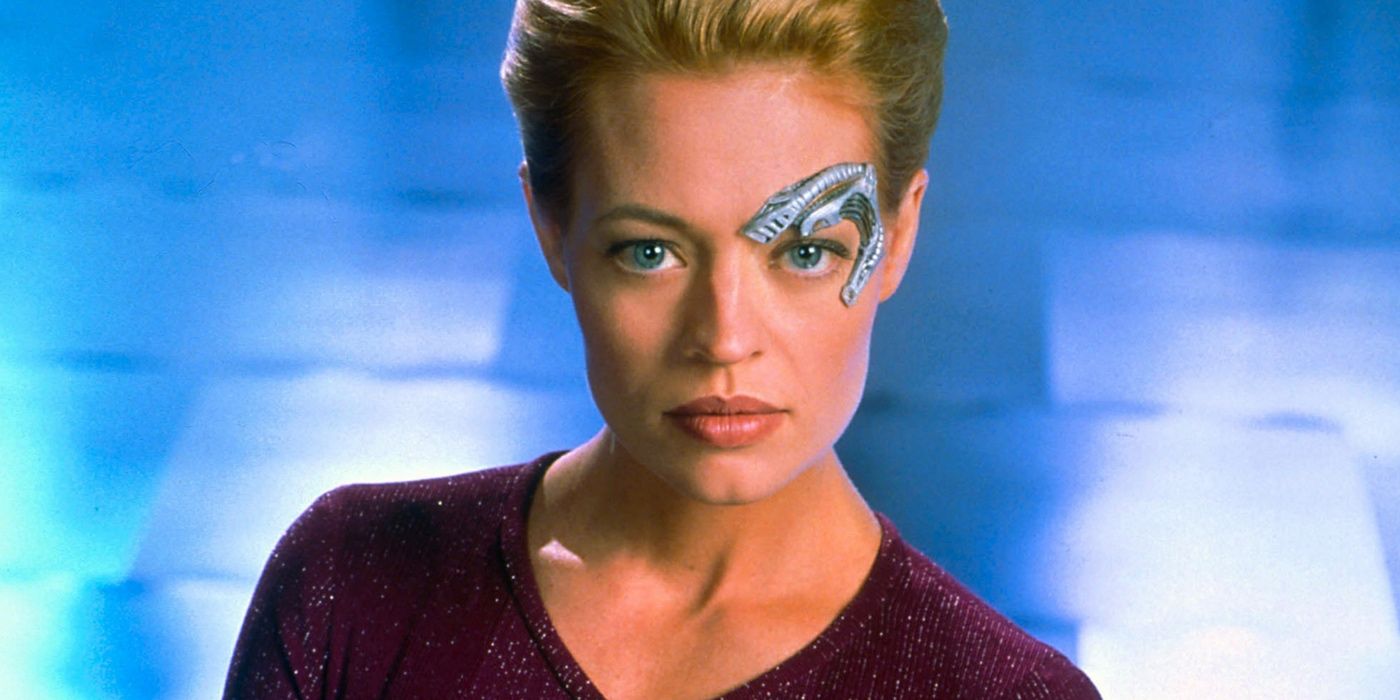
When Seven of Nine first stepped onto the bridge of the USS Voyager in 1997, the "fan response" was... let's just say it was predictable. She was wearing a silver catsuit. She was clearly brought in to boost sagging ratings. People rolled their eyes. Honestly, it looked like a desperate move by UPN. But then something weird happened over the next four seasons. Star Trek Voyager 7 of 9 became the most complex, tragic, and deeply human character the franchise had ever seen, proving that you can't judge a Borg by her exoskeleton.
She wasn't just eye candy. Far from it.
Jeri Ryan took a role that could have been a one-dimensional "robot girl" and turned it into a masterclass in trauma recovery. Think about it. Annika Hansen was assimilated at age six. Her childhood was literally erased by a collective hive mind. When Janeway severed her link to the Borg, Seven didn't feel "saved." She felt like she was being kidnapped from the only family she knew. That's dark. It's much darker than most Trek fans admit when they're reminiscing about the 90s.
The Borg Conflict: Why Seven of Nine Changed Everything
The show was struggling before she arrived. Ratings were dipping. The writers were running out of ways to make the Delta Quadrant feel dangerous. Enter the Borg. But not the scary, faceless Borg from "The Best of Both Worlds." No, this was a Borg who had to learn how to use a fork.
The dynamic between Captain Janeway and Seven of Nine is basically the heartbeat of the show’s later years. It’s a mother-daughter relationship, sure, but it’s also a battle of wills. Janeway is obsessed with "humanity" as a moral high ground. Seven? She thinks humanity is inefficient, messy, and frankly, a bit of a step down from the perfection of the Hive.
There's a specific scene in "The Gift" where Seven begs to be sent back. She's terrified. You can see the genuine panic in Jeri Ryan's performance. It reframes the entire Federation ethos. Is it really "freedom" if you're being forced to be free against your will? It's a heavy question for a show that also featured a guy turning into a giant salamander.
Breaking Down the "Ratings Grab" Myth
Everyone talks about the suit. Yes, the costume was designed by Robert Blackman to be provocative. It was a conscious choice by the producers. But Jeri Ryan has spoken openly at conventions about how difficult that era was. The suit was so tight she had trouble breathing. She had to have oxygen on set.
Despite the physical restrictions, her acting was surgical. She had to convey deep emotion while keeping her face almost entirely still. That’s not easy. If you watch her closely in the episode "Someone to Watch Over Me," where she's trying to learn how to date, the subtle shifts in her posture tell you everything. She’s a fish out of water who is slowly realizing she might actually like the water.
Recovery as a Narrative Arc
What most people get wrong about Star Trek Voyager 7 of 9 is the idea that she "became human." She never really did. Not fully. Even by the time we see her again decades later in Star Trek: Picard, she’s still a hybrid. She’s a woman who carries the scars of her past—literally, with the cortical node and the ocular implant.
Her journey is actually a very accurate representation of living with CPTSD.
- She struggles with social cues.
- She has flashbacks to the Collective.
- She feels a constant sense of "otherness" that never truly goes away.
- She seeks out structure (like the Astrometrics lab) because the chaos of human emotion is overwhelming.
Seven didn't just join the crew; she challenged their assumptions. She pointed out when Janeway was being hypocritical. She mocked the Doctor’s ego. She brought a cold, hard logic that the ship desperately needed, especially when they were facing off against Species 8472 or the Hirogen.
The Kate Mulgrew Tension
It’s no secret now that things were tense on set. Kate Mulgrew was protective of the show’s feminist legacy. She had worked hard to be the first female lead in a Trek series, and she felt—rightly or wrongly—that bringing in a "sex symbol" undermined that.
But here’s the irony: the friction between the two actresses actually translated into some of the best onscreen chemistry in TV history. The sparks were real. When Janeway and Seven argue in "Hope and Fear," the intensity is palpable. They weren't just playing roles; they were fighting for the soul of the show. Over time, Mulgrew and Ryan moved past it, but that early conflict gave the characters an edge that you can't fake with a script.
Why 7 of 9 Still Dominates the Conversation
We are living in an era of TV reboots and nostalgia, but Seven of Nine is one of the few characters who actually improved with a comeback. When she showed up in Picard, she was a Fenris Ranger. She was jaded. She was drinking bourbon. She had finally shed the "efficiency" of the Borg and embraced the messy reality of being a survivor.
It’s rare for a character to have a 25-year arc that actually makes sense.
Think about the sheer volume of episodes focused on her. "Raven," "One," "Infinite Regress," "Dark Frontier." The writers leaned on her heavily because she was the only character who could realistically change. Harry Kim was always going to be the ensign who got rejected. Tuvok was always going to be the logical Vulcan. But Seven? She was a blank slate.
The Science of the Borg Implant
Let's get technical for a second. The lore of Star Trek Voyager 7 of 9 hinges on the idea of "nanoprobes." In the 90s, this was cutting-edge sci-fi jargon. Today, we’re actually looking at nanomedicine in the real world. The show explored the ethics of using Borg tech to save lives long before we had actual conversations about neural interfaces.
Seven’s existence is a walking ethical dilemma. Should she be allowed to use her Borg knowledge to "fix" things, even if that knowledge was gained through the murder and assimilation of thousands of species? Voyager usually landed on "yes, because we want to get home," but Seven herself often questioned the cost.
Dealing with the Fanbase
If you go to a Trek convention today, the line for Jeri Ryan is still one of the longest. Why? Because Seven of Nine represents the outsider. Everyone has felt like they don't fit in. Everyone has felt like they’re "performing" humanity rather than actually feeling it.
She's a queer icon, too. While the writers on Voyager never explicitly went there (it was the 90s, after all), her relationship with Seven and the way she navigated identity resonated deeply with the LGBTQ+ community. When Picard finally made her relationship with Raffi Musiker canon, a lot of fans felt like it was the natural conclusion to a journey that started back in the Delta Quadrant.
The "One" Episode
If you want to see the peak of this character, watch the episode "One." Seven is left alone on the ship while the rest of the crew is in stasis to pass through a nebula. It’s a bottle episode. Just Seven and the Doctor.
As the weeks go by, she starts to lose her mind. She sees hallucinations. She hears the voices of the Collective. It is a haunting, claustrophobic hour of television. It strips away the Borg "perfection" and shows a terrified woman who is scared of being alone. It is, quite simply, one of the best hours of Star Trek ever produced.
Actionable Takeaways for the Modern Fan
If you're revisiting Voyager or diving in for the first time because of the buzz around Star Trek: Picard or the newer series, here is how to actually appreciate the Seven of Nine arc without the 90s "eye candy" filter:
- Watch the "Borg Trilogy" first: Start with "Scorpion" (Parts 1 and 2) and then immediately watch "The Gift." This is the foundation of her entire personality.
- Ignore the costume: It sounds hard, but try to focus on the dialogue. Seven’s lines are often the most intelligent and biting in the series. Her dry wit is actually hilarious once you get her rhythm.
- Trace the Janeway-Seven evolution: Pay attention to how Janeway moves from "mentor" to "peer." It's one of the few long-form character growths that doesn't feel rushed.
- Compare Voyager Seven to Picard Seven: Notice the posture. In Voyager, she is stiff, mimicking a drone. In Picard, she leans back, uses her hands more, and speaks with a different cadence. It’s a brilliant piece of long-term acting.
The legacy of Seven of Nine isn't about a silver suit or a high-concept sci-fi trope. It's about the grueling, painful, and eventually rewarding process of reclaiming an identity that was stolen. She remains the gold standard for how to introduce a new character into an established cast and have them completely steal the show.
She was assimilated. She was liberated. But most importantly, she became herself. Over twenty years later, that’s still the most compelling story Star Trek has ever told.