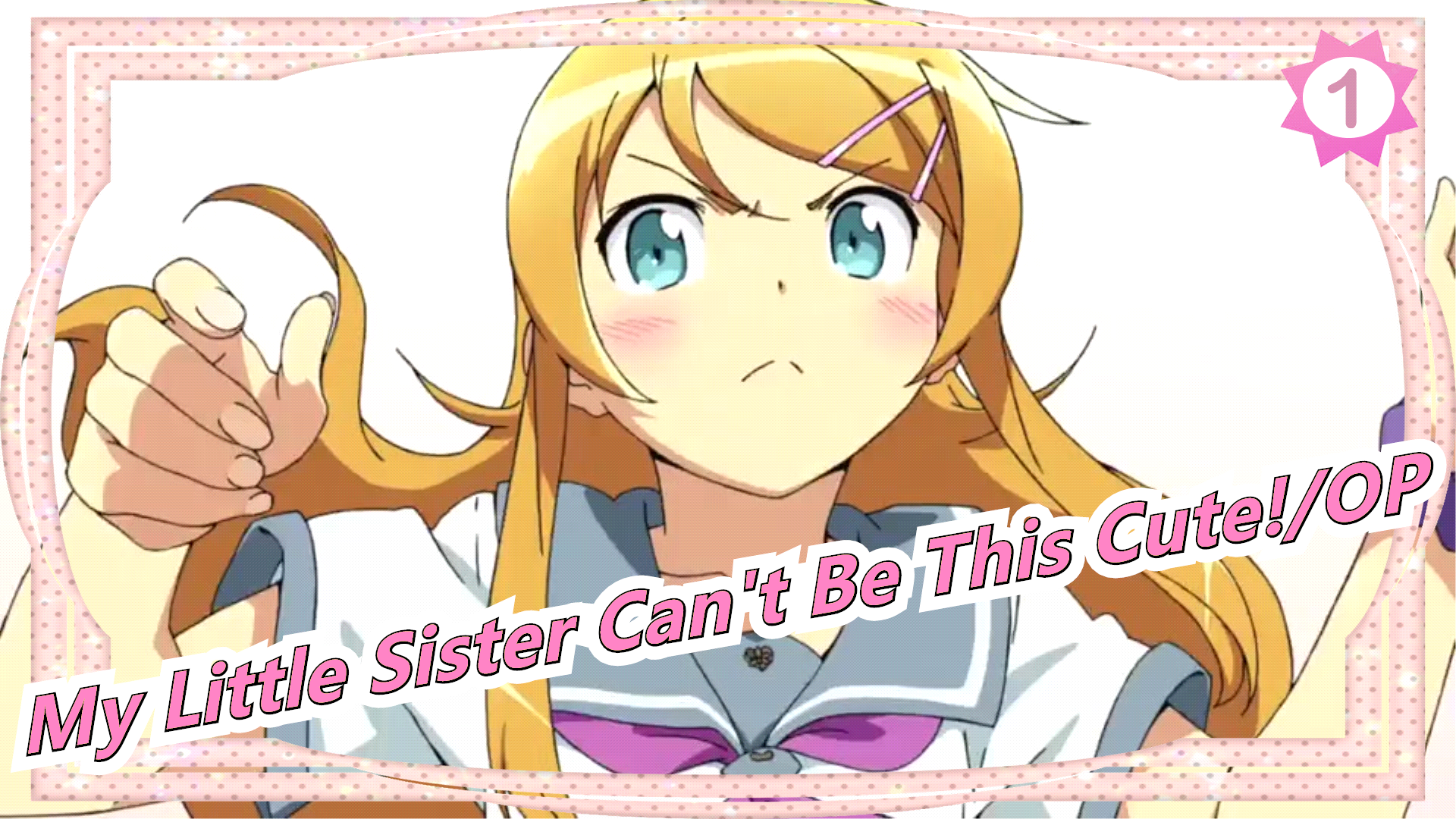
You remember the first time you saw that title. My Little Sister Can’t Be This Cute. It’s a mouthful. Most fans just call it Oreimo, a shorthand for the Japanese Ore no Imōto ga Konnani Kawaii Wake ga Nai. Back in 2010, when the first season hit screens, it felt like a weird little niche comedy about a guy finding out his sister is a secret nerd. Then things got complicated. Very complicated.
It basically changed how we talk about "otaku culture" in media.
Kyousuke Kosaka is just a regular guy. He’s "boring" by design. His sister, Kirino, is the opposite. She’s a model, an athlete, and a straight-A student. She also happens to have a secret stash of "eroge" (adult visual novels) hidden in her closet. That’s the hook. It’s not just about a sibling rivalry; it's about the shame and excitement of being an obsessive fan in a world that doesn’t get it. Honestly, for a lot of us, that part felt real. The rest? Well, that’s where the internet usually starts screaming.
The Secret Life of Kirino Kosaka
Kirino isn't exactly "nice." She’s abrasive. She calls her brother "trash." But the show works because it taps into that specific anxiety of having a hobby you think will get you ostracized. When Kyousuke finds her Stardust Witch Meruru DVD, he doesn't mock her. He helps her. That’s the core of the show’s heart, even if that heart eventually leads to a very messy ending that split the fanbase in half.
Tsukasa Fushimi, the original light novel author, didn't hold back. He wrote a story that pushed boundaries. By the time we got to the second season, Oreimo 2, the "Life Counseling" sessions between the siblings had evolved from helping Kirino buy games to navigating a complex web of romantic interests including the fan-favorite Kuroneko.
Kuroneko (Ruri Goke) is arguably the best-written character in the series. She’s a Chuunibyou—someone who lives in a fantasy world to cope with social awkwardness. Her relationship with Kyousuke provided a grounded, bittersweet alternative to the chaotic sibling dynamic. When they break up? It hurt. It felt like a genuine shift from a zany comedy into a heavy drama about the consequences of choice.
Why Oreimo Is More Than Just Its Ending
People fixate on the finale. I get it. The ending of the light novels and the "True Route" OVAs is infamous. But if you look at the industry impact, Oreimo paved the way for the "Little Sister" trope explosion of the 2010s. Without Kirino, we probably don't get Eromanga Sensei or Himouto! Umaru-chan. It defined a specific aesthetic.
The production by AIC Build (Season 1) and later A-1 Pictures (Season 2) was top-tier for its time. Hiroyuki Oda’s character designs are iconic. Those round, expressive eyes and the sharp contrast between Kirino’s "public" face and her "otaku" face became a blueprint.
There’s also the music. ClariS. You can’t talk about My Little Sister Can’t Be This Cute without mentioning "Irony." It was the debut for the middle-school duo ClariS, who went on to become titans of the anime song industry. That opening track perfectly captured the frantic, sugary, yet slightly melancholic vibe of the series. It’s a banger. Still is.
The Conflict of the "True Route"
Let's be real: the ending is a mess of logic and emotion. Fushimi wanted a specific ending. The publishers and the censors had other ideas. The result was a "compromise" that left a lot of people feeling cold. Kyousuke and Kirino "date" for a short period with the understanding that they will return to being "just siblings" afterward.
It’s an ending that tries to have its cake and eat it too.
Some fans saw it as a brave exploration of "taboo" subjects within the safety of fiction. Others saw it as a massive betrayal of the character growth Kyousuke showed throughout the series. Especially considering he rejected Kuroneko and the hardworking Ayase for a dead-end relationship.
But that frustration is exactly why the show stays in the conversation. It didn't play it safe. In a sea of "moe" shows that disappear from memory two weeks after they air, Oreimo stuck around. It forced viewers to have an opinion. You either love it or you want to throw your monitor out the window. There’s no middle ground.
Navigating the Legacy of the Series
If you're looking to revisit the series or watch it for the first time, there are a few things you should know. It’s not just a straight watch from Episode 1 to 24.
The first season has two versions of its ending. There’s the "Good End" (Episode 12) and the "True Route" (Episodes 13-15). If you want the actual story, you have to watch the True Route. The same thing happened with the second season. The televised broadcast ended on a cliffhanger, and the actual conclusion was released as four ONA (Original Net Animation) episodes.
- Season 1: 12 Episodes + 3 OVA/True Route Episodes
- Season 2: 13 Episodes + 3 "Special" Episodes
Without those specials, the story literally doesn't finish. It’s a weird distribution model that reflects the chaotic nature of the production.
Cultural Context and the Akihabara Factor
One thing Oreimo gets incredibly right is the depiction of Akihabara. This was before the district became a sanitized tourist trap. The show captures the feeling of the "Electric Town" back when it felt like a secret club for people who knew which back-alley shops had the best doujinshi.
The "Otaku Girls' Meetings" that Kirino attends are a great look at the community. You have Saori Bajeena, the tall, bespectacled leader who hides her wealthy background to fit in with her friends. You have the petty rivalries over which anime is better. It's a love letter to a subculture that was just starting to go mainstream.
How to Approach Oreimo Today
Watching My Little Sister Can’t Be This Cute in 2026 is a different experience than it was in 2010. We’ve seen a thousand clones since then. The "shock value" has diminished, but the character writing—specifically the banter—still holds up. The dialogue is snappy. The way Kyousuke and Kirino talk to each other feels like real siblings who actually can't stand each other but share a secret bond.
If you’re going to dive in, don’t go in expecting a standard romance. Expect a character study of someone who is deeply insecure (Kirino) and someone who is pathologically helpful (Kyousuke).
Actionable Steps for Fans and Newcomers:
- Watch the OVAs: Do not skip the "True Route" episodes. The broadcast versions are essentially non-canon "what-if" scenarios that provide no closure.
- Read the "If" Light Novels: Recently, Tsukasa Fushimi began writing "Ayase If" and "Kuroneko If" light novels. These are official alternate histories where Kyousuke ends up with the other girls. If the original ending made you angry, these are your remedy.
- Pay Attention to the Backgrounds: The art team did an incredible job recreating real-life locations in Chiba and Akihabara. It’s a time capsule of 2010-era Japan.
- Listen to the Lyrics: The ending themes for almost every episode are different. They were often crowdsourced from fans on Nico Nico Douga, making the show a collaborative piece of otaku history.
The series remains a polarizing pillar of modern anime. It’s uncomfortable, it’s hilarious, it’s frustrating, and it’s beautifully animated. Whether it "can be this cute" is up for debate, but its influence on the industry is undeniable. Stick to the True Route, keep an open mind about the "If" stories, and you'll see why people are still arguing about Kirino and Kuroneko over a decade later.