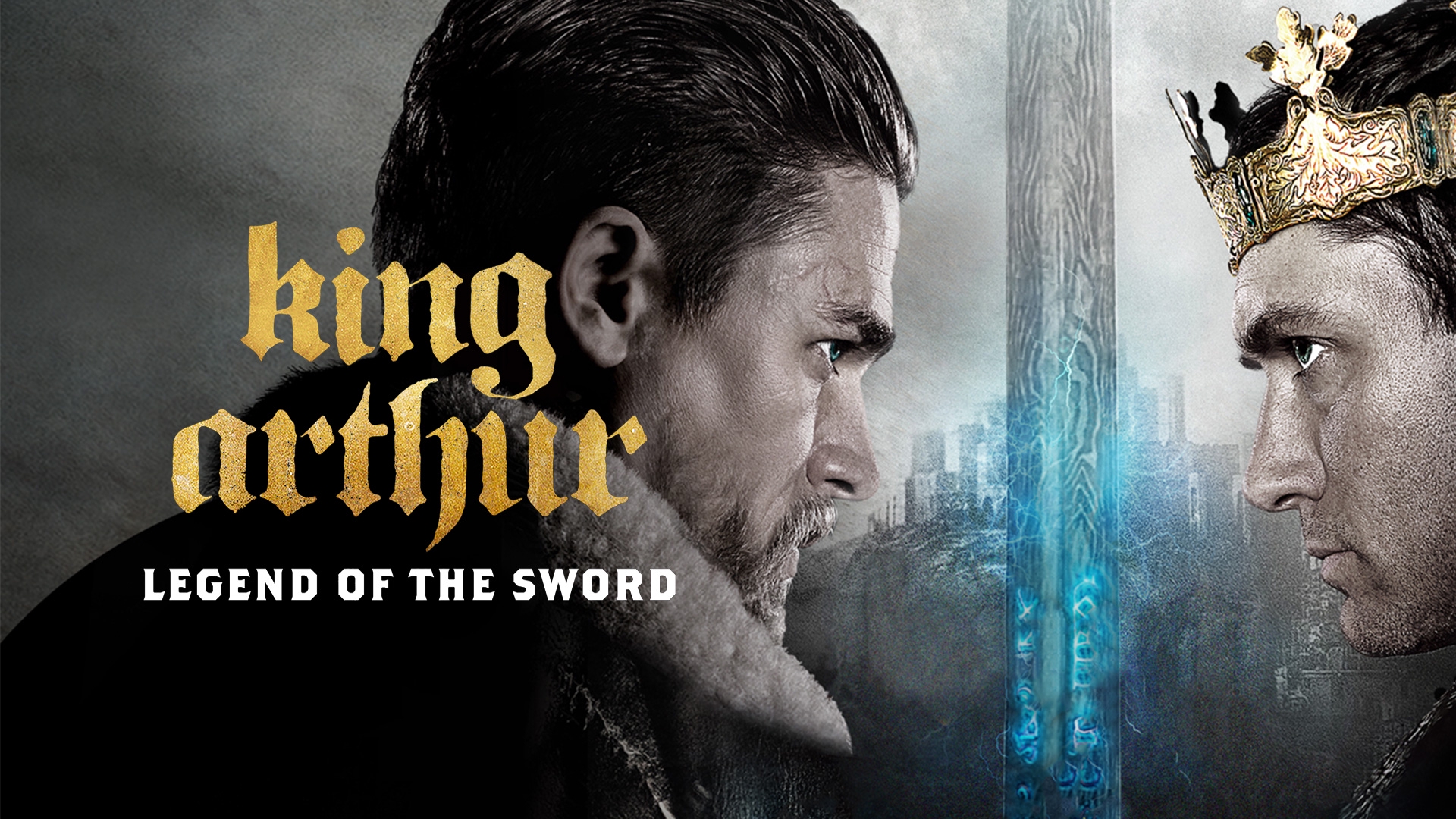
Guy Ritchie didn’t just make a movie about a sword in a stone. He made a music video for a medieval gang war, and honestly, people are still catching up to what he was trying to do. If you’ve sat down to watch King Arthur: Legend of the Sword, you probably realized within ten minutes that this isn't your grandfather’s Camelot. There are no shiny knights in silver armor sitting at round tables discussing chivalry. Instead, we get Charlie Hunnam as a street-smart hustler running a brothel in Londinium.
It’s loud. It’s fast.
The movie cost Warner Bros. a fortune—somewhere in the neighborhood of $175 million—and it famously struggled at the box office. But that’s not the whole story. While critics were busy complaining that it didn't feel "Arthurian" enough, a cult following was quietly forming. They didn't care about the historical inaccuracies because the movie never claimed to be history. It’s a fantasy epic seen through the lens of a London heist flick.
The Chaos of the Guy Ritchie Style
You know that feeling when you're listening to a story and the person telling it keeps jumping back and forth, getting faster as they get excited? That’s the "Ritchie" touch. When you finally watch King Arthur: Legend of the Sword, you’ll see his signature non-linear editing style applied to a genre that usually moves at a snail’s pace.
Take the "Growing Up" montage at the beginning. Most directors would spend forty minutes showing Arthur’s childhood. Ritchie does it in about two minutes of rhythmic, percussive cuts. We see the kid get beaten up, learn to fight, make some money, and turn into Charlie Hunnam. It’s efficient storytelling that treats the audience like they’re smart enough to keep up.
Then there’s the dialogue. It’s snappy. Characters talk over each other. They use slang that feels more like modern-day East End London than 5th-century Britain. Some people hated this. They felt it broke the immersion. But others found it refreshing. Why should everyone in fantasy movies talk like they’re reciting Shakespeare? Arthur is a orphan who grew up in the mud. It makes sense that he sounds like a guy who knows how to survive a street fight.
Jude Law as the Perfect Villain
We have to talk about Vortigern. Jude Law plays the usurper king with this weird, cold intensity that makes your skin crawl. He’s not a cartoon villain. He’s a man who sacrificed his own family to sit on a throne made of bones and shadows.
The visual design for Vortigern’s power is actually pretty dark. Whenever he taps into the dark magic provided by the "Syrens" (those giant, grotesque octopus-women living under the castle), he becomes something truly monstrous. Law plays it with a sense of regret that makes it even creepier. He knows he’s a monster, but he’s already too far gone to stop.
Where to Watch King Arthur: Legend of the Sword Right Now
Tracking down where to stream this thing can be a bit of a moving target because licensing deals change every few months. As of early 2026, you can usually find it on platforms like Max (formerly HBO Max) or occasionally Netflix depending on your region.
If it’s not on your subscription services, digital rental is basically everywhere. Apple TV, Amazon Prime Video, and the Google Play Store all have it in 4K. And honestly? This is one of those movies where 4K actually matters. The cinematography by John Mathieson—the same guy who did Gladiator—is stunning. The use of scale, especially with the giant elephants in the opening scene, is meant for the biggest screen you own.
The Sound of Excalibur
Daniel Pemberton’s score is the secret weapon here. Seriously. Most fantasy movies use sweeping orchestras with lots of violins. Pemberton used heavy breathing, clanging metal, and what sounds like someone beating a leather hide with a stick.
The music is visceral. It pulses.
When Arthur finally grabs the handle of Excalibur with both hands and the power surges through him, the music doesn't just play; it screams. It’s a sensory experience that sets this movie apart from the "generic" fantasy clutter we usually see on streaming services.
The Movie That Was Supposed to Be a Universe
Warner Bros. had massive plans for this. They wanted a six-movie franchise. You can see the seeds being planted throughout the film. There are mentions of Merlin, who only appears in brief, shadowy glimpses. There’s the "Mage" (played by Astrid Bergès-Frisbey), who isn't Guinevere but serves a similar narrative role. The film was building toward something much bigger.
But the box office numbers didn't agree.
The film made only about $148 million worldwide. For a movie that cost nearly $200 million to make and market, that’s a disaster in the eyes of a studio. This is why we’ll likely never see the sequel where Arthur actually builds the Round Table or goes on the Quest for the Holy Grail. It’s a shame, really. There’s a certain grit to this world that felt more alive than the polished, CGI-heavy worlds of many modern blockbusters.
Why It Failed (And Why It’s Better Than You Remember)
So, why didn't people go see it?
Timing was a big factor. It came out in 2017, sandwiched between massive hits like Guardians of the Galaxy Vol. 2 and Wonder Woman. It also suffered from a confusing marketing campaign. Was it a gritty reboot? A magical epic? A comedy? The trailers couldn't quite decide.
But viewing it today, away from the hype and the "box office failure" headlines, it’s just a damn good time. It’s a movie that takes risks. It has a specific personality. Even if you don't like Guy Ritchie’s style, you have to admit that he had a vision. In an era where many franchise movies feel like they were made by a committee, King Arthur: Legend of the Sword feels like it was made by a person.
The Action is Genuinely Creative
Forget the boring sword-swinging. The action sequences in this film are shot like a superhero movie but with the weight of medieval steel. The scene where Arthur uses Excalibur to take out a courtyard full of soldiers is shot with a "GoPro" perspective and high-frame-rate speed ramping.
It feels like a video game in the best way possible.
Arthur isn't just a good fighter; he’s overwhelmed by the sword’s power. You see him struggling to control the magic. It’s not a "chosen one" trope where he’s instantly a god; it’s a burden. He literally faints the first time he tries to use it. That’s a human touch you don’t often get in these types of legends.
Notable Cast Members You Might Have Missed
Look closely and you’ll see some familiar faces.
- Aidan Gillen: Littlefinger from Game of Thrones plays "Goosefat Bill," a master archer.
- Djimon Hounsou: He brings some much-needed gravitas as Bedivere.
- David Beckham: Yes, the soccer legend has a cameo as the guard overseeing the sword in the stone. He’s barely recognizable under all the prosthetics.
- Kingsley Ben-Adir: Before he was a superstar, he was part of Arthur's crew as Wet Stick.
What to Do After You Watch
If you’ve finished the movie and you’re craving more of that specific energy, there are a few places you can go next.
First, check out Guy Ritchie’s other work if you haven't already. The Gentlemen (both the movie and the Netflix series) carries that same fast-talking, criminal-underworld vibe. If you want more "gritty fantasy," The Witcher on Netflix or The Last Kingdom are your best bets for that mud-and-blood aesthetic.
For the real history nerds—or at least those who like the idea of a real Arthur—look into the works of Bernard Cornwell. His Warlord Chronicles trilogy is arguably the best "grounded" take on the Arthurian legend ever written. It strips away the magic and looks at what a 5th-century warlord trying to hold back the Saxon invasion might actually have looked like.
Ultimately, you should watch King Arthur: Legend of the Sword if you want to see a director take a massive swing. It’s flawed, sure. It’s messy. But it’s never boring. In a world of safe, predictable movies, that’s worth something.
How to maximize your viewing experience:
- Sound System: Crank it up. The percussion in the soundtrack is half the fun.
- Focus: Don't scroll on your phone. The editing is so fast that if you look away for thirty seconds, you'll miss three plot points and a flashback.
- Context: Forget everything you know about the Knights of the Round Table. Just treat it as a fantasy heist movie.
The movie is a relic of a time when studios were willing to spend $175 million on a weird, stylistic experiment. We might not get another one like it for a long time. Enjoy the beautiful, loud, chaotic mess for what it is.