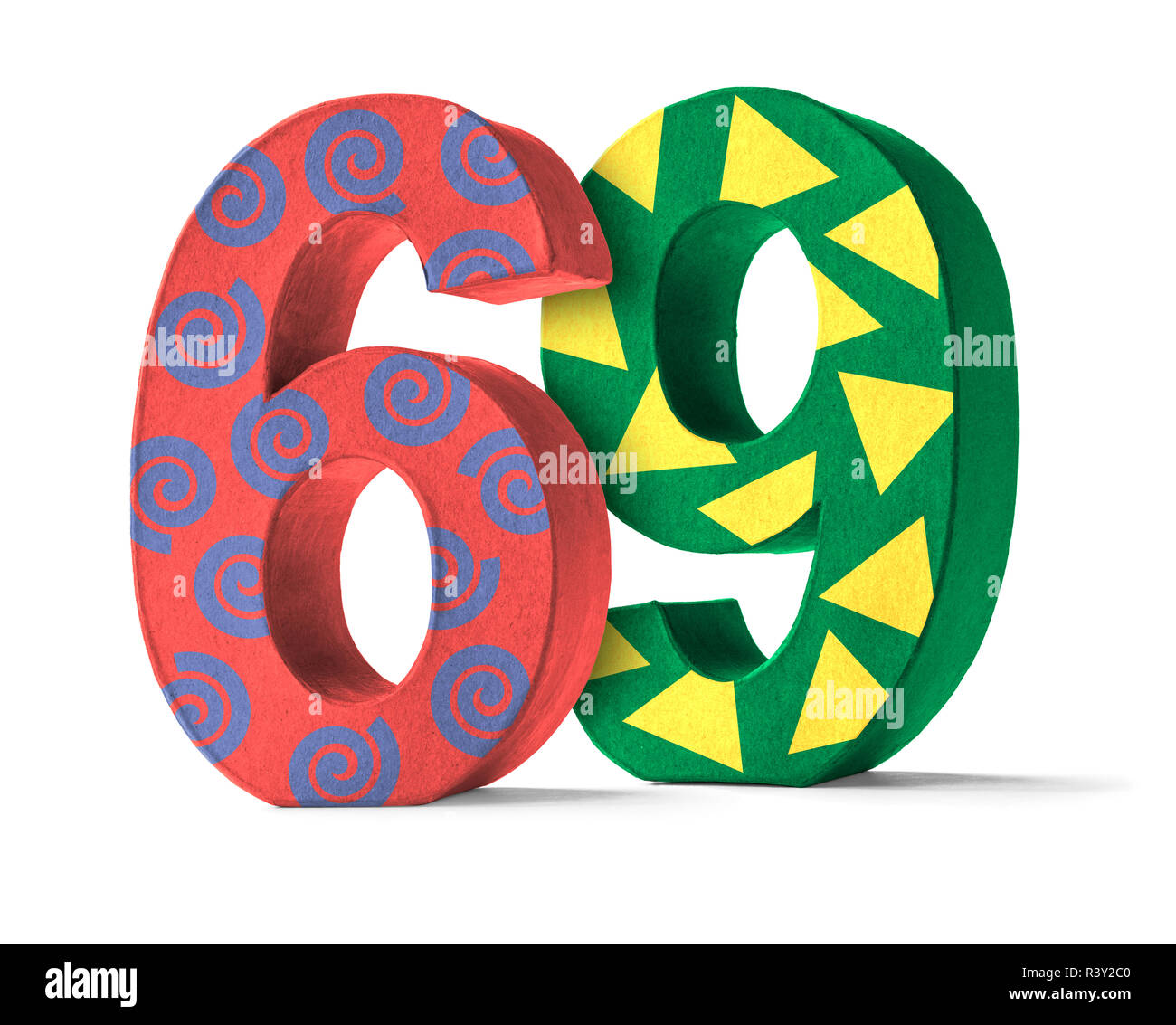
It is the universal language of the comment section. You see it under a weather report. You see it in the stock market tickers. Someone posts a photo of a receipt totaling $69.00 and, like clockwork, a thousand people reply with a single word: "Nice." It is a reflex. It is a digital ritual.
But honestly, why is the number 69 funny to begin with?
If we are being real, the joke is incredibly simple. It’s a reference to a specific sexual position where two partners are oriented head-to-toe. The visual symmetry of the digits—one right-side up, one upside down—creates a literal pictogram of the act. That's the baseline. But a simple sexual reference doesn't explain why a 40-year-old accountant and a 14-year-old gamer both find it equally compelling to type "Nice" on a Reddit thread. The humor isn't really about sex anymore. It’s about the community of the joke itself. It's a "low-stakes" shibboleth, a way to signal that you’re part of the internet’s collective, slightly immature consciousness.
The Visual Geometry of a Digit
Most numbers are just quantities. Seven is a prime. Twelve is a dozen. But 69 is a glyph.
If you look at the typography of the number, the "6" and the "9" are rotational ambigrams of each other. If you rotate the number 180 degrees, it remains exactly the same. This visual mimicry is what makes it stand out from other "dirty" numbers. Take "420," for example. That's a code based on a specific time of day and a historical anecdote involving high schoolers in San Rafael, California. It requires a bit of backstory. But 69? It’s a literal diagram.
Human brains are wired to find patterns. When we see a pattern that maps onto something "taboo" or "adult," the brain experiences a tiny jolt of recognition. It’s a cognitive shortcut.
How "Nice" Became the Law
You can't talk about why 69 is funny without talking about the word "Nice."
This isn't just an adjective anymore; it's a structural requirement of the internet. The origin of this specific meme-response is hard to pin down to one single person, but it surged in the mid-2010s on platforms like Twitter, Reddit, and Twitch. It peaked with the "Nice" chain. If someone posts the number, the first reply must be "Nice." The second reply must be "Nice." If someone breaks the chain or uses a different word, they are downvoted into oblivion.
It’s a game of social cohesion. We aren't laughing at the number; we are laughing because we all know the "rules" of the number. It’s the digital equivalent of a "that’s what she said" joke. It’s predictable, and in a chaotic world, there is something oddly comforting about predictability.
Elon Musk, NASCAR, and the Mainstreaming of the Meme
There was a time when this was a playground joke whispered by kids who just discovered what "the talk" actually meant. Then it moved to the early internet forums. Now? It’s in the boardroom and on the racetrack.
Elon Musk is perhaps the most famous perpetrator of 69-related humor. He has famously priced Tesla models and features to include the number (or 420). When Tesla lowered the price of the Model S to $69,420, it wasn't a mathematical decision based on profit margins. It was a marketing stunt aimed directly at the "extremely online" demographic. He knows the "Nice" Pavlovian response is powerful enough to generate millions of dollars in free impressions.
Then you have Greg Biffle. In the world of NASCAR, Biffle famously drove the No. 69 Ford early in his career and later leaned into the meme culture surrounding it. Or look at Rob Gronkowski. The former NFL tight end famously missed a free throw on purpose during a high school basketball game just so his team's score would stay at 69. He literally chuckled about it on camera years later.
When professional athletes and billionaires use the joke, it loses its "edgy" status and becomes part of the cultural furniture. It becomes a shorthand for "I am one of you."
The Psychology of Juvenile Humor
Psychologists often point to "Benign Violation Theory" to explain why we laugh at things that are technically "wrong." For something to be funny, it has to violate a norm (in this case, the taboo of sexual discussion) but in a way that is ultimately harmless.
The number 69 is the perfect benign violation.
It isn't offensive. It isn't mean-spirited. It doesn't punch down. It is a victimless joke. By acknowledging the number, you are acknowledging a shared human experience (sex) while simultaneously acknowledging the absurdity of being an adult who still laughs at a digit. There is a layer of self-deprecation involved. We know it’s stupid. That’s why we like it.
Why It Outlasted Other Memes
Memes usually have the lifespan of a fruit fly. Remember "Harlem Shake"? "Planking"? Those died because they required effort.
The 69 joke requires zero effort. It’s built into the infrastructure of our lives. As long as we use a base-10 numbering system, the number 69 will exist. It appears on speed limit signs, digital clocks, sports jerseys, and grocery receipts. It’s a "found" meme. You don't have to create it; you just have to notice it.
Cultural Variations and Limitations
Is it funny everywhere? Sorta.
In most Western cultures, the joke translates perfectly. However, humor is deeply tied to linguistics. In some languages, the phonetic sound of certain numbers carries the weight that 69 does in English. For instance, in Cantonese, the number 6 sounds like "cool" or "smooth," and in Mandarin, 666 is a compliment, not a reference to the devil.
But the visual 69 is increasingly global because of the internet. If you go to a gaming server in Seoul or a tech hub in Berlin, the "Nice" culture persists. It is the closest thing the internet has to a universal emoji that isn't actually an emoji.
What Happens When the Joke Dies?
Actually, it probably won't.
We’ve reached a point of "ironic post-humor." People don't laugh at 69 because they think the sexual position is hilarious; they laugh because they are mocking the fact that humanity has decided this number is significant. It’s meta-humor.
We are currently in the "post-Nice" era. We’ve seen the joke so many times that the joke is now the repetition itself. It's an endurance test. How many years can we keep this going? Probably forever.
Actionable Takeaways for the "Online" Citizen
If you want to navigate this weird corner of the internet without looking like a "boomer" or a bot, here is the protocol:
- Don't overthink it. If you see the number in a public thread, a simple "Nice" is the only acceptable response. Adding emojis or explaining the joke ruins the vibe.
- Recognize the context. Using the joke in a professional Slack channel is a high-risk, low-reward move. Know your audience.
- Observe the "Nice" chain. If you see a string of "Nice" comments, do not be the one to break it with a "Lol" or "So true."
- Understand the "420" pairing. These two numbers are the "peanut butter and jelly" of internet culture. If you see one, the other is likely nearby.
The number 69 is funny because it is the ultimate low-brow equalizer. It reminds us that no matter how sophisticated our technology becomes, or how complex our global economy gets, we are all still basically just kids in the back of a bus, pointing at a sign and giggling. And honestly? That's fine.
Next time you see a YouTube video with 69,420 views, just type the word. You know you want to.
Next Steps for the Reader:
- Audit your brand’s social media: If you’re a social media manager, understand that your followers will comment "Nice" on any post containing the number. Decide now if your brand voice allows you to "heart" those comments or if you should ignore them.
- Explore the "Nice" Bot history: Look into the history of Reddit bots that were specifically designed to track and rank users based on how many times they replied "Nice" to a 69-related post. It is a fascinating study in niche community governance.
- Observe the data: Check the "69" trend on Google Trends. You'll notice it doesn't "spike" like other memes; it has a remarkably consistent baseline, proving its status as a permanent cultural fixture rather than a passing fad.