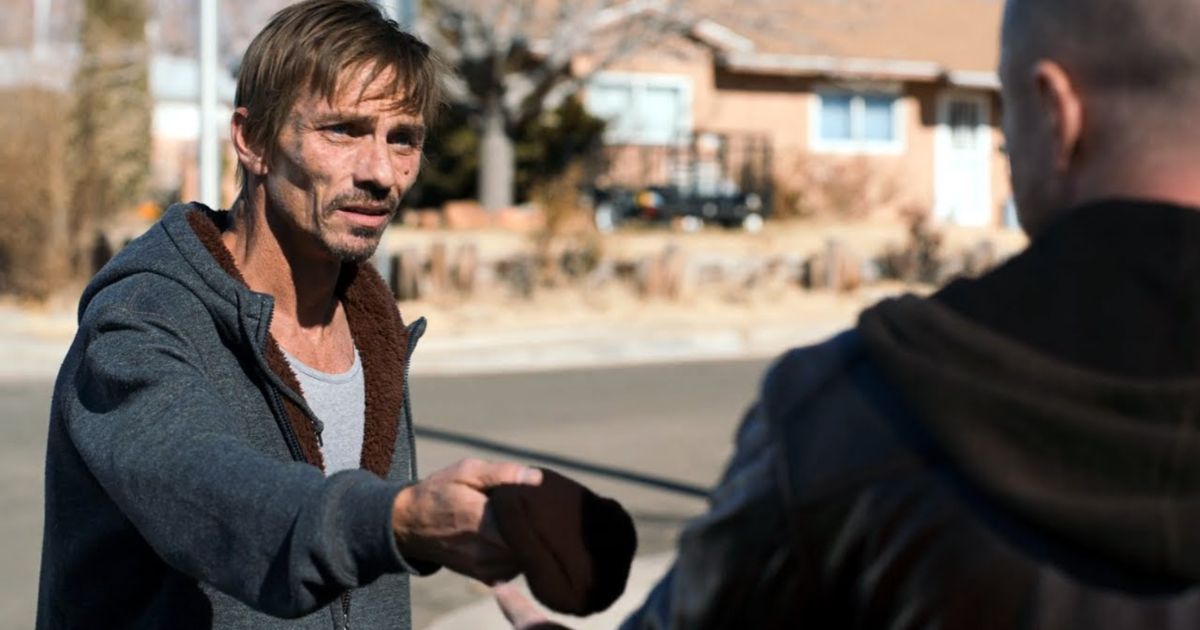
Charles Baker was originally hired for a one-day gig. One day. That was supposed to be the extent of Breaking Bad Skinny Pete. He was just a skinny guy in a beanie meant to facilitate a drug deal and vanish into the Albuquerque desert. Instead, he became the soul of the show's underworld.
Most people remember him for the "church" speech or the way he played the piano with the hands of a virtuoso. But if you look closer, Skinny Pete is one of the few characters who never actually loses his humanity, even while sinking deeper into the meth trade. It's a wild contrast. You have Walter White, a chemistry genius who turns into a monster, and then you have Skinny Pete, a street-level dealer who turns out to be a sensitive, loyal, and surprisingly talented artist.
The Piano Scene: A Masterclass in Subverting Expectations
Think back to season five, episode three, "Hazard Pay." Skinny Pete and Badger are in a music store. It’s a classic setup for a joke. You expect them to goof off, maybe play "Smoke on the Water" badly, or just be the comic relief they usually are. Then, Pete sits down at a keyboard.
He plays C.P.E. Bach’s "Solfeggietto."
It isn’t just a "cool moment." It’s a devastating reveal of a wasted life. The way his fingers move across those keys—precise, fast, trained—tells you everything the script doesn't say. This guy had a future. He had discipline. He had a gift that required years of practice, likely in a structured environment. And yet, here he is, helping a kingpin move product. It’s arguably the most "Breaking Bad" moment in the entire series because it highlights the tragedy of potential gone to rot.
Charles Baker actually plays the piano in real life, which is why that scene feels so authentic. There’s no hand double. There’s no camera trickery. It’s just a man who knows he’s thrown away something beautiful.
Loyalty Beyond the Blue Meth
Skinny Pete and Badger are often lumped together as a singular comedic unit. They’re the Rosencrantz and Guildenstern of the ABQ drug scene. But Pete is the grounded one. While Badger is busy arguing about Star Trek scripts or zombie logic, Pete is the one who shows up when the chips are down.
Take the aftermath of Combo's death. Pete is visibly shaken. He’s not a hardened killer. He’s a guy who loves his friends. When Jesse is at his lowest, Pete doesn't judge him. He doesn't try to play him. He just offers a place to crash and a bit of normalcy.
In El Camino, we see the peak of this loyalty. Jesse shows up at Pete’s door, looking like a ghost, traumatized and smelling like a caged animal. Pete doesn't hesitate. He gives Jesse his own bed. He devises a plan to distract the police, using his own car as a decoy.
"Dude, you're my hero and shit."
That line from Pete to Jesse at the end of the movie isn't just filler. It’s a genuine acknowledgment of Jesse's struggle to escape. Pete knows he’s stuck in his life. He knows he’s never getting out of that living room in Albuquerque. But he wants Jesse to make it. It’s an act of pure, selfless love that is incredibly rare in a show defined by greed and ego.
The "Church" Monologue and the Philosophy of the Street
We need to talk about the "church" speech. This is from season three, when Pete is describing the quality of Walt’s meth. He calls it "choice." He says it’s like "being in church."
On the surface, it’s a funny bit of slang. In reality, it’s Pete explaining how the product fills a void. For him, the meth isn't just a chemical; it’s an experience that borders on the spiritual. It’s the only thing in his world that feels perfect, which is a pretty sad indictment of his reality.
He’s a man of simple needs but deep thoughts. He’s observant. He notices the shift in Jesse long before others do. He sees the "dead eyes" Jesse gets after killing Gale. Pete might not have a PhD, but his emotional intelligence is higher than almost anyone else in the cast, including Skyler or Marie. He feels the weight of the world, even if he masks it with a beanie and a "yo, man."
Why the Fans Won't Let Him Go
Why does a secondary character like Breaking Bad Skinny Pete have such a massive following? Why did people cheer when he appeared in the El Camino trailer?
It's because he represents us.
Not the drug dealing part, hopefully. But the part of us that is flawed and struggling but still fundamentally good. Pete isn't trying to build an empire. He isn't trying to prove he's the smartest guy in the room. He's just trying to get by and look out for his people. In a world of wolves like Gus Fring and Mike Ehrmantraut, Skinny Pete is just a guy.
He’s the everyman of the criminal underworld.
Technical Details You Probably Missed
If you’re a superfan, you might have noticed some of the subtle details the costume department put into Pete’s look. His beanies changed based on the "vibe" of the season. In the early days, they were brighter, more chaotic. As the show got darker, his wardrobe muted.
Also, his house—or his parents' house, presumably—in El Camino is filled with subtle nods to his past. There are musical scores tucked away. There’s a sense of a middle-class life that he drifted away from. It’s a visual representation of "what could have been."
The Legacy of the Skinny One
Ultimately, Skinny Pete survives. That’s his biggest achievement. In a show where almost everyone ends up dead, in prison, or hiding in Nebraska, Pete is still there. He’s still in Albuquerque. He’s still, presumably, a "good" dude in a bad business.
He’s the witness. He saw the rise and fall of the Heisenberg empire from the front row and lived to tell the tale. He didn't get the money. He didn't get the power. But he kept his soul.
How to Appreciate the Character Further
If you want to really understand the depth of this performance, watch these specific episodes in order. Don't just skip to the "best bits." Look at the evolution:
- Season 1, Episode 6: "Crazy Handful of Nothin'" – His introduction. See how "small" he feels here compared to later.
- Season 2, Episode 6: "Peekaboo" – The trauma of the "skank" robbery. This is where he realizes the game is more dangerous than he thought.
- Season 5, Episode 3: "Hazard Pay" – The piano scene. Watch it twice. Once for the music, once for the look on his face when he stops playing.
- El Camino: Watch the final interaction between him and Jesse. Pay attention to the way he hands over his hat. It’s a passing of the torch.
The best way to honor the character is to recognize that in the Breaking Bad universe, morality isn't about being perfect. It's about how you treat the people who have nothing left. By that metric, Skinny Pete might be the best man in the whole story.
Check out the official Vince Gilligan interviews regarding the casting of Charles Baker; it's a fascinating look at how a minor role can grow through sheer acting talent. You can find these on the "Better Call Saul Insider Podcast" archives where they often reminisce about the original series. Also, if you’re into the music, search for the full version of the Bach piece he plays—it's a staple of piano repertoire that takes immense finger dexterity.
Next time you rewatch, don't just laugh at the slang. Look at the eyes. There’s a lot more going on under that beanie than just meth talk.