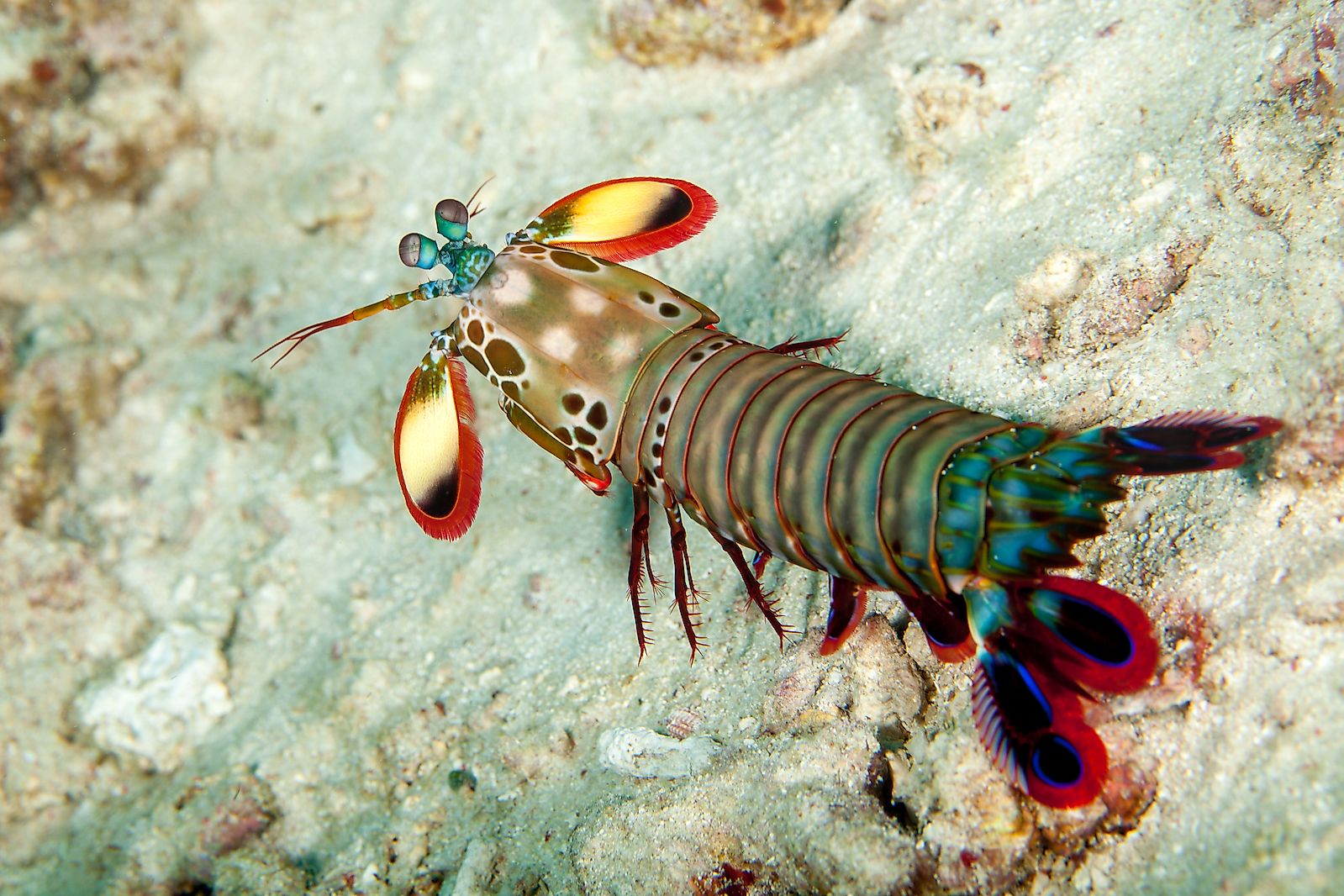
You’re standing in a dimly lit aquarium room. The water is still, reflecting the neon scales of some tropical fish, until—crack. A sound like a small-caliber gunshot echoes off the tile walls. You look at the tank and see a spiderweb of white fractures spreading across the thick acrylic. Somewhere in the sand, a creature no bigger than your hand is looking back at you with independent, rotating eyes that look like they belong on a spaceship.
Yes, a praying mantis shrimp breaks glass. It isn't an urban legend or an exaggeration meant to sell nature documentaries. It is a terrifying, mechanical reality of the ocean.
People usually assume small sea creatures are fragile. We think of shrimp as cocktail appetizers or delicate scavengers. But stomatopods—the scientific name for these underwater brawlers—are basically the heavy-metal version of a crustacean. They don't just swim; they dominate. Specifically, the "smashers" (the ones with club-like appendages rather than spears) possess one of the most violent physical mechanisms in the animal kingdom. If you put one in a standard 10-gallon glass tank, you’re basically inviting a wrecking ball into a china shop. It’s not a matter of if it will break the glass, but when it decides it’s annoyed enough to do it.
The Physics of a 50-Mile-Per-Hour Punch
How does a six-inch shrimp generate enough force to shatter tempered glass? It’s all about the "power amplification" system. Imagine a crossbow. You can’t throw an arrow with your bare hands at 200 miles per hour, but you can use your muscles to slowly pull back a string, storing energy in the bow’s limbs, and then release it all at once.
The mantis shrimp does exactly this with its "raptorial appendages."
Inside their arms, they have a saddle-shaped structure that acts like a spring. They use massive muscles to latch this spring into a cocked position. When they let go, the arm snaps forward with the acceleration of a .22 caliber bullet. We are talking about 10,000 times the acceleration of gravity. It’s so fast that the human eye can’t even begin to track the movement; it just looks like a blur, followed by the target—be it a crab shell or a glass wall—exploding.
The Double-Hit: Cavitation Bubbles
Here’s where things get weird. The physical strike of the limb isn't the only thing hitting the glass. Because the arm moves so fast through the water, it creates a low-pressure zone behind it. This causes the water to literally boil at room temperature for a split second, forming what's called a cavitation bubble.
When that bubble collapses, it releases a secondary shockwave.
This second hit is nearly as powerful as the first strike itself. It also produces a tiny flash of light and an immense amount of heat—for a microsecond, the temperature inside that collapsing bubble can reach several thousand degrees Kelvin. This is why even if the shrimp misses its prey slightly, the shockwave alone can stun or kill. When a praying mantis shrimp breaks glass, it’s often this combination of the physical club and the collapsing cavitation bubble that does the final damage.
Why Do They Even Attack the Tank?
They aren't necessarily trying to escape. Mantis shrimp are notoriously grumpy and highly territorial. In the wild, they live in burrows or rock crevices. They spend their days defending their "home" from intruders.
When you put one in a glass aquarium, the shrimp sees its own reflection.
To a stomatopod, that reflection isn't "me." It’s a rival mantis shrimp encroaching on its territory. It tries to scare the intruder off with a threat display. When the "other" shrimp doesn't move, it decides to end the argument. It strikes the glass. Or, it might just be hungry. If a piece of food gets stuck near the corner of the tank, the shrimp will try to "dig" through the glass to get it. Since its only tool is a biological hammer, it uses it.
Real World Incidents
Back in 1998, a mantis shrimp nicknamed "Tyson" (after Mike Tyson) at the Sea Life Centre in Blackpool, England, became famous for this. Tyson was a four-inch peacock mantis shrimp that managed to punch a hole through a quarter-inch thick glass pane. The staff found him chilling in the hole he’d made, while the water level in the tank was rapidly dropping.
It happens more often than people think in the hobbyist world. People buy a "live rock"—pieces of coral rubble used for filtration—and don't realize a hitchhiking mantis shrimp is hiding inside. A few weeks later, they hear a loud click-click-click at night. Then, they find their expensive hermit crabs missing. Eventually, if the shrimp gets bored or territorial, the owner finds a crack in the bottom of the aquarium.
The Secret Engineering of the Club
You’d think that hitting something as hard as glass or a thick clam shell would shatter the shrimp’s own arm. Why doesn't the praying mantis shrimp break its own "hand" when it strikes?
The answer lies in the "impact region" of the club. Researchers at places like the University of California, Riverside, have studied these appendages using high-powered electron microscopes. They found a complex "chiral" structure—layers of mineralized fibers (mostly calcium phosphate and calcium carbonate) arranged like a spiral staircase.
This design is incredibly good at absorbing shock. When the shrimp hits something hard, the spiral structure prevents cracks from spreading. Instead of the whole club shattering, the energy gets dissipated through the layers. It’s basically natural body armor that is more sophisticated than anything Boeing or NASA has currently developed for aircraft frames.
- The Outer Layer: A hard, ceramic-like coating that handles the initial impact.
- The Inner Layers: A softer, more flexible region that acts as a shock absorber.
- The Striated Region: A series of wraps that keep the whole club compressed so it doesn't expand and burst under the pressure of the strike.
Managing a Smasher in Captivity
If you’re brave enough to keep one of these as a pet—and many people are because they are incredibly intelligent and colorful—you can’t just use a standard goldfish bowl.
Acrylic is the gold standard for mantis shrimp owners. Unlike glass, which is brittle and prone to shattering upon point-impact, acrylic is a type of plastic that has a bit of "give." It’s much harder for the shrimp to crack. If you absolutely must use a glass tank, "stomatopod enthusiasts" usually recommend putting a sheet of PVC or egg-crate plastic along the bottom of the tank. This prevents the shrimp from striking the bottom glass while trying to burrow.
The Complexity of Their Vision
We can't talk about their power without talking about their eyes. A mantis shrimp doesn't just see the world; it perceives a reality we can't even imagine. While humans have three types of color-receptive cells (photoreceptors), mantis shrimp have sixteen.
They can see ultraviolet light. They can see infrared. Most impressively, they can see circularly polarized light.
This vision is likely tied to their combat. They use their eyes to spot the weak points in an opponent's shell or to judge the exact distance needed to trigger that cavitation bubble. When they look at the glass of a tank, they aren't just seeing a clear wall; they are seeing a complex interaction of light and reflection that likely triggers their predatory or territorial instincts.
Lessons for Human Technology
Engineers are currently obsessed with the mantis shrimp. Why? Because we want to make things that don't break.
By mimicking the spiral structure of the mantis shrimp’s club, researchers are developing new types of carbon fiber composites. These could lead to ultra-lightweight body armor for soldiers, or car frames that are half the weight of steel but much harder to crush. We are learning how to build better by looking at a "shrimp" that has spent millions of years perfecting the art of the punch.
Honestly, the term "shrimp" feels like an insult to these animals. They are apex predators in a miniature world. They represent a perfect marriage of biological engineering and raw, kinetic violence. When a praying mantis shrimp breaks glass, it’s not just a freak accident; it’s a demonstration of one of the most efficient weapons systems ever evolved on Earth.
What to Do If You Encounter One
If you are a diver, don't try to pet them. They aren't called "thumb splitters" by fishermen for nothing. They can slice a human finger to the bone in a fraction of a second.
If you are an aquarium hobbyist and suspect you have a hitchhiker:
- Identify the sound: Frequent, rhythmic clicking or popping sounds at night are a giveaway.
- Observe your livestock: Missing snails or crabs with smashed shells are a red flag.
- Use a trap: Don't try to grab it with your hands or a thin net. Use a plastic bottle trap or a commercial "X-Terminator" trap.
- Upgrade your glass: If you want to keep it, move it to an acrylic tank immediately to avoid a flood in your living room.
The mantis shrimp doesn't hate your aquarium; it just doesn't respect the structural integrity of glass. To a creature that can boil water with a punch, a thin sheet of silica is barely an inconvenience.
Next Steps for Enthusiasts:
If you're interested in the mechanical properties of stomatopods, look into the research of Dr. Sheila Patek. Her work on ultra-fast animal movements has provided the foundation for much of what we know about the mantis shrimp's strike. For those looking to set up a "species-only" tank, prioritize acrylic construction and ensure you provide at least three inches of sand and rubble to satisfy their burrowing instincts, which reduces the likelihood of them "testing" the tank walls.