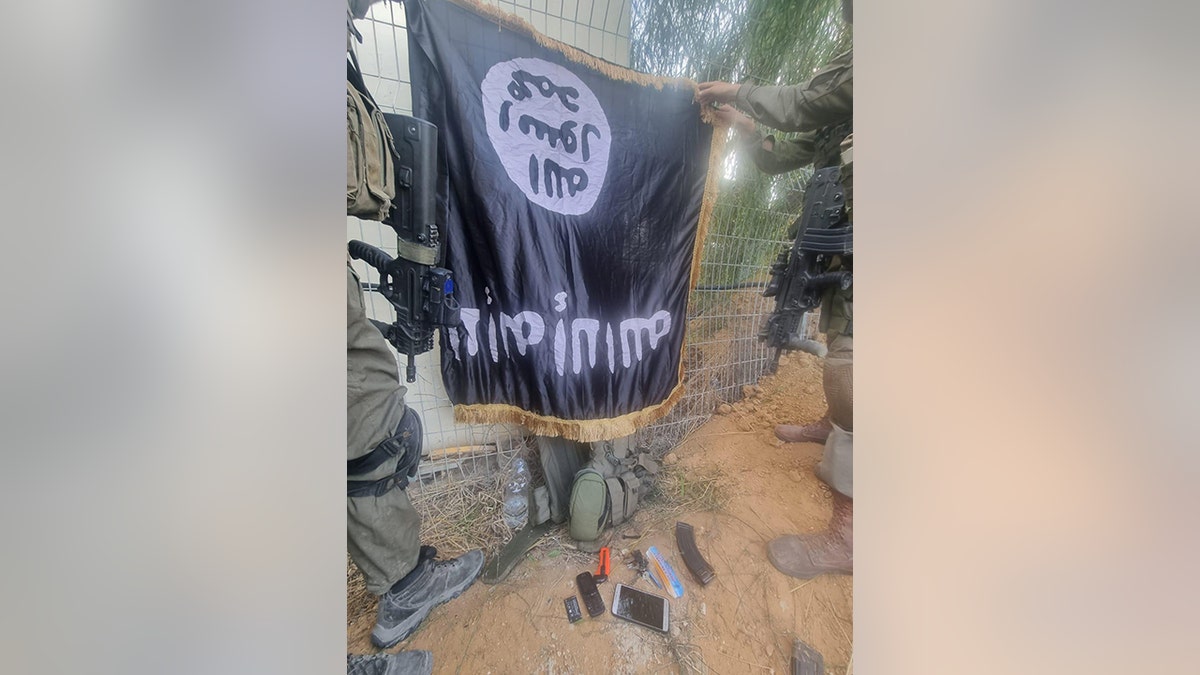
You’ve probably seen it on the news or in a grainy social media clip. A stark, black banner that immediately signals tension. But if someone asked you to describe the details, could you? Most people just see "the scary black flag," but there is actually a very specific design here that is often misunderstood, even by people who study this stuff for a living.
So, what does an ISIS flag look like exactly?
Basically, it’s a black rectangle. On it, there are two distinct parts written in white. At the top, there is a line of Arabic text. Below that, there’s a white circle with three words stacked inside it. It looks rough. It looks hand-drawn. Honestly, that’s entirely by design.
The Visual Breakdown: What’s Actually on the Flag
If you look closely at the ISIS flag, you'll notice it isn't polished like the flag of Saudi Arabia. The top line of text says La 'ilaha 'illa-llah. In English, that translates to "There is no god but God." This is the first half of the Shahada, the Islamic declaration of faith.
Underneath that line is a white, slightly wobbly circle. It’s meant to represent the Seal of Muhammad. Inside the circle, three words are written: Allah, Rasul, and Muhammad. Read from bottom to top, they mean "Muhammad is the messenger of God."
The "hand-drawn" look isn't because they lacked a graphic designer. It’s a deliberate attempt to look ancient. They want you to think this flag came straight out of the 7th century. By avoiding modern, elegant calligraphy, they are trying to signal a "pure" and "primitive" connection to the early days of Islam. It’s a branding trick, plain and simple.
Why the Color Black?
Black isn't just a random choice because it looks intimidating. In Islamic history, the Black Standard (or ar-rayah) has deep roots. Tradition says the Prophet Muhammad used a black banner in battle. Later, the Abbasid Caliphate used black as their official color to distinguish themselves from their rivals.
But for a group like ISIS, the black flag serves a darker, more specific purpose: Apocalyptic symbolism.
There is a prophecy in some Islamic traditions (though widely debated by scholars) about "black banners" coming from the East (specifically the Khorasan region) to signal the end of the world. By flying this flag, the group isn't just claiming territory; they are claiming they are the army of the apocalypse. It’s a way to recruit people who believe they are living in the "end times."
Misconceptions: Not Every Black Flag belongs to ISIS
This is where things get tricky and, honestly, kinda dangerous for the average person. Just because a flag is black and has Arabic on it does not mean it belongs to ISIS.
- The Shahada is Universal: The phrase "There is no god but God" is the core of Islam. Millions of Muslims have this phrase on posters, jewelry, or even other flags.
- The Seal of Muhammad: The white circle is a historical symbol. You might see it on a ring or in a mosque. ISIS didn't invent it; they hijacked it.
- Other Groups: Groups like Al-Shabaab in Somalia or Al-Qaeda have used very similar black banners. Sometimes the only difference is the font or the specific organization name written at the bottom.
Back in 2014, there was a famous incident in New Jersey where a man flew a black flag with the Shahada on it. People panicked and called the cops. Turns out, he’d been flying it for ten years as a sign of his faith, long before ISIS was a household name. This kind of confusion happens all the time because the group intentionally used symbols that are deeply meaningful to 1.8 billion people.
The Legal Reality of the Flag
Because this banner is so closely tied to a designated terrorist organization, owning or displaying it can get you into serious legal trouble in many parts of the world.
In Germany, for instance, the public display of the ISIS flag has been banned since 2014. The same goes for Austria. In Australia, laws have been passed to criminalize the display of "prohibited hate symbols," which explicitly includes this specific flag design.
Authorities in these countries argue that the flag isn't being used as a religious statement but as a tool for "incitement to violence." However, this creates a massive headache for historians, journalists, and educators. How do you show what the group is without breaking the law? Usually, there are "educational" exceptions, but the line is blurry.
Why Does the Design Still Matter Today?
Even though the "territorial caliphate" has collapsed, the image of the flag persists in digital spaces. It remains a powerful "brand" for lone-wolf actors.
What makes it so effective—and so frustrating for counter-terrorism experts—is its simplicity. Anyone with a black sheet and some white paint can recreate it. It doesn't require a factory. It’s a "DIY" symbol for a decentralized age.
Actionable Insights for the Curious
If you are researching this for a project or just trying to be a more informed news consumer, keep these points in mind:
- Look at the font: If the Arabic looks like it was written with a thick marker, it’s likely the ISIS-specific version.
- Check the circle: The presence of that specific "wobbly" white circle (the Seal) is the biggest giveaway.
- Context is king: In many countries, even searching for or downloading high-res versions of this flag can trigger red flags with internet service providers or security agencies. Be smart and stick to reputable news or educational sites for your research.
- Distinguish between faith and extremism: Remember that the words on the flag are sacred to Muslims; the way ISIS uses them is what is condemned.
The ISIS flag is a case study in how a group can take ancient, respected symbols and weaponize them for modern psychological warfare. By understanding exactly what is on it, you can see past the shock value and understand the propaganda machine behind it.