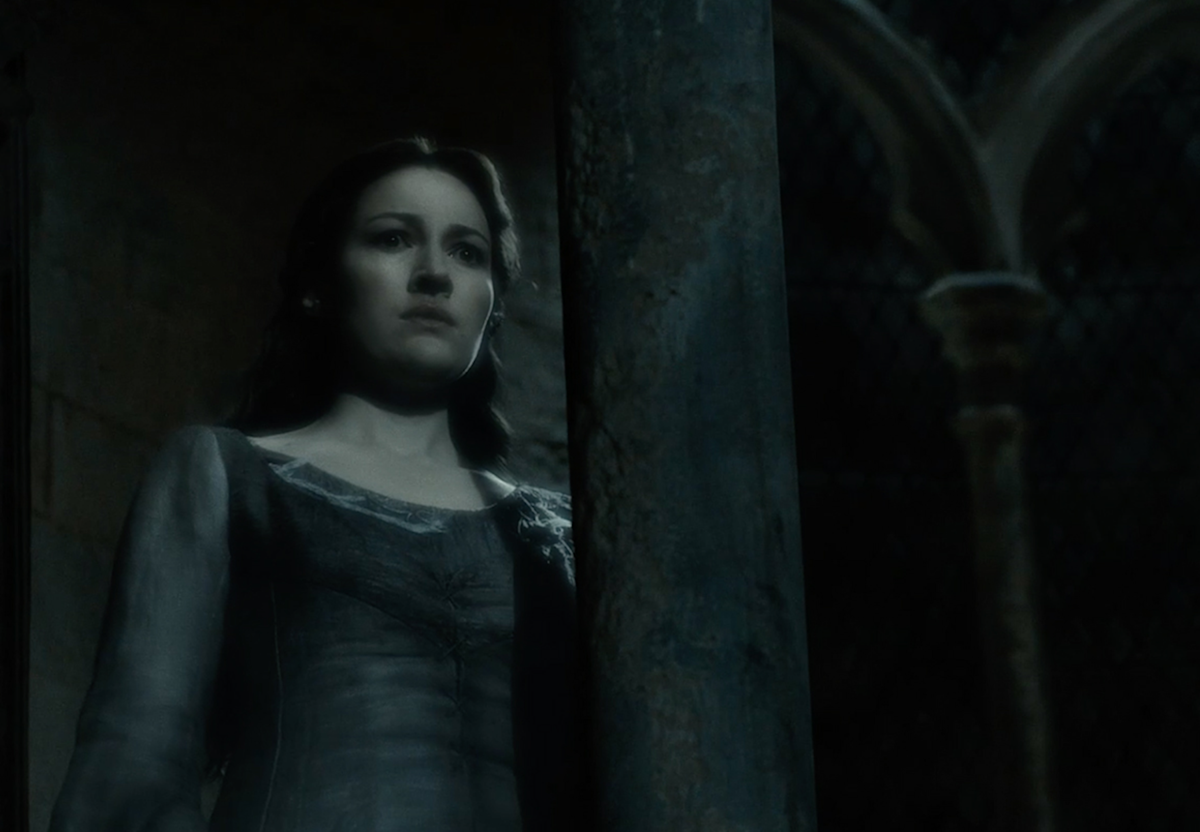
She’s just there. If you’ve only watched the early movies, the Gray Lady is basically background dressing, a silvery blur floating through the stone corridors of Hogwarts without much to do. But honestly, she is one of the most complex characters J.K. Rowling ever penned. Helena Ravenclaw—the ghost's real name—isn't just some random spirit. She’s the daughter of a founder. She’s a thief. She’s a victim.
Most fans forget that without the Gray Lady, Voldemort never becomes the threat he was. That’s a heavy burden for a ghost to carry for a thousand years.
Who exactly was the Gray Lady before she died?
Helena Ravenclaw was born into wizarding royalty. Her mother, Rowena Ravenclaw, was arguably the most brilliant witch of her age. Imagine growing up in that shadow. It’s hard. You’d feel like you’re never enough, right? Helena certainly did. She wanted to be smarter. She wanted to be more important than her famous mother.
So, she did something desperate. She stole her mother’s diadem—the famous crown that was said to grant wisdom to the wearer. She thought the object could make her equal to Rowena.
It didn't work.
Rowena fell ill, and even after the theft, she didn't want her daughter punished by the law. She sent a man to find her. That man was the Baron, who we now know as the Bloody Baron, the Slytherin ghost. He loved her, but it was a dark, obsessive kind of love. When he found her in an Albanian forest and she refused to come home with him, he snapped. He killed her. Then, overcome with a sudden, crushing guilt, he killed himself with the same weapon.
Now they both haunt the same castle. Talk about an awkward workplace environment.
The Tom Riddle Connection
Decades before Harry Potter ever set foot in Hogwarts, a young, charming Tom Riddle started asking questions. He was a prefect. He was handsome. He knew how to talk to people—and ghosts.
He found the Gray Lady and did what nobody else had bothered to do in centuries: he listened.
Helena was lonely. She felt misunderstood. Riddle played on that. He convinced her that he was just like her—someone seeking greatness, someone who would keep her secrets safe. He manipulated a ghost. Think about the level of sociopathy required to do that. She told him where she had hidden the diadem in that Albanian forest all those years ago.
Tom traveled there, found the relic, and turned it into a Horcrux. He defiled her mother’s greatest treasure. When Harry finally talks to her in The Deathly Hallows, the regret she feels is palpable. It’s a heavy, silvery grief that defines her entire existence.
Why the movies got her wrong (and why it matters)
In the Sorcerer's Stone film, she's barely a cameo. In the final movie, played by Kelly Macdonald, she’s much more intense, but the nuance of her relationship with the Bloody Baron is largely glossied over.
In the books, the dynamic is far more haunting.
The Baron wears chains as a sign of penance for murdering her. He has been wearing them for a millennium. Helena, meanwhile, spends her afterlife avoiding him at all costs. It’s a story of domestic violence and obsession frozen in time. It adds a layer of darkness to Hogwarts that the "magical school" aesthetic usually hides.
Hogwarts isn't just a school; it's a mausoleum of ancient mistakes.
Sorting out the Diadem mystery
The diadem itself is a fascinating piece of lore. It was inscribed with the words: "Wit beyond measure is man's greatest treasure."
- Location: Hidden in a hollow tree in Albania for centuries.
- The Transformation: Tom Riddle turned it into his fifth Horcrux.
- The Return: He brought it back to Hogwarts, thinking he was the only one who knew the castle's deepest secrets.
- The Destruction: It wasn't a spell that killed it. It was Fiendfyre in the Room of Requirement.
The irony is sharp. Helena stole the diadem to gain wisdom, but her lack of wisdom in trusting Riddle led to its total destruction.
The Gray Lady and the Search for Forgiveness
When Harry approaches her during the Battle of Hogwarts, he isn't just looking for an object. He's looking for the truth. Helena is reluctant. Why wouldn't she be? The last time she trusted a "bright young student," he became the darkest wizard in history.
She tells Harry, "I stole it. I meant to make myself cleverer, more important than my mother."
That admission is the climax of her character arc. It’s the first time she really owns her sin. In a way, Harry helps her find a tiny shred of peace by finally destroying the object that had tethered her to her greatest shame.
She isn't just a ghost who gives directions. She's a warning about the dangers of envy.
Real-world inspirations for the character
Many believe Rowling drew inspiration from "The Grey Lady" legends found across the UK. There’s a famous Grey Lady at Glamis Castle in Scotland, allegedly the ghost of Lady Janet Douglas. Others point to the "Brown Lady" of Raynham Hall.
These folklore spirits are almost always women who died under tragic, often violent circumstances involving betrayal or lost love. Helena Ravenclaw fits this archetype perfectly, blending classic Gothic horror with the modern wizarding world.
How to explore the lore further
If you're looking to dive deeper into the history of the Hogwarts ghosts, there are a few things you should do next.
First, go back and re-read the "Forest of Dean" and "The Lost Diadem" chapters in The Deathly Hallows. Pay close attention to how Helena describes her mother. There's a lot of subtext there about the pressure of being a "Ravenclaw" and the high expectations that come with that house.
Second, look into the history of the Bloody Baron. His story is the mirror image of hers. You can’t fully understand the Gray Lady without understanding the man who ended her life.
Lastly, check out the Hogwarts Legacy game if you're a gamer. The game lets you explore the Ravenclaw common room and the higher towers of the castle where her presence is most felt. It gives a great sense of the physical space she occupied while she was alive and where she chose to hide after her death.
Don't just see her as a background character. She is the keeper of Ravenclaw's greatest tragedy. Knowing her story changes how you see the entire Ravenclaw house—it’s not just about books and cleverness; it’s about the crushing weight of trying to be perfect.
Keep an eye out for the small details next time you watch the films or read the books. The ghosts aren't just there for atmosphere. They are the living (well, dead) history of the school's failures. And Helena Ravenclaw is perhaps the most tragic of them all.