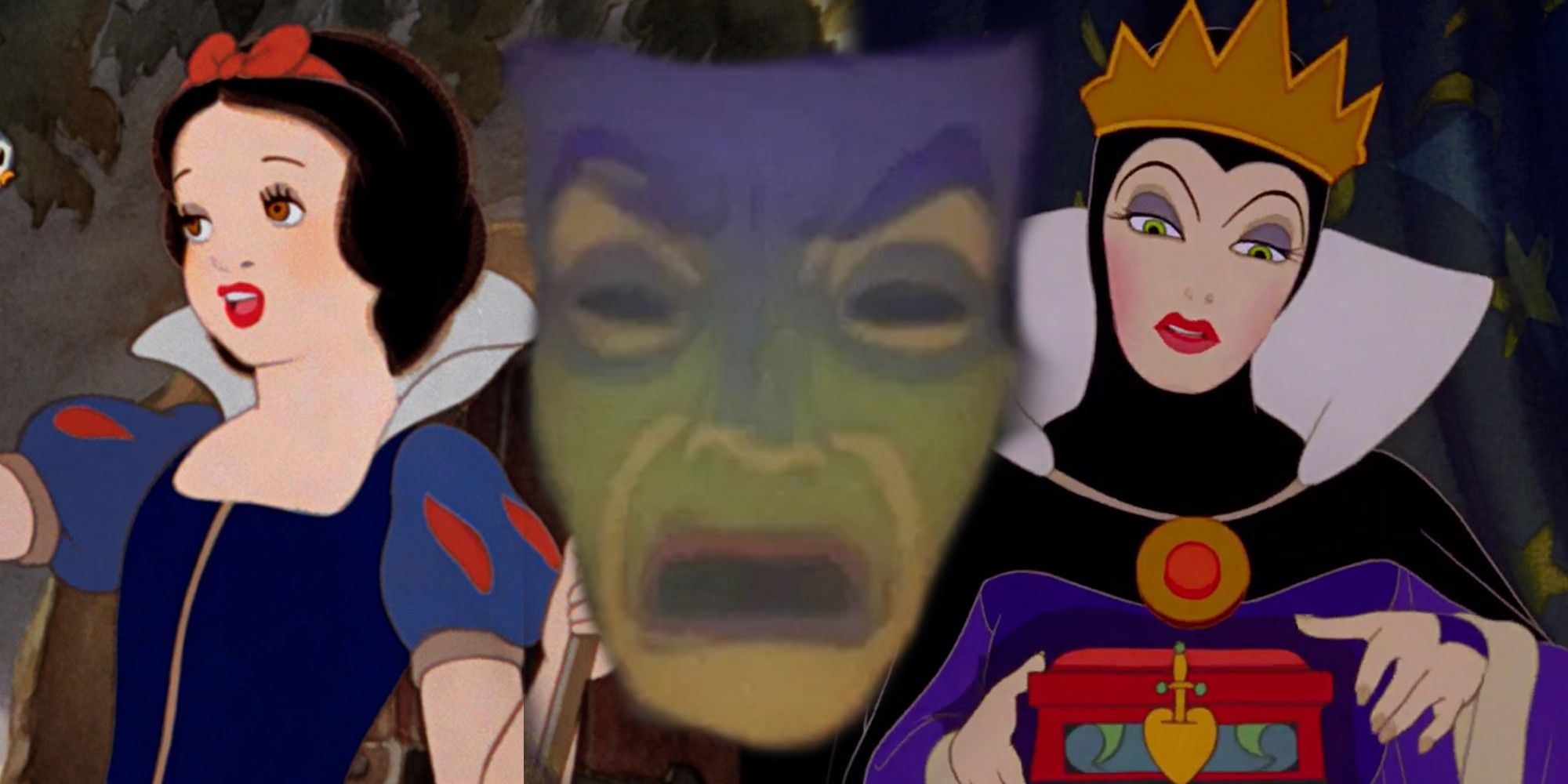
She is the reason a generation of kids grew up afraid of their own shadows. Honestly, when you look back at the 1937 masterpiece Snow White and the Seven Dwarfs, the Evil Queen isn't just a cartoon villain. She’s a psychological powerhouse. She represents that raw, unfiltered vanity that most of us are too scared to admit we even have.
Walt Disney knew what he was doing. He didn't want a "fairytale" villain; he wanted a nightmare.
Most people remember the poison apple. It's iconic. But if you really sit down and watch the film today, the horror of the Evil Queen starts much earlier. It starts with the silence. She doesn't scream. She doesn't cackle—at least not at first. She just stares into that mirror with a cold, calculated desperation that feels strangely human. It’s about the fear of being replaced. It’s about aging. It’s about the loss of power.
The Queen's Real Name and Where She Came From
You might call her "The Evil Queen," but Disney historians and die-hard fans usually refer to her as Queen Grimhilde. That name wasn't actually used in the 1937 film itself, but it appeared in promotional materials and comic strips around that time. It sounds heavy. It sounds old-world. It perfectly fits the vibe of a woman who would literally ask a huntsman to cut out a girl's heart and bring it back in a jewelry box.
Think about that for a second. This wasn't a "send her away" situation. This was a "bring me her internal organs" situation.
The design of the character was heavily influenced by several real-world and cinematic inspirations. Concept artist Albert Hurter and animator Art Babbitt looked at Hollywood royalty. They drew inspiration from Joan Crawford’s icy features and the statuesque beauty of Helen Gahagan in the 1935 film She. There’s also a heavy dose of German Expressionism in her castle. Look at the shadows. Look at the jagged arches. It feels like The Cabinet of Dr. Caligari because the animators wanted her environment to reflect her fractured mind.
She's the first real villain in feature-length animation history, and she set a bar that almost nobody has cleared since.
Why the Transformation Scene Still Works (And Why It’s Horrifying)
If you want to see where the budget went, watch the transformation scene. The Evil Queen decides that if she can’t kill Snow White as a beautiful monarch, she’ll do it as a "hag."
It’s a masterclass in pacing.
The spinning room. The colors shifting from cold blues to sickly greens and purples. The way her hands warp and grow gnarled. This wasn't just "magic." This was body horror before body horror was a mainstream genre. Joe Grant, the legendary Disney artist, based the "Old Witch" look on a woman who lived in his neighborhood. He literally used real-life observation to make a monster.
People often ask why she chose to become "ugly" to achieve her goal. It’s the ultimate irony. Her entire life was built on being the "fairest in the land," yet she willingly throws away her beauty to satisfy her spite. It shows that her hatred for Snow White was actually stronger than her love for herself. That’s dark. Like, really dark for a "kids" movie.
The Mirror as a Psychological Tool
The Magic Mirror isn't just a plot device. It’s her conscience, or maybe her ego. Notice how the Mirror never lies? It can’t. In the original Brothers Grimm tale, the mirror is just a mirror, but Disney turned it into a "Slave in the Magic Mirror," voiced by Moroni Olsen.
The Mirror acts as a catalyst. It doesn't tell her to kill Snow White; it just tells her the truth. She’s the one who reacts with violence. In modern psychological terms, you could argue the Queen is suffering from a massive narcissistic injury. The moment she isn't "the best," her entire world view collapses.
Snow White and the Seven Dwarfs: The Evil Queen vs. The Brothers Grimm
We have to talk about the ending. If you think the movie ending is scary—where she falls off a cliff and a couple of vultures fly down to finish the job—you haven't read the original German folklore.
In the Grimm version, the Queen is invited to Snow White’s wedding. Talk about an awkward guest list. As punishment for her crimes, she is forced to put on a pair of iron shoes that have been heated over a fire. She has to dance in those red-hot shoes until she falls down dead.
Disney actually softened the story. Let that sink in.
The film version focuses more on the "divine intervention" of the lightning bolt. It feels more like the universe itself rejected her existence. But regardless of which version you prefer, the core theme is the same: obsession consumes the obsessed.
Small Details You Probably Missed
Next time you watch, look at the Queen’s throne. It’s shaped like a giant peacock. Usually, we think of peacocks as beautiful, right? But they are also the universal symbol of vanity. It’s literally built into her furniture.
Also, pay attention to the colors. Before she turns into the witch, she wears deep purples and golds—the colors of royalty and wealth. After the transformation, she’s in tattered black rags. She goes from the highest social standing to the absolute lowest.
And the heart box? If you look closely at the latch, it’s a heart pierced by a dagger. She had that box ready. She didn't just find it; she owned a custom-made box for human remains. This woman was prepared for a murder long before Snow White turned fourteen.
The Legacy of the First Villainess
The Evil Queen paved the way for Maleficent, Ursula, and Cruella de Vil. But she’s different because she doesn't have a "fun" side. Ursula is flamboyant. Maleficent is elegant. The Queen is just... cold. There are no jokes. There are no catchy songs for her to sing while she stirs her cauldron.
She’s pure, distilled envy.
Even the way she dies is unceremonious. She doesn't get a big final speech. She tries to crush the dwarfs with a boulder, the ground gives way, and she's gone. The vultures landing afterward is the final "yikes" moment that stayed with kids for decades. It’s visceral.
Actionable Takeaways for Fans and Collectors
If you’re looking to dive deeper into the history of Snow White and the Seven Dwarfs and the Evil Queen, don't just stick to the movie.
- Check out the "Art of Disney" archives: Look for the original sketches by Gustaf Tenggren. His work gave the film its "Old World" European look that feels much grittier than later Disney films.
- Compare the voice acting: Listen to Lucille La Verne. She voiced both the Queen and the Witch. To get the "Witch" voice, legend has it she took out her false teeth. It changed the resonance of her mouth and created that iconic, raspy hiss.
- Visit the Walt Disney Family Museum: If you’re ever in San Francisco, they have original cels and the multiplane camera technology used to give the Queen’s dungeon that terrifying depth.
- Read "The Fairest of All" by Serena Valentino: If you want a "wicked" style backstory, this novel explores the Queen's descent into madness. It’s not "canon" to the 1937 film, but it’s a fantastic character study.
The Evil Queen remains the gold standard for villains because she represents a very real human flaw: the inability to be happy for someone else's success. She had the kingdom, the crown, and the magic. But it wasn't enough as long as someone else was "fairer."
That’s a lesson that hits just as hard in the age of social media as it did in 1937.
Next Steps for Enthusiasts:
Start by re-watching the film specifically focusing on the background art in the Queen’s scenes. Notice how the architecture is designed to make her look smaller and more trapped as her obsession grows. Then, look into the 1930s "Horror" genre—films like Dracula and Frankenstein—to see how Disney was actually competing with live-action monster movies of the time. You'll see the Queen in a whole new, much darker light.