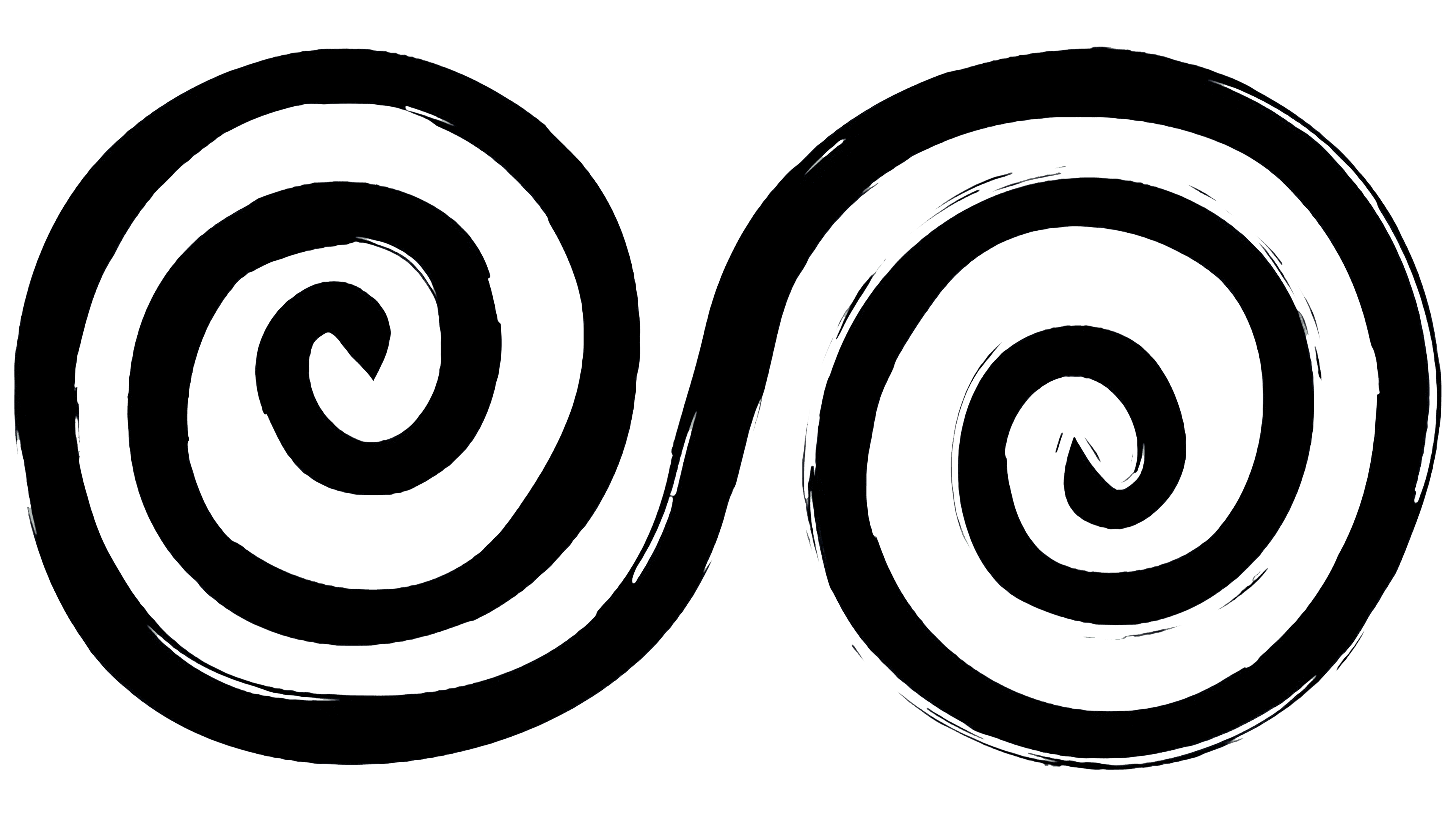
You see it in your thumbprint. You see it when you pull the plug in a bathtub and the water gurgles down the drain. If you’ve ever stared at a sunflower or looked at a satellite image of a hurricane, you’ve seen it there too. The meaning of the spiral isn't just some abstract "new age" concept or a cool tattoo design. It’s basically the universe’s favorite way of getting from point A to point B without wasting energy.
Nature is lazy. Honestly, it is. It always looks for the path of least resistance.
The spiral is that path.
Why the Meaning of the Spiral Matters in Nature
If you want to understand why this shape carries so much weight, you have to look at the math, but don't worry—it’s not boring math. It’s the kind of math that makes plants grow efficiently. Most people have heard of the Fibonacci sequence. It’s that string of numbers ($0, 1, 1, 2, 3, 5, 8, 13...$) where each number is the sum of the two before it. When you turn those numbers into squares and draw an arc through them, you get the Golden Spiral.
Plants use this because it’s the most efficient way to pack seeds or leaves without overlapping too much. Think about a pinecone. If the scales grew in straight lines, the pinecone would be clunky and fragile. Instead, they spiral. This allows for maximum density.
It’s about growth.
But it’s also about preservation.
Carl Jung, the famous psychiatrist, spent a lot of time thinking about these symbols. He viewed the spiral as an archetype. To him, the meaning of the spiral represented the path to the self. You aren't just walking in a circle, repeating the same mistakes over and over—though it feels like that sometimes, doesn't it? In a spiral, you come back to the same point, but you’re at a different level of understanding. You’ve evolved. You’re seeing the same problem from a higher vantage point.
Ancient History and the Spiral
Go back 5,000 years to Newgrange in Ireland. Long before people had CAD software or even a standardized alphabet in northern Europe, they were carving massive triple spirals into stone. This specific design is called the Triskele.
What were they thinking?
We can't ask them, obviously. But archaeologists like Dr. Miranda Aldhouse-Green suggest these symbols were tied to the movement of the sun or the cycle of life, death, and rebirth. It’s a triple motion. It never stops. In many ancient cultures, a straight line was considered unnatural. Straight lines don't really exist in the wild; they are a human invention. The spiral, however, is everywhere.
In Native American traditions, specifically among the Hopi, the spiral often represents the journey of the soul. It’s the "path of emergence." You start at the center and you work your way out into the world. Or, depending on the ritual, you start at the edge and work your way back to the center to find your true essence.
It's a bit of a paradox.
It moves inward and outward at the exact same time.
The Difference Between Whirlpools and Labyrinths
A lot of people get spirals mixed up with circles or labyrinths. They aren't the same. A circle is a closed loop. It’s a boundary. A spiral is open-ended. It implies that there is no "end," only a continuation.
Then you have the labyrinth. Unlike a maze—which is designed to make you get lost—a labyrinth is a single, winding path that leads to the center. Many labyrinths are built using a spiral-like structure. When you walk one, like the famous one at Chartres Cathedral, you’re engaging in a physical meditation. You’re forced to slow down. You can’t run a spiral quickly without getting dizzy. You have to pace yourself.
That’s a big part of the meaning of the spiral in a modern context: pacing.
The Dark Side of the Spiral
It isn't all "growth and harmony," though. We use the word "spiraling" to describe mental health crises for a reason.
When things go wrong, they go south fast.
A "downward spiral" is a feedback loop where one bad thing triggers another. In psychology, this is often linked to rumination. You have a negative thought, which makes you feel anxious, which makes you focus more on the negative thought. You’re spinning. The center of that spiral feels like a drain.
Is there a way out?
Actually, the geometry of the shape says yes. Because a spiral is open, you can technically change the trajectory at any point. You aren't locked in a cage; you’re on a path. Changing the "pitch" of the spiral—how wide or tight the turns are—is how you break the cycle.
Spirals in Science and Space
Look up.
Our galaxy, the Milky Way, is a barred spiral galaxy. We are literally living on one of the "arms" of a massive, rotating spiral of stars and gas. It’s mind-blowing when you think about it. The same shape that governs how your DNA—the double helix—is wound also governs the structure of the universe.
British astrophysicist Sir Arthur Eddington once noted that the "arrow of time" moves in a way that often mimics these expanding structures. Entropy increases, things expand, and the universe "spirals" outward.
It’s the signature of the cosmos.
How to Use This Symbol in Your Life
If you’re feeling stuck, or if you’re looking for a bit of clarity, the meaning of the spiral can actually be a practical tool. It’s not just for looking at. It’s for doing.
- Audit your "circles": Look at the habits you think are repetitive. Are you actually moving in a circle (nowhere), or is it a spiral? Are you getting slightly better each time you face a challenge? If not, you need to widen your arc.
- Try Spiral Drawing: This sounds weirdly simple, but it’s used in art therapy. Start a pen in the center of a page and draw a slow, continuous spiral outward until you hit the edges. It forces your brain to sync your hand movement with your breath. It’s a "nervous system hack" for anxiety.
- Observe the "Micro": Next time you’re at the grocery store, look at the cabbage. Look at the shells at the beach. Recognizing these patterns in the mundane helps ground you. It reminds you that you’re part of a much larger, very organized system.
The spiral reminds us that change is the only constant. You can't stay at the center forever, and you can't stay on the outer edge forever. You’re always moving. The trick is to make sure you’re moving toward something that matters.
Actionable Next Steps
To truly integrate the power of this shape, start by identifying one recurring "loop" in your daily routine that feels stagnant. Change one small variable in that loop—the time you wake up, the route you drive, or the first thing you say to your partner. By shifting that one point, you effectively convert a closed circle into an upward spiral. Practice "wide-angle" thinking when you feel overwhelmed; imagine your current problem as just one small curve on a much larger spiral that extends years into your future. This perspective shift naturally reduces the immediate pressure of the moment. Finally, spend five minutes tonight looking at images of the "Fibonacci in nature" to visually remind your brain that growth is rarely a straight line, but it is always happening.