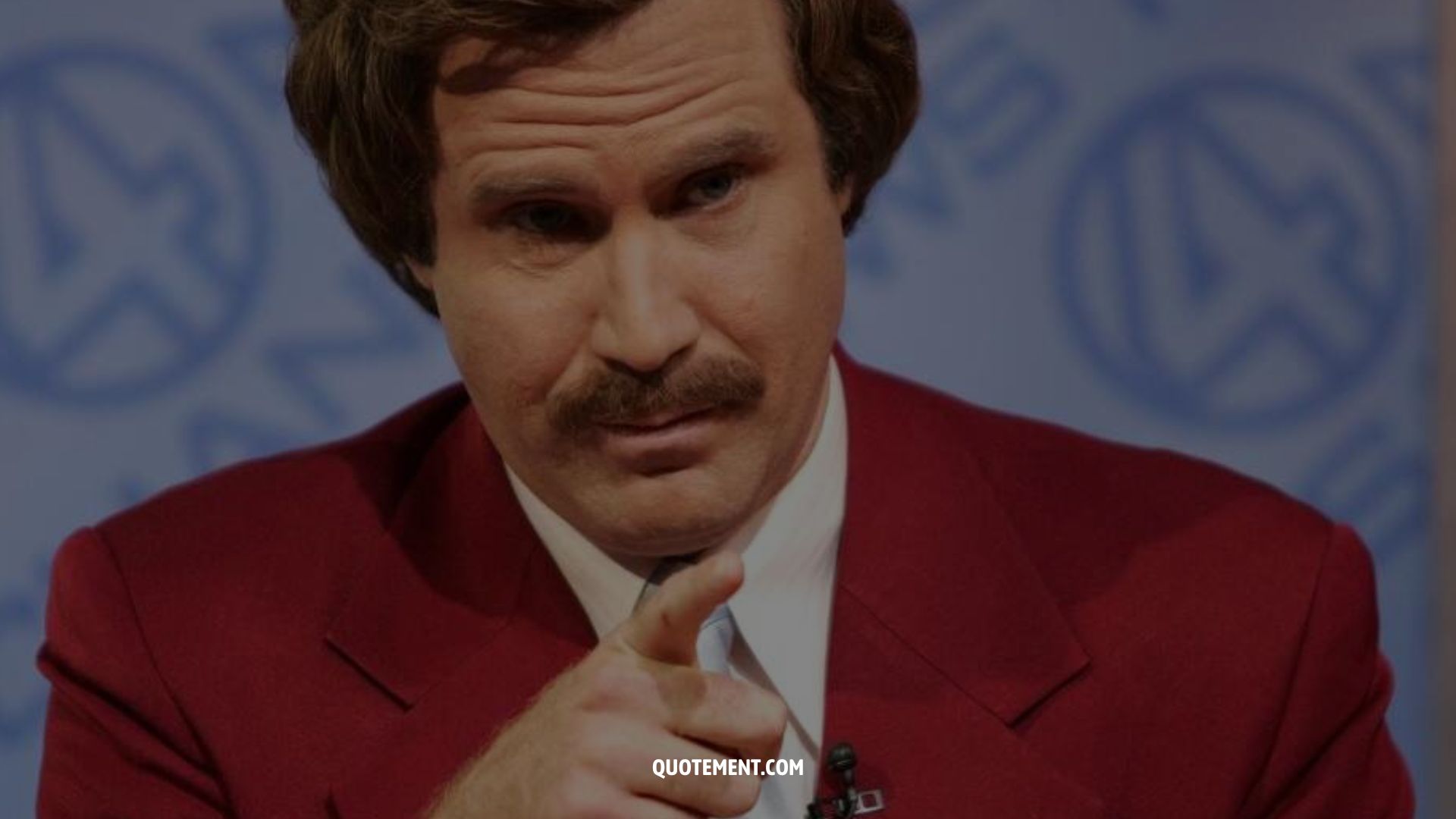
You know that feeling when you're in a conversation that's way over your head? Everyone is talking about deep stuff—relationships, the meaning of life, maybe even the economy—and you’re just sitting there, desperate to contribute something, anything, so you don't look like a total statue. That is the exact energy of Steve Carell’s Brick Tamland.
And it's where we got the most iconic non-sequitur in movie history.
"I love lamp." It’s three words. It’s objectively nonsense. Yet, here we are, over twenty years since Anchorman: The Legend of Ron Burgundy hit theaters in 2004, and people still shout it at parties, put it on t-shirts, and use it as a shorthand for "I have no idea what is going on." But why? Why did a line about a piece of office furniture become a cultural pillar while other comedies from that era faded into the background?
The Secret Origin of the Lamp
Honestly, the best part about the "I love lamp" scene is that it wasn't even supposed to happen. It wasn't in the script. Not originally.
While filming the scene where Ron Burgundy (Will Ferrell), Brian Fantana (Paul Rudd), and Champ Kind (David Koechner) are trying to explain the concept of love to Brick, director Adam McKay realized the scene needed more "Brick." He literally walked up to Steve Carell and told him to just say something. Anything.
Carell, being a Second City improv legend, looked around the room. He saw a rug. He saw a desk. He saw a lamp.
How the Improv Went Down
- The Lead-up: The guys are talking about their "expert" experiences with love. Brian mentions a questionable encounter at a K-Mart.
- The Breaking Point: Brick, feeling the pressure to fit in with the "cool" guys, starts pointing at things.
- The Delivery: "I love carpet. I love desk." And then, with a look of pure, unadulterated sincerity: "I love lamp."
The genius isn't just in Carell saying it. It's in Will Ferrell’s reaction. Instead of ignoring it, Ferrell stays in character as Ron and challenges him: "Brick, are you just looking at things in the office and saying that you love them?"
Brick’s defiant "I love lamp!" in response is what seals the deal. It’s the sound of a man doubling down on a lie he doesn't even understand.
Why Brick Tamland Is the Ultimate Outsider
We've all been Brick. Not the "ate a big red candle" or "killed a guy with a trident" version of Brick, hopefully. But the version that feels like they’re playing a game where everyone else knows the rules except them.
Comedy experts often point to Brick as the "absurdist anchor" of the film. While Ron is a blowhard and Brian is a sleazeball, Brick is a complete blank slate. He has an IQ that is technically "below 48" according to the film’s lore, and he’s frequently confused by his own shadow.
But in the "I love lamp" moment, he’s trying to be human. He sees his friends bonding over a shared emotion—love—and he wants in. Since he doesn't understand the complex neurochemistry of human attachment, he applies the word "love" to the first thing that provides him light. It’s weirdly wholesome. Sorta.
The "I Love Lamp" Meme Before Memes Were a Thing
Back in 2004, we didn't have TikTok. We barely had YouTube. "Viral" was something you went to the doctor for.
Yet, Anchorman quotes spread through schools and offices like wildfire. It was a social currency. If you said "I love lamp" and someone laughed, you knew you were part of the same tribe. It was a litmus test for a specific kind of "new" comedy that Adam McKay and Judd Apatow were pioneering—one based on long, rambling improvisations and characters who were aggressively stupid but weirdly confident.
The Science of a Non-Sequitur
Why is it funny? Psychologically, it’s a violation of expectations.
- Context: A serious (for them) talk about romance.
- Expectation: A funny anecdote about a girl.
- Reality: A confession of feelings for a 40-watt bulb.
Our brains love that gap between what we expect and what we get. It's why "Loud Noises!" works. It’s why "60% of the time, it works every time" works. It’s nonsense that sounds like sense.
What Most People Get Wrong About the Scene
There’s a common misconception that the news team was making fun of Brick in that moment. If you watch closely, they’re actually trying to help him. Ron is genuinely curious if Brick understands the words coming out of his mouth.
There’s a strange sweetness to the Channel 4 News Team. They are terrible people in many ways—sexist, arrogant, and shallow—but they fiercely protect Brick. They don't treat him like the office idiot; they treat him like a brother who just happens to think he's being chased by a black man on sunny days (his shadow).
Actionable Takeaways for Comedy Lovers
If you're a fan of this brand of humor, or if you're trying to write your own stuff, there are a few "Brick-isms" you can actually use to understand why this worked so well.
1. Commitment is King
Steve Carell never winks at the camera. He plays Brick with 100% sincerity. If he looked like he knew he was being funny, the joke would die instantly. To make absurdity work, you have to play it straight.
2. The Power of the "Call Out"
The joke isn't just the lamp. The joke is Ron Burgundy calling out the behavior. In your own storytelling, if something weird happens, having a "straight man" character acknowledge it makes the audience feel like they're in on the joke.
3. Use Your Environment
The next time you're stuck in a creative rut, do what Carell did. Look around the room. What’s the most mundane object you see? How can you give it a backstory or an emotional weight it doesn't deserve?
Looking Back From 2026
It’s wild that we’re still talking about a movie that came out over twenty years ago. In an era where content is forgotten in forty-eight hours, Anchorman and its "I love lamp" legacy have survived. It reminds us that sometimes, the best moments aren't the ones we plan meticulously. They’re the ones where we just look at a lamp and decide, for no reason at all, that we love it.
Next Step: Go back and watch the "Afternoon Delight" scene immediately following the lamp confession. Notice how Brick is the one who hits the high notes. It’s a perfect example of how he’s simultaneously the most useless and most essential member of the team.