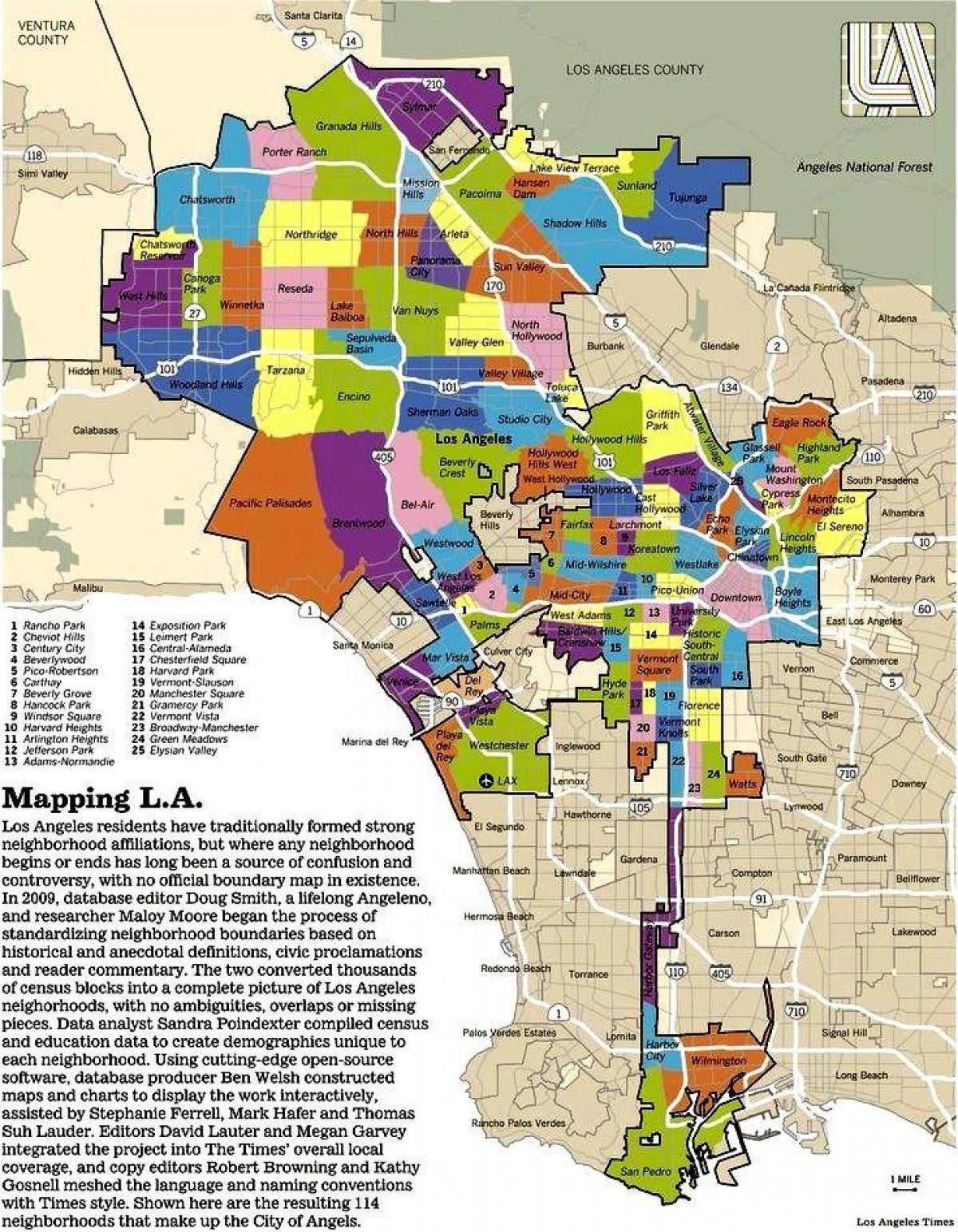
Los Angeles is basically a giant puzzle that someone accidentally dropped on the floor and tried to put back together in the dark. If you've ever tried to look up la city map boundaries, you know exactly what I mean. One minute you are in the City of Los Angeles, and the next, you’ve crossed an invisible line into West Hollywood or Santa Monica, and suddenly the parking tickets cost twice as much. It’s a mess.
People think LA is just one big blob. It isn't. It is a massive patchwork of 88 incorporated cities, dozens of "unincorporated areas" managed by the County, and over 100 distinct neighborhoods within the city limits itself. Honestly, even the post office gets it wrong sometimes. You can have a Beverly Hills mailing address but actually live within the Los Angeles city limits, which means you’re paying LA taxes and voting for the LA mayor, not the folks in 90210.
The Invisible Lines of the LA City Map Boundaries
So, how do you actually define where the City of Los Angeles starts and stops? You have to look at the "shoestring." That’s what locals call the narrow strip of land that runs south to the Port of Los Angeles. Back in the early 20th century, the city wanted the harbor. To get it, they had to annex a thin sliver of land to connect the main body of the city to the water. This is why the la city map boundaries look like a weirdly shaped octopus with one very long, skinny leg reaching for San Pedro.
If you look at a formal map from the Los Angeles Department of City Planning, you’ll see the city is roughly 469 square miles. But it’s not a solid block. It’s full of "holes." Places like San Fernando and Beverly Hills are entirely surrounded by the City of Los Angeles but are not part of it. They are their own islands with their own police departments, schools, and rules. It’s why you might see a LAPD cruiser on one block and a Beverly Hills PD SUV on the next.
The boundaries are defined by Ordinance. Every time a new chunk of land was added—like the massive San Fernando Valley annexation in 1915—the legal description of the city grew. The Valley was brought in mostly because of water. William Mulholland and the boys built the aqueduct, and if you wanted that sweet, fresh mountain water, you had to join the city. Most did. Some, like Burbank and Glendale, said "no thanks" and kept their own borders.
Why the Valley is the Wild West of Mapping
The San Fernando Valley is where the la city map boundaries get truly chaotic. Most people just say they live in "the Valley," but that covers a dozen different neighborhoods that all feel like separate towns. Van Nuys, Northridge, Sherman Oaks—these are all technically part of the City of Los Angeles.
However, if you drive a few miles east, you hit Burbank. Burbank is its own city. If you call 911 in Burbank, you get Burbank dispatch. If you call it in North Hollywood, you get LAPD. This matters for everything from building permits to how quickly a pothole gets fixed. The City of LA uses a system called ZIMAS (Zone Information and Map Access System). It is the holy grail for anyone trying to figure out if their house is actually in the city. You type in an address, and it tells you the exact legal jurisdiction.
There's this weird tension in the Valley. Every few decades, there is a movement for the Valley to secede from Los Angeles. They feel the city is too big and the boundaries are too broad to manage efficiently. In 2002, it actually went to a vote. It failed, but it showed just how much people care about these lines on a map. People want to feel connected to their local government, and when you’re just one of 4 million people in a city that spans from the San Gabriel Mountains to the Pacific Ocean, that’s tough.
The Complexity of Unincorporated LA
Here is where it gets really trippy. Have you ever been to East LA? Most people assume it’s a neighborhood in the city. It’s not. East Los Angeles is "unincorporated." This means it’s part of the County but not part of any specific city. The la city map boundaries literally stop at its edge.
- Sheriff vs. Police: In unincorporated areas like East LA or Marina del Rey, the Los Angeles County Sheriff’s Department handles law enforcement.
- Supervisors: Instead of a City Council member, these residents report to the County Board of Supervisors.
- Services: Trash and fire services come from the County, not the City of LA.
Marina del Rey is another great example. It’s famous, it’s expensive, and it’s a tiny pocket of County land surrounded by the City of LA (Venice and Playa del Rey). If you live there, your lease looks different, your taxes are different, and your "local" government is miles away in Downtown LA. It’s a quirk of history. Usually, these areas didn't incorporate because they didn't have the tax base at the time, or the residents just liked being left alone by the bigger city machine.
How to Check Your Own Status
If you are trying to find the la city map boundaries for a move or a business license, don't trust Google Maps 100%. It’s good for directions, but it’s not a legal document.
- Use the L.A. City Neighborhood Council Map. This is a great way to see how the city carves itself up into smaller, manageable communities.
- Check the "Jurisdiction" tab on your property tax bill. If it says "City of LA," you're in.
- Look at the street signs. The City of Los Angeles has distinct blue signs. If the sign changes color or style, you’ve likely crossed a boundary.
The city isn't just a geographical area; it's a political one. When the city passed the "mansion tax" (Measure ULA) recently, knowing if you were inside or outside those la city map boundaries became a million-dollar question for real estate agents. A house on one side of the street might be subject to the tax, while a house across the street in Santa Monica is not. It’s wild.
The Cultural vs. Legal Border
We also have to talk about how we think about LA. Most people think West Hollywood is just a neighborhood. It's not; it's a city that incorporated in 1984. Most people think Culver City is just a neighborhood. Nope, it’s been its own city since 1917. These places have their own identities that often clash with the "official" la city map boundaries.
You've got the "Post Office City" problem too. The USPS has its own map. Sometimes they assign a city name to a zip code based on the nearest post office, not the actual legal city. This is why people in the "Post Office City" of North Hollywood might actually live in the City of LA or even a tiny pocket of unincorporated land. It drives people crazy when they try to register to vote or get a library card.
Actionable Steps for Navigating LA Boundaries
If you need to be certain about where a property or business falls within the la city map boundaries, take these specific actions.
First, go to the ZIMAS website. It is the only definitive source for the City of Los Angeles. Enter the Assessor's Parcel Number (APN) or the street address. Look specifically for the "Jurisdiction" field. If it doesn't say "Los Angeles," you are dealing with a different entity.
Second, verify the service providers. If you pay the Los Angeles Department of Water and Power (LADWP), you are almost certainly within the city. If you pay Southern California Edison or a different local utility, you might be outside the lines.
Third, consult the NavigateLA tool. This is a more technical mapping application provided by the LA Bureau of Engineering. It’s a bit clunky, but it shows every sewer line, easement, and legal boundary line with surgical precision. It’s what the pros use.
Finally, remember that boundaries change—rarely through annexation nowadays, but frequently through redistricting. Every ten years, the city redraws its Council Districts. While this doesn't change the outer la city map boundaries, it changes who represents you and how resources are allocated in your specific corner of the map. Knowing your district is just as important as knowing your city.