Everyone knows the ears. Those two giant black circles are basically the universal symbol for childhood. But if you think famous mouse cartoon characters start and end with Mickey, you're missing out on a century of weird, wild, and surprisingly complex animation history. Honestly, it’s kind of strange when you think about it. We spend hundreds of dollars on pest control to keep actual rodents out of our kitchens, yet we’ve spent the last hundred years falling in love with their animated counterparts.
It isn’t just about being cute. These characters often represent the underdog. They’re small. They’re vulnerable. Yet, they almost always win. Whether it’s Jerry outsmarting a house cat or Danger Mouse saving the world from a literal toad, there is something deeply satisfying about seeing the little guy come out on top.
The Mouse That Built an Empire
Let’s talk about Mickey. It’s impossible to discuss famous mouse cartoon characters without starting with the guy who debuted in Steamboat Willie back in 1928. But here is what most people get wrong: Mickey wasn't Walt Disney's first choice. He was a desperation move. Walt had just lost the rights to Oswald the Lucky Rabbit to Universal, and he needed a replacement fast.
Ub Iwerks, the legendary animator, basically sketched Mickey in a matter of minutes. In those early days, Mickey wasn't the polite, corporate mascot we see today. He was a bit of a jerk. He was mischievous, sometimes even mean-spirited, and he played music on a cow’s teeth. It wasn't until later, as his popularity skyrocketed, that the Disney company "sanitized" him into the nice guy he is now.
The evolution of Mickey’s design is a masterclass in psychology. Over time, animators made his head larger and his eyes bigger. This is a biological phenomenon called neoteny. It triggers a nurturing instinct in humans. We’re literally hardwired to think he’s adorable. By the time Fantasia rolled around in 1940, Mickey had become a symbol of American optimism. He wasn’t just a mouse; he was a brand.
The Rivalry That Defined Slapstick
While Disney was building a kingdom based on "nice," MGM was busy perfecting chaos. Enter Jerry. If Mickey is the hero, Jerry is the ultimate survivor. Tom and Jerry, created by William Hanna and Joseph Barbera, debuted in 1940 with Puss Gets the Boot. Interestingly, Jerry didn't have a name in the first short—the cat was called Jasper.
Jerry is a fascinating study in character motivation. Is he a victim? Or is he a bully? It depends on the episode. Sometimes he’s minding his own business, and other times he’s actively ruining Tom’s life for a laugh. The brilliance of Jerry lies in the physics. The way he stretches, squashes, and defies gravity set a standard for animation that still holds up. Unlike Mickey, Jerry never speaks (well, rarely). He communicates through pure physical comedy. This made him a global superstar because you don't need a translator to understand the humor of a mouse dropping a piano on a cat’s head.
More Than Just Sidekicks
In the 1950s and 60s, the world of famous mouse cartoon characters expanded into television. This is where we got characters like Pixie and Dixie, who were essentially a gentler version of the Tom and Jerry dynamic. But the real game-changer was The Rocky and Bullwinkle Show.
Rocky (Rocket J. Squirrel) wasn't a mouse, but his influence on the "small hero" trope is massive. However, if we look at the mice of that era, we have to mention Speedy Gonzales. Created by Warner Bros., he was "The Fastest Mouse in all Mexico." Today, Speedy is a controversial figure. Some see him as a collection of ethnic stereotypes, while others, particularly in Hispanic communities, view him as a hero who always outsmarted the "gringo" cat, Sylvester. It’s a nuanced conversation. In fact, when Cartoon Network tried to pull Speedy off the air in the early 2000s, the League of United Latin American Citizens campaigned for his return. They saw him as a cultural icon, not a caricature.
The Intellectual Rodent
Then there’s Pinky and the Brain. This wasn't your typical cat-and-mouse chase. It was a Shakespearean tragedy dressed up as a Saturday morning cartoon. The Brain is a genetically modified lab mouse who wants to take over the world. Pinky is... well, Pinky.
What’s brilliant here is the subversion of the trope. Usually, the mouse is the "good guy." The Brain is technically a villain, but we root for him anyway because his ambition is so grand and his failure is so inevitable. The show was packed with high-brow references that kids didn't get, from Orson Welles parodies to complex political satire. It proved that famous mouse cartoon characters could be used to tell sophisticated, adult-oriented stories without losing the "cartoon" magic.
The Darker Side of the Mouse Hole
Not every mouse is a sunshine-and-rainbows hero. In the 1980s, we saw a shift toward more cinematic and sometimes darker storytelling. Don Bluth’s The Secret of NIMH (1982) is a prime example. Mrs. Brisby is a widowed field mouse trying to save her family.
This movie is intense. It deals with animal experimentation, death, and mystical power. Mrs. Brisby isn't "cool" or "funny." She is terrified the entire time. That’s what makes her one of the greatest famous mouse cartoon characters ever created. She shows that bravery isn't the absence of fear; it’s doing what needs to be done even when you’re the smallest creature in the woods.
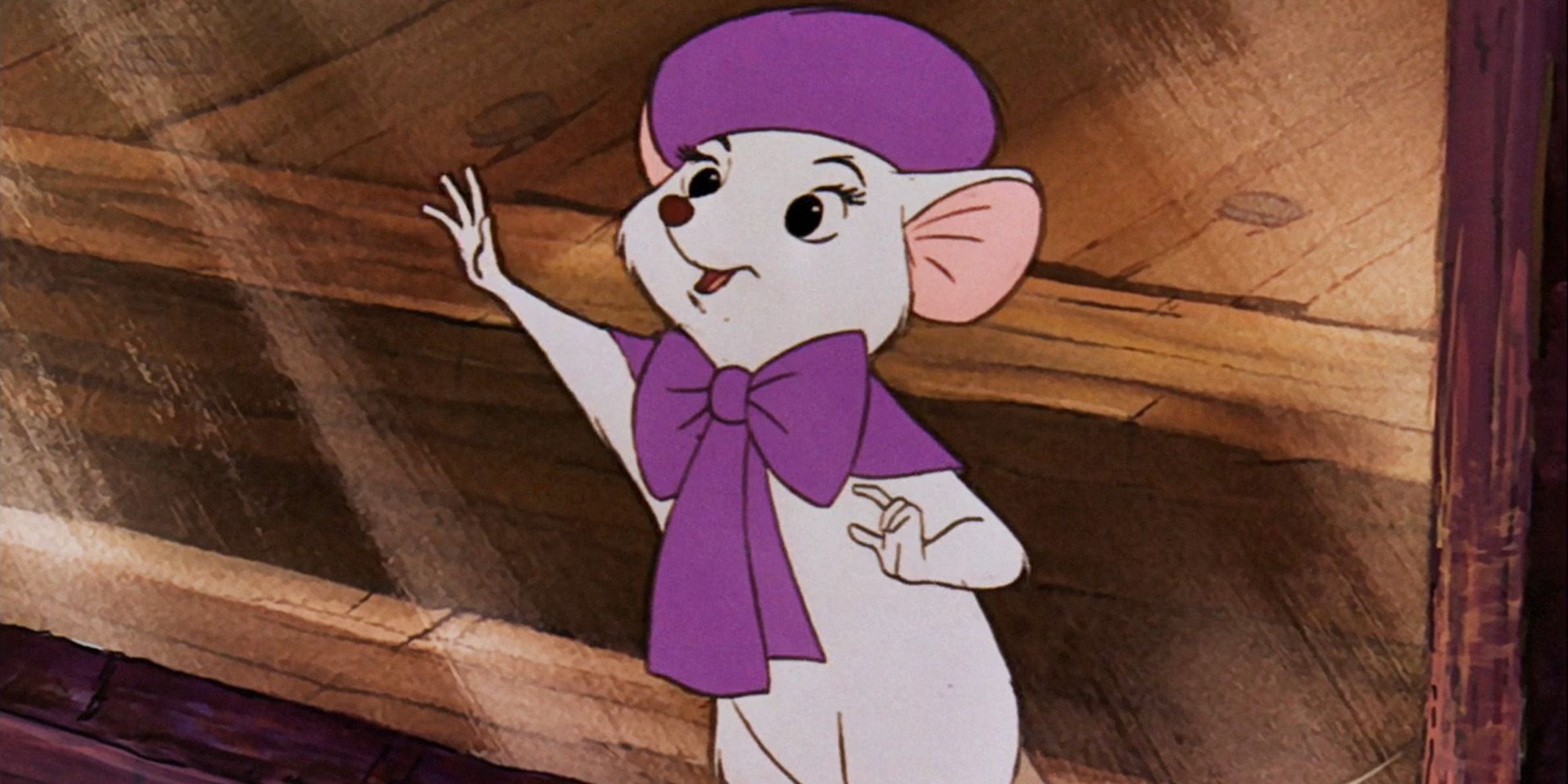
Similarly, The Rescuers and The Rescuers Down Under showed mice as part of a global, UN-like organization. Bernard and Miss Bianca weren't just living in the walls; they were international spies. This era moved the mouse away from the "nuisance" category and into the "hero" category.
Why Do These Characters Persist?
You’ve probably noticed that mice are rarely the "bad guys." In animation, rats are usually the villains (think Professor Ratigan in The Great Mouse Detective), while mice are the noble protagonists. It’s a weirdly specific bias we have. Mice are considered "clean" and "cute," while rats are "dirty."
This distinction allows creators to use mice as a stand-in for the human child. A mouse in a giant house feels exactly like a toddler in a world built for adults. They have to climb chairs like mountains. They have to hide from the "monsters" (cats and vacuums). We relate to them because we’ve all felt small and powerless at some point.
Think about Ratatouille. Yes, Remy is technically a rat, but he follows the "mouse" character arc perfectly. He has a big dream that contradicts his nature. He’s an outsider. He uses his small size to his advantage. It’s the same DNA that made Mickey a hit in 1928.
Modern Icons and Digital Fur
Today, we see these characters evolving with CGI. The Stuart Little films or the live-action Tom and Jerry movie show how much work goes into making a digital mouse feel "real." But even with all that technology, the core appeal remains the same.
Look at Danger Mouse. The 2015 reboot of the 1981 classic proved that a British secret agent mouse is still funny. Or consider the mice in Cinderella. They aren't the stars, but Gus and Jaq provide the heart of the story. They are the audience's surrogate.
Putting the Knowledge to Use
If you're an aspiring animator, a writer, or just a fan of the medium, there are real lessons to be learned from these famous mouse cartoon characters.
- Design for Empathy: If you want a character to be likable, look at Mickey’s proportions. Large eyes and rounded features create an instant connection.
- Conflict is Key: Jerry works because the stakes are always high. It’s life or death, even if it’s played for laughs.
- Subvert Expectations: Pinky and the Brain worked because they took a "cute" animal and gave it a god complex.
- The Power of Silent Acting: Watch old Tom and Jerry shorts to see how much emotion you can convey without a single line of dialogue.
To really appreciate the craft, watch The Old Mill (1937). It’s a Disney Silly Symphony that features mice during a storm. There’s no plot, just pure atmosphere. It shows that these characters aren't just for selling plush toys; they are tools for exploring the human (and rodent) condition.
If you want to dive deeper, check out the archives at the Museum of the Moving Image or look into the works of Floyd Gottfredson, who drew the Mickey Mouse comic strips for 45 years. He’s the one who actually gave Mickey a personality beyond the "cheerful mascot" persona.
The world of animation is constantly changing, but the mouse isn't going anywhere. We are obsessed with the small. We are obsessed with the struggle. And as long as there are cats to be outsmarted and worlds to be saved, we'll keep watching.
Next Steps for Enthusiasts:
- Watch the transition: Compare Steamboat Willie (1928) with The Band Concert (1935) to see how Mickey’s personality and animation style shifted in just seven years.
- Analyze the physics: Watch a Chuck Jones-directed Tom and Jerry versus a Hanna-Barbera one. The "timing" and "weight" of Jerry's movements are drastically different.
- Explore the "Secret" History: Research the production of The Secret of NIMH to understand how Don Bluth used traditional techniques to challenge the Disney monopoly on "cute" mice.