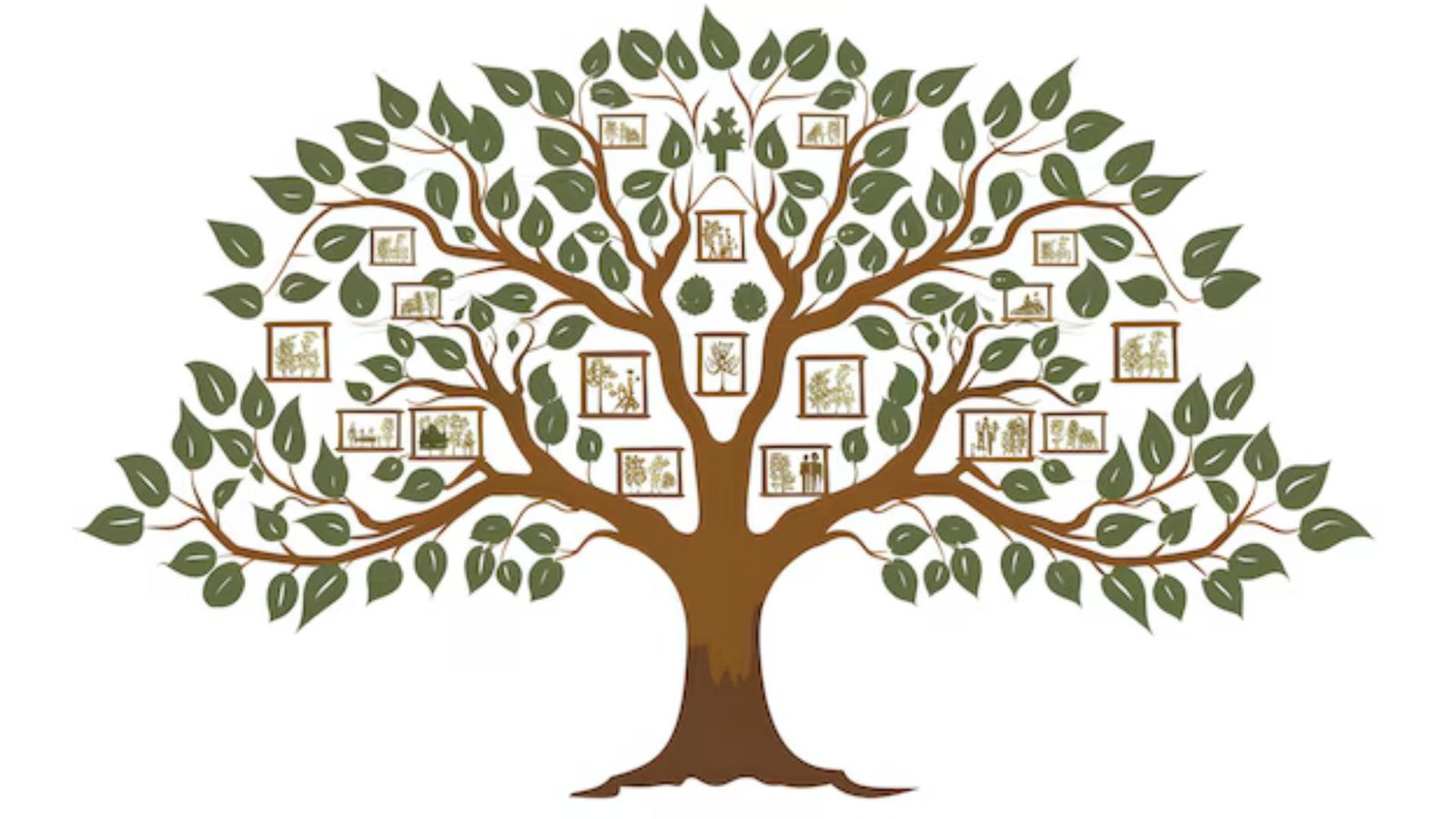
Let's be honest. Most family tree charts are kind of an eyesore. You’ve seen them: those stiff, overly formal diagrams that look like they belong in a dusty law office or a basement archive. They're clinical. They're rigid. And frankly, they don’t do justice to the chaotic, beautiful, and deeply personal reality of where you come from. If you’re looking for family tree design ideas, you probably want something that balances historical record-keeping with actual aesthetic appeal. You want something that sparks a conversation when people see it on your wall, rather than making them feel like they’re looking at a biology textbook.
Genealogy is a massive industry now, but the visual side of it hasn't always kept pace. We’ve moved past the era of just scribbling names on the back of a photograph. Now, we’re looking at ways to blend ancestry with interior design. It’s about more than just who birthed whom; it’s about the narrative.
The Problem With Traditional Charts
Standard pedigree charts are functional. They get the job done. But they often fail to capture the "vibe" of a family. They’re built on a binary system that doesn't always account for the complexity of modern families—blended households, adoptions, or "found family" that feels more real than biological ties. When you start thinking about family tree design ideas, you have to decide if you're following the strict rules of heraldry or if you're telling a story.
I've seen people get stuck because they think they have to use a specific template they found on a random genealogy site. You don't. Honestly, the best designs are the ones that break the rules. Some people use circles. Some use horizontal timelines. Some don't even use a "tree" shape at all.
Going Beyond the Literal Tree
We call it a "tree," so we naturally gravitate toward branches and leaves. It’s a classic for a reason. But you can get way more creative than a green oak tree with names in the foliage.
Think about a Circular Fan Chart. These are incredibly satisfying for people who like symmetry and data visualization. Instead of growing "up," the tree radiates outward from a central point—usually you or your children. Each ring represents a generation. It’s compact. It’s modern. It looks like a piece of abstract art from a distance. Companies like Family ChartMasters specialize in these high-density designs that can fit 10 generations into a space that doesn’t require a 20-foot hallway.
Then there’s the DNA-Inspired Design. Since the rise of services like 23andMe and AncestryDNA, some designers are using double-helix structures or color-coded maps to represent heritage. It’s less about names and more about the "where." You might have a map of Europe or Africa with lines connecting specific cities to your current home. It’s a more geographical approach to family tree design ideas.
The Minimalist Approach
If your house is all white walls and clean lines, a traditional brown tree will look totally out of place. Minimalist designs focus on typography. Imagine a simple grid of names in a clean, sans-serif font like Helvetica or Montserrat. No icons. No illustrations. Just the names, dates, and maybe a tiny location.
You’ve probably seen these on Pinterest. They look like high-end gallery posters. The beauty here is in the negative space. You aren't trying to fill every inch. You're letting the history breathe. It’s subtle, and honestly, it’s much easier to update if you discover a new second cousin twice removed.
Using Photography as the Anchor
Names are just data points. Faces are memories.
A Photo-Centric Gallery Wall is arguably the most emotional way to handle this. Instead of drawing lines, you use the physical layout of the frames to show descent. You place the oldest known ancestors at the top and branch downward. The trick is using consistent framing. If you have a mix of 19th-century daguerreotypes, grainy 1970s Polaroids, and high-res digital shots, the wall can look messy.
A pro tip? Convert all the photos to black and white or sepia. This creates a unified "look" even if the photos were taken 100 years apart. It ties the generations together visually. You can then use vinyl wall decals—just thin lines or simple text—to bridge the gap between the frames. It’s basically a living museum in your living room.
Digital vs. Physical Designs
We live in a digital age, but family trees feel more "real" when they are physical. However, the design process almost always starts on a screen.
- Adobe Illustrator or Canva: If you have some design chops, these are your best friends. Canva has templates, but they’re often a bit generic. Illustrator allows you to build a vector-based tree that you can scale to any size without losing quality.
- Specialized Software: Programs like Gramps or RootsMagic are great for the data, but their "chart" outputs are usually pretty ugly. Use them to organize your facts, then export the data to a designer or a more creative tool.
- The Hybrid Method: Print a very basic outline on high-quality canvas or parchment, then hand-write the names in calligraphy. This adds a human touch that a printer can't replicate. It feels like an heirloom immediately.
Common Pitfalls to Avoid
Don't try to include everyone. This is where most family tree design ideas go off the rails. If you try to put every single cousin and great-uncle on one wall-mounted chart, it’s going to be a cluttered disaster. You have to curate.
Decide on a "scope." Are you doing a Pedigree Chart (just your direct ancestors: parents, grandparents, etc.) or a Descendant Chart (starting with one ancestor and showing everyone who came from them)? Pedigree charts are much easier to design because the number of people doubles every generation—2, 4, 8, 16, 32. It’s predictable. Descendant charts are wildcards. One branch might have twelve kids, and another might have none. That’s how you end up with a lopsided tree that looks like it’s falling over.
Also, watch out for the "date trap." Do you really need the exact birth, marriage, and death dates for everyone? Usually, just the years (e.g., 1892–1954) are enough for a visual piece. Save the specific dates for the family history book.
Incorporating Meaningful Symbols
If your family has a history of seafaring, maybe your "branches" are actually ropes or nautical lines. If there's a deep connection to a specific country, use the national flower as a recurring motif in the background. These are the details that turn a generic template into a custom piece of art.
I once saw a design where the "tree" was actually a map of a family farm, with names placed in the fields they used to work. It was brilliant. It grounded the names in a physical place. When you're brainstorming family tree design ideas, think about what "home" meant to your ancestors. Was it a specific city? A trade? A religion? Use those elements to frame the data.
Material Matters
Paper is fine, but it’s not the only option.
- Wood Engraving: Laser-engraved wood maps or trees are incredibly popular right now. They have a tactile, rustic feel that fits perfectly in a study or a hallway.
- Metal Prints: For a more industrial or modern look, printing on brushed aluminum can look stunning.
- Fabric and Quilts: Historically, family trees were often embroidered. If you’re into fiber arts, a quilted or needlepoint tree is the ultimate heirloom. It’s soft, it’s warm, and it’s literally woven together.
How to Get Started Right Now
Don't wait until you've "finished" your research. You'll never be finished. There's always one more record to find.
Start by picking a focal point. Is this for you? For your parents’ 50th anniversary? For your newborn child? That determines the "root." Once you have the root, decide on the generation depth. Four to five generations is usually the "sweet spot" for a wall display. It’s enough to show history without becoming a wall-sized spreadsheet.
Next Steps for Your Project:
- Audit your data: Make sure you have the correct spelling and years for the direct lines you want to feature.
- Choose your style: Decide between a literal tree, a geometric fan, or a photo-based gallery.
- Pick a medium: Will this be a DIY project on cardstock, a professional print on canvas, or something more unique like an engraved wood piece?
- Measure your space: Don't design a horizontal masterpiece for a narrow vertical wall. The physical location dictates the layout.
- Gather the visuals: If you're using photos, start scanning them now at a high resolution (at least 600 DPI) so they look sharp when enlarged.
Creating a visual record of your family isn't just about the past; it's about giving the future something to hold onto. A well-designed tree makes the names more than just ink on a page—it makes them part of the room. It makes them present. Forget the boring templates and build something that actually looks like your family. Something a bit messy, totally unique, and full of life.