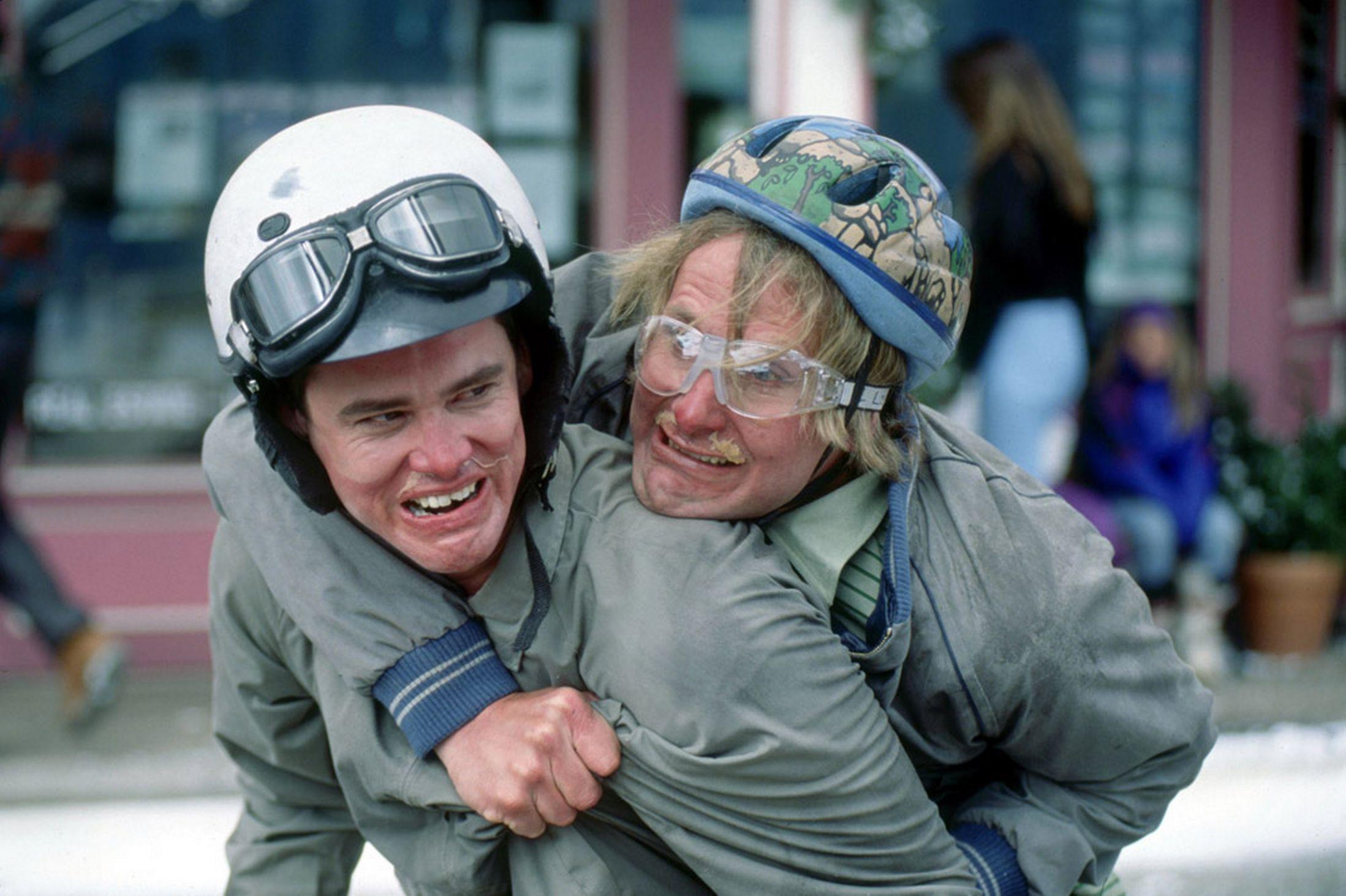
Twenty years is a massive gap in the movie world. Most sequels that wait two decades usually end up as forgotten straight-to-streaming projects or "legacy sequels" that try way too hard to be serious. But Dumb and Dumber To wasn't trying to be deep. It was just Jim Carrey and Jeff Daniels putting the bowl cuts back on.
Honestly, the road to getting this movie made was probably more chaotic than the plot of the film itself. Fans spent years hearing rumors. One day Jim Carrey was in; the next day he was out because he felt Warner Bros. wasn't enthusiastic enough. Then, suddenly, Red Granite Pictures stepped in, the Farrelly brothers got the band back together, and in 2014, we finally got to see what Lloyd Christmas and Harry Dunne were up to in middle age. It was weird. It was gross. It was exactly what you’d expect, yet somehow totally different from the 1994 original.
The Long, Messy Road to Dumb and Dumber To
You’ve gotta remember that when the first Dumb and Dumber came out, it was a cultural juggernaut. It helped make Jim Carrey the biggest star on the planet. For years, the Farrelly brothers resisted a sequel, mostly because Carrey famously didn't like doing them. The only reason we got Ace Ventura: When Nature Calls was because of intense pressure. So, for a long time, the only "sequel" we had was that 2003 prequel, Dumb and Dumberer: When Harry Met Lloyd, which—let’s be real—most fans try to pretend doesn't exist. It didn't have the original cast or the original directors. It lacked the soul.
The real momentum for Dumb and Dumber To started around 2011. Carrey mentioned in an interview that he was open to it. Jeff Daniels was always down. But the studio politics were a nightmare. Warner Bros. eventually passed on the project, which seems crazy in hindsight given how much money the brand was worth. Universal eventually picked it up.
When production finally started, the first photo from the set went viral instantly. Seeing those two in the iconic haircuts again felt like a time warp. But the world had changed. Comedy had changed. The Farrelly brothers' brand of slapstick was competing with the Judd Apatow era of "R-rated improv" comedies. They had to prove that being "dumb" was still funny in a much more cynical age.
The Plot: Finding a Daughter and a Kidney
The story picks up in real-time. Lloyd has been committing to a "prank" for twenty years, pretending to be in a catatonic state at a mental institution just to mess with Harry. It's a bit dark if you think about it too much, but that's the point. They’re still the same idiots.
The main engine of the plot is Harry’s health. He needs a kidney. He discovers he might have a long-lost daughter with Fraida Felcher (played by Kathleen Turner), and the duo sets off on a road trip to find her so Harry can ask for an organ. It’s classic Farrelly brothers: a noble-ish goal wrapped in layers of absolute stupidity.
Why the Comedy Landed Differently This Time
Comedy is hard. Comedy twenty years later is nearly impossible. Dumb and Dumber To faced a massive hurdle: nostalgia. People don't just love the first movie; they love the memory of how they felt when they saw it in '94.
The sequel doubled down on the "gross-out" humor. There’s a scene involving an old woman named Grandma P.A. that... well, if you’ve seen it, you know. It’s uncomfortable. Some critics hated it. They felt the characters had crossed the line from "lovable losers" to "borderline sociopaths." But if you talk to die-hard fans, that’s exactly what they wanted. Lloyd and Harry aren't supposed to grow. They aren't supposed to learn lessons. If they became "better people," the joke would be over.
One thing that genuinely worked was the chemistry. Carrey and Daniels didn't miss a beat. It’s rare to see two actors who are so clearly on the same wavelength. Even when the jokes felt a bit dated—like some of the gags involving Billy in 4C (the blind kid with the birds)—the sheer physicality of their performance carried the scene.
- The Billy in 4C Callback: Seeing the return of the "Pretty Bird" kid, now an adult who breeds exotic birds, was a highlight. It showed the film knew its history.
- The Mutt Cutts Van: While the iconic dog van makes a brief appearance, the movie mostly swaps it for a Zamboni and other ridiculous vehicles.
- The Cameos: Bill Murray is actually in this movie. He’s the roommate, "Ice Pick," wearing a hazmat suit. You can’t even see his face. That’s the kind of weird energy this production had.
The Financial Reality vs. The Critical Reception
If you look at Rotten Tomatoes, the movie sits at around 30%. The critics were not kind. They called it "tiresome" and "mean-spirited." But look at the box office. It opened at number one. It grossed over $169 million worldwide against a $40 million budget.
By any business standard, Dumb and Dumber To was a success. It proved there was still a massive audience for physical comedy. It also proved that Jim Carrey could still draw a crowd, even after taking a bit of a hiatus from massive blockbusters.
The discrepancy between what critics want and what the audience wants is rarely wider than in a Farrelly brothers movie. Critics want wit and sharp satire. This audience wanted to see a guy get hit in the face with a bag of urine. It sounds crude because it is. But there’s an art to that kind of "pure" stupidity that is actually quite difficult to pull off.
Kathleen Turner and the Fraida Felcher Legend
One of the best casting choices was Kathleen Turner. In the first movie, Fraida Felcher was just a name on a tractor. She was the "legend" that both guys had a thing with. Bringing a powerhouse like Turner in to play the "real" version of that character was brilliant. She played it straight, which made the absurdity of Harry and Lloyd's behavior stand out even more.
What Most People Get Wrong About the Sequel
A lot of people think the movie failed because it didn't "feel" like the first one. But if you watch them back-to-back, the original is actually quite dark and gritty in places. The sequel is much brighter, more colorful, and almost cartoon-ish.
The real difference isn't the characters; it's the pacing. The 1994 film had a lot of "dead air" where the characters just talked, which built their relationship. The 2014 version is frantic. It’s joke-joke-joke-stunt. This is a common trap for sequels. They feel like they have to justify their existence by being "more" of everything.
Is it as good as the first? No. Not even close. The first movie is a perfect comedy screenplay. Every setup has a payoff. In the sequel, some setups just kind of... end. But as a companion piece, it’s a fascinating look at these characters as "men" who have completely failed to age mentally.
Actionable Insights for Your Next Rewatch
If you're going to dive back into Dumb and Dumber To, keep a few things in mind to actually enjoy it for what it is rather than what you want it to be:
- Watch the credits: There are some great stingers and callbacks that you'll miss if you shut it off early.
- Look for the cameos: Beyond Bill Murray, look for Rob Riggle playing double duty as twins. His performance is actually one of the more underrated parts of the film.
- Lower the expectations of "heart": The first movie had a weirdly sweet core about friendship. The sequel is more about the endurance of stupidity.
- Check out the "making of" features: If you can find the behind-the-scenes footage, seeing Jeff Daniels get into character is a masterclass in acting. He’s an Emmy-winning dramatic actor who treats "Harry Dunne" with the same level of seriousness as a role in a Sorkin drama.
Ultimately, the movie exists because people loved these characters. It wasn't a cash grab in the traditional sense, because it took twenty years of fighting to get it made. It was a labor of love for a very specific, very dumb brand of humor. It serves as a time capsule of a specific era of comedy and a reminder that sometimes, it's okay for characters to never, ever grow up.
If you want to understand why this franchise still has a grip on pop culture, go back and watch the "Most Annoying Sound in the World" scene from the original, then jump straight into the "Aspen" conference scenes in the sequel. The DNA is exactly the same. They are the last of a dying breed of pure, unadulterated slapstick heroes.
To get the most out of the experience, try watching the "Unrated" version. It includes several gags that were trimmed for the theatrical release for being just a bit too "Farrelly" for a general audience. It doesn't fix the plot holes, but it certainly makes the movie feel more like the unfiltered vision the directors had in mind. Use a streaming search tool like JustWatch to see where it's currently playing, as it frequently rotates between platforms like HBO Max and Netflix depending on the month.