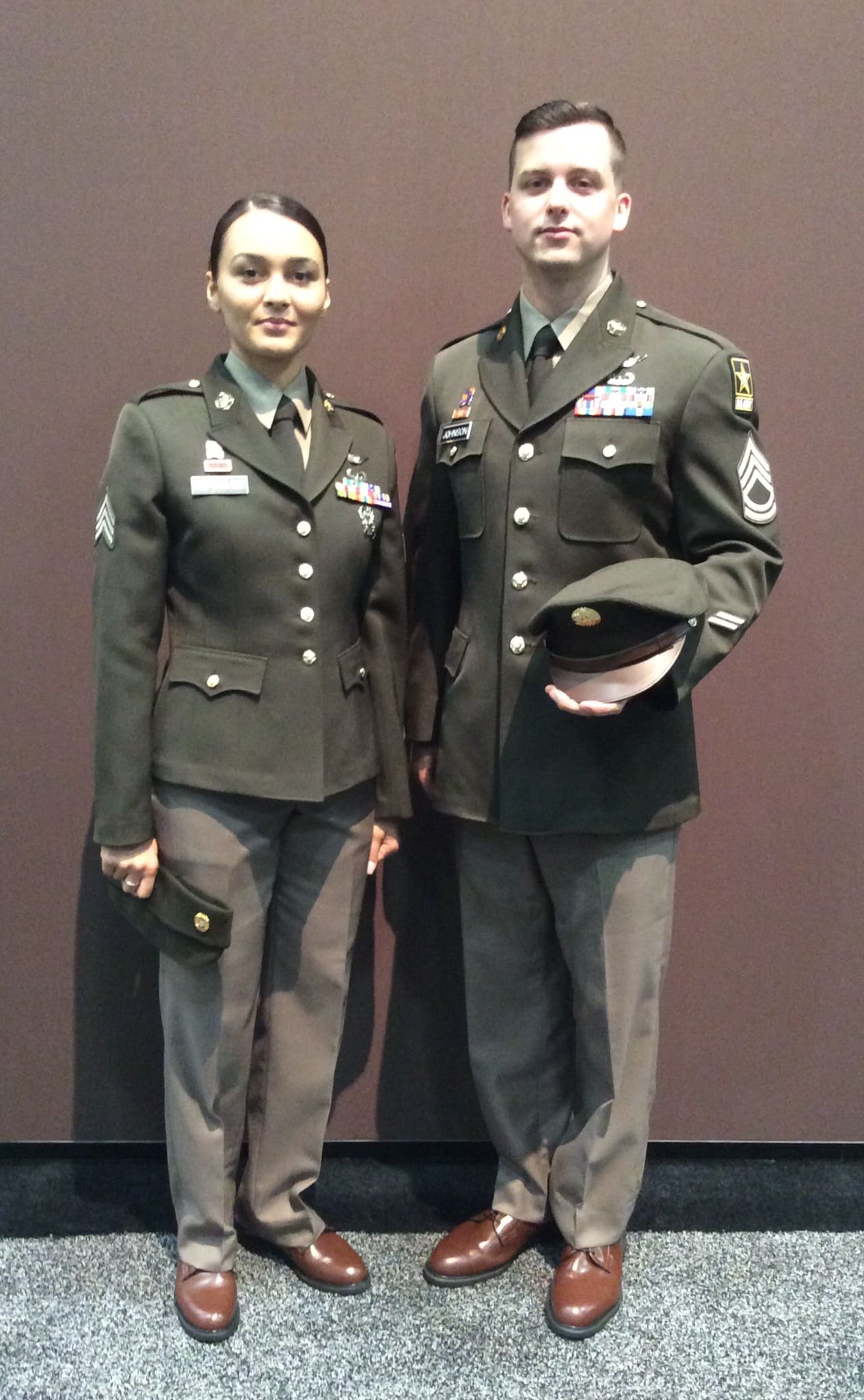
Walk into any airport in 1945 and you’d see them. Thousands of soldiers returning from the European or Pacific theaters, wearing what many still consider the sharpest uniform ever designed. It wasn’t just a work outfit. It was a statement. The taupe trousers—often called "pinks" because of their slight rose-colored hue—paired with a dark olive-drab jacket. This was the Army Pinks and Greens look, a style so deeply embedded in American victory that it basically defined the Greatest Generation.
Then, for decades, it vanished.
The Army moved on to the Army Green Service Uniform (the "pickle suit") and eventually the blue Army Service Uniform (ASU) that looked more like something you’d wear to a high-end gala than a daily office environment. But things changed around 2018. The Army realized that while the blues were formal, they lacked the daily utility and the historical "cool factor" that the World War II era provided. So, they brought them back. But this isn't just a costume play or a nostalgic whim. It's a massive logistical and cultural shift for the modern soldier.
What Are Army Pinks and Greens Exactly?
The official name today is the Army Green Service Uniform (AGSU). If you call them "pinks and greens" to a veteran, they'll know exactly what you mean, but if you're looking for the regulation manual, it's AGSU.
The color palette is specific. The "pinks" aren't actually pink—they are a pinkish-taupe or light shade of brown. In the 1940s, the fabric was a wool gabardine or elastique. Depending on the light, that specific weave gave off a rosy tint. It was a status symbol. Officers usually bought their own, leading to variations in shade, but the goal was always that distinct contrast between the lighter trousers and the "chocolate" or dark olive-drab tunic.
Modern versions try to replicate this using a more durable wool blend. You get the nostalgia, but you don't have to deal with the itchy, heavy wool of 1944. The jacket is a dark olive green, featuring a belted waist—a nod to the old "Sam Browne" belt style without the literal leather strap over the shoulder. It's meant to be worn in professional settings: the Pentagon, recruiting offices, or a typical day at the unit headquarters.
The Heritage Factor
Why now? Honestly, the Army had a branding problem.
The blue ASUs are fine for a wedding or a funeral, but they look a bit stiff for a Tuesday afternoon meeting. By reverting to the Army Pinks and Greens, leadership tapped into the lineage of Eisenhower, Marshall, and Patton. There is a psychological weight to it. When a young private puts on a uniform that looks like the one that liberated Europe, there’s an immediate connection to the past. It’s a bridge between the "old Army" and the "new Army."
Breaking Down the Components
It’s a complicated set. You aren't just throwing on a jacket and pants.
- The Tunic: This is the centerpiece. It’s a four-pocket coat in olive drab. It uses heritage-style buttons and has a functional belt.
- The Trousers: These are the "pinks." They sit higher on the waist than your typical civilian chinos.
- The Headgear: You’ve got options here. There is the standard Garrison Cap (the "c*nt cap" in soldier slang), but the real star is the Service Cap with the brown leather visor.
- Footwear: Brown leather oxfords. This was a big deal because for years, the Army was strictly black leather for dress shoes. Switching back to brown was a major nod to the mid-century aesthetic.
- The All-Weather Coat: Even the trench coat got a makeover to match the 1940s noir vibe.
Some soldiers have complained about the cost. While the Army provides a clothing allowance, the initial rollout required a lot of out-of-pocket spending for officers and NCOs who wanted to stay ahead of the curve. But most agree: it looks better. It fits better. It actually looks like a military uniform rather than a flight attendant's suit.
The Logistics of a Uniform Change
You can't just flip a switch and have a million people change clothes. The rollout of the Army Pinks and Greens started small. Recruits at Basic Combat Training were among the first to get them issued. Then it moved to recruiters, who are the "face" of the Army.
The transition period has been long. The Army set a mandatory wear date—the point where you must have them—for October 1, 2027. Until then, you'll see a mix of the blue ASUs and the new AGSUs. It creates a bit of a "two-tier" look in some formations, but it’s the only way to manage the supply chain. Making millions of high-quality wool jackets takes time.
Fabric and Durability
The modern AGSU is actually more tech-forward than it looks. The fabric is a blend of 55% polyester and 45% wool. Why? Because 100% wool is a nightmare to maintain. It wrinkles if you look at it wrong and it holds onto smells. The blend allows the uniform to "spring back" after a long day at a desk or a flight across the country.
Daniel Dailey, the former Sergeant Major of the Army who was a huge proponent of this change, often pointed out that the Army needed a "daily" dress uniform. The blues were too nice to get dirty, and the camouflage ACUs (Army Combat Uniforms) were too casual for the office. The Army Pinks and Greens occupy that middle ground perfectly.
Common Misconceptions
People get a few things wrong about this uniform.
First, it’s not just for men. The female version of the Army Pinks and Greens was designed from the ground up to be functional. Early versions of Army dress uniforms for women were often afterthoughts, but the AGSU includes options for slacks or a skirt, and the tunic is tailored for a female frame without losing the heritage details.
Second, it’s not "retro" for the sake of being retro. There was a legitimate functional gap. The Army was the only branch without a "Class B" uniform that looked professional yet rugged. The Marines have their Khakis/Service Bravos. The Navy has their Khakis. The Army had... pajamas (ACUs) or a tuxedo (Blues). This filled the hole.
Third, the "pinks" don't look like Barbie pink. If you buy a pair and they look actually pink, you’ve bought a knock-off or a bad batch. It’s a "muted mauve-taupe." Think of the color of a dusty road at sunset. That’s the target.
How to Wear It Properly
If you're a soldier or someone interested in military history, the details matter.
- The Belt: The belt on the coat should be snug but not "cinched." It should follow the natural waistline.
- The Gig Line: This is a basic military rule, but it's vital here. The edge of your shirt, the edge of your belt buckle, and the fly of your trousers must align perfectly.
- The Shoes: Brown leather needs a specific type of care. You aren't looking for a mirror-shine like you do with black jump boots, but they should be clean and conditioned.
- Insignia: One of the best things about the AGSU is that it limits the "flair." The Army moved toward a "ribbons only" or "top three" look for some variations to keep the uniform from looking cluttered. It highlights the soldier, not the medals.
The Cultural Impact
There’s something about the Army Pinks and Greens that resonates with the American public. When soldiers wear them in public, the reaction is different. It’s recognizable. It evokes the imagery of Band of Brothers or Saving Private Ryan.
In an era where the military is often seen as a distant, tech-heavy force of drones and satellites, the AGSU brings it back to a human scale. It’s a reminder of the citizen-soldier. It’s also a recruitment tool. Let’s be real: people like wearing cool clothes. If you’re a 19-year-old looking at your options, a sharp, historical uniform is a much bigger draw than a sea of polyester blue.
Actionable Steps for Personnel
If you are currently serving or entering the service, here is how to handle the transition to the Army Green Service Uniform:
- Check the Wear-Out Date: You have until October 1, 2027, to keep wearing your blues as your primary service uniform. Don't feel pressured to drop $500–$800 immediately if you're short on cash, but start budgeting now.
- Tailoring is Mandatory: These uniforms look terrible if they are baggy. Because of the heritage cut, they are meant to be form-fitting. Take it to a professional tailor who understands military specs. A baggy AGSU makes you look like you're wearing your dad’s suit.
- Invest in the Flight Jacket: There is an optional "tanker" style jacket that goes with this uniform. It’s incredibly comfortable and much better for driving or commuting than the full tunic.
- Maintenance: Use a horsehair brush. Since the fabric is a wool blend, it will pick up lint and hair easily. Brushing it down after every wear will extend the life of the garment by years.
The return of the Army Pinks and Greens is more than a fashion choice. It’s a reclamation of identity. It’s the Army saying that while they are ready for the future of warfare, they haven't forgotten the aesthetic and the ethos that won the biggest conflict in human history. Whether you're a history buff or a soldier on active duty, the AGSU is a massive upgrade to the military's visual legacy.